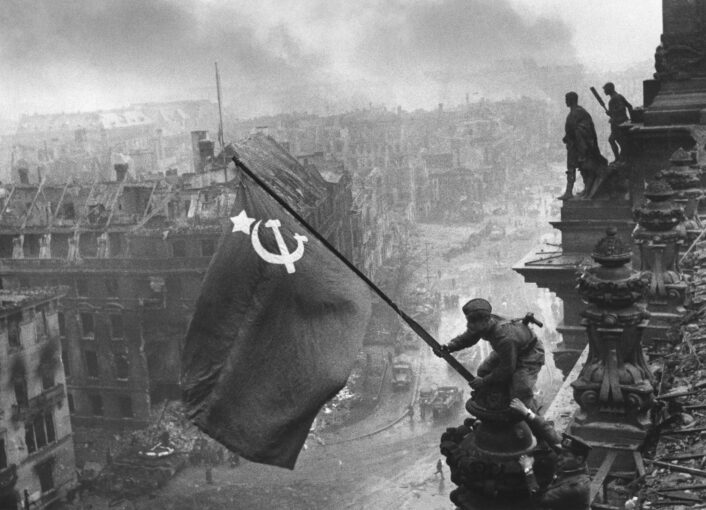
Yevgeny Khaldei’s photograph of a Soviet flag over the Reichstag, taken on 2 May 1945 after earlier flag raisings. This arranged and subsequently retouched image became a symbol of victory. Restoration by Adam Cuerden; public domain via Wikimedia Commons.

Berlin, 1945: A City at the End of the War

The photograph shows a flag above the Reichstag. The city beneath it is the harder subject. By the time Yevgeny Khaldei arranged his famous image on 2 May 1945, Berlin had endured bombing, encirclement and fighting through its streets. The photograph gives the ending a single gesture. The battle had given the people inside it thousands of smaller, less conclusive moments.

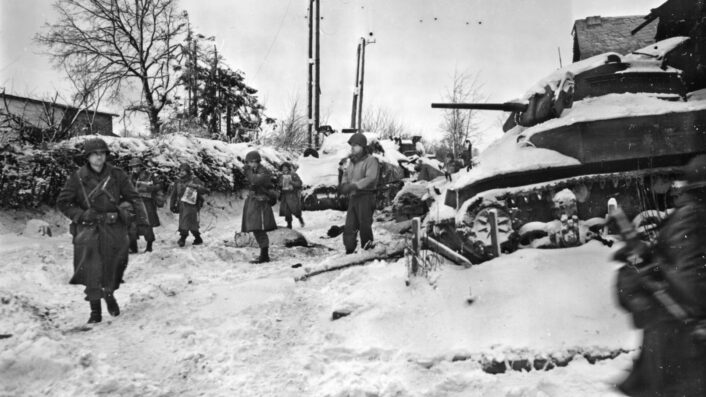
U.S. infantry pass a destroyed Stuart tank during the advance towards St. Vith, January 1945. U.S. Army photograph; public domain via Wikimedia Commons.

The Battle of the Bulge: Roads Through the Winter

A junction was a small place to set against a grand strategy. Yet in December 1944, villages and road crossings in the Ardennes repeatedly consumed the hours on which Germany’s offensive depended. The plan pointed towards Antwerp. The fighting kept returning to a road that would not open, a bridge that could not be used, or a position whose defenders had refused to disappear.

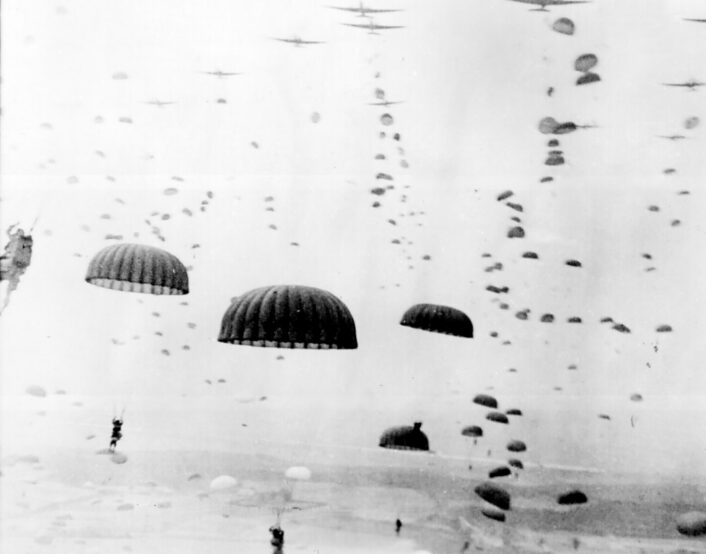
Paratroops descend during Allied airborne operations in the Netherlands, September 1944. U.S. Army photograph; public domain. The image shows the wider operation, not a verified view of Arnhem bridge.

Arnhem: The Bridge at the End of the Road

By 23 September 1944, Sergeant Dennis Smith’s account from Arnhem had narrowed to the essentials: shelling, rain, exhaustion and the need for relief. Six days earlier, aircraft had delivered an army into the Netherlands with the promise of speed. Now the men around Oosterbeek were measuring time by what they could still endure.