

A junction was a small place to set against a grand strategy. Yet in December 1944, villages and road crossings in the Ardennes repeatedly consumed the hours on which Germany’s offensive depended. The plan pointed towards Antwerp. The fighting kept returning to a road that would not open, a bridge that could not be used, or a position whose defenders had refused to disappear.
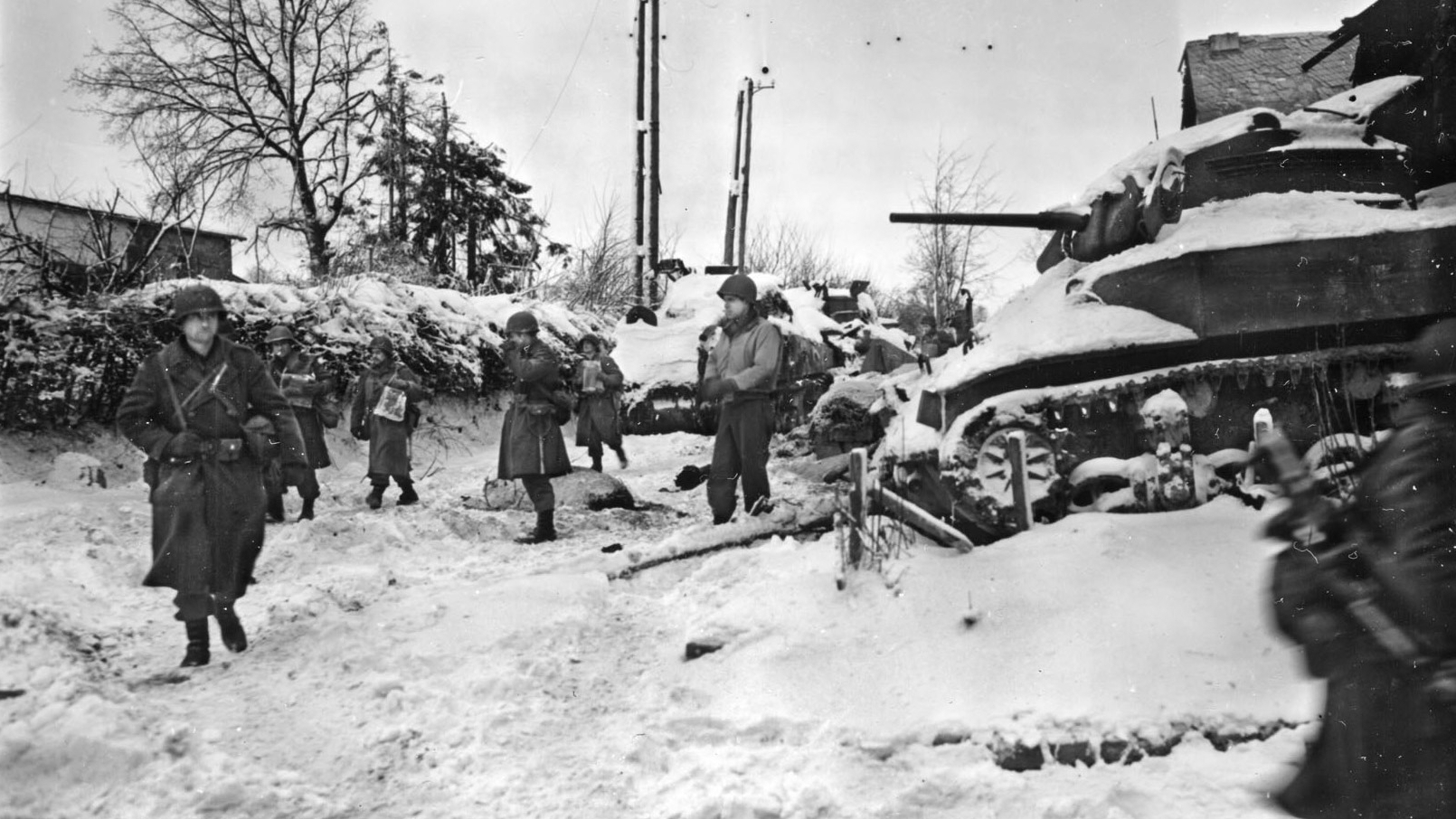
The offensive began on 16 December 1944 with artillery fire and attacks against a thinly held American front. Some units in the Ardennes were recovering from earlier combat; others were gaining their first experience. Germany intended to break through, cross the Meuse, reach Antwerp and split the Allied armies. The plan demanded speed from forces whose fuel, transport and reserves left little room for delay.
That made time a different resource for the two sides. A defending unit could suffer terribly and still make an operational contribution by holding long enough. An attacking formation could gain ground and still fall behind what the plan required. A map showing German arrows moving west does not by itself answer which side was gaining the more useful hours.
Poor flying weather reduced the immediate weight of Allied air power. German forces penetrated the front and created the bulge that gave the battle its common name. But a breakthrough on a map still had to move through actual roads, villages and defended positions.
The Ardennes channelled movement. Columns could not always spread across the countryside when a road became blocked. A bridge, a junction or a village held for another few hours could disrupt an advance well beyond its immediate surroundings. The battle’s strategic ambition therefore encountered the stubborn practical resistance of small places.
The positions that consumed time
St. Vith illustrates the point. Its road network made it valuable, and American resistance complicated the German timetable before the defenders eventually withdrew. The withdrawal does not erase the effect of the earlier stand. Battles are sometimes remembered as a series of places either “held” or “lost,” but the time between arrival and departure may explain more than the final label.
At Elsenborn Ridge, the northern shoulder remained an obstacle to the intended routes of advance. Artillery and organised defensive positions helped deny the attackers the freedom they needed. It was less easily turned into a single dramatic scene than an encircled town, but it mattered to the shape of the whole offensive.
Farther into the penetration, Joachim Peiper’s SS battle group illustrated both the violence and the limits of the advance. It captured American fuel at Büllingen, but bridges destroyed ahead of it forced changes of route. At Trois-Ponts, American engineers demolished the crossing before the column could use it. Armour that had driven deep into Allied territory still depended on finding an intact road forward and keeping a connection behind.
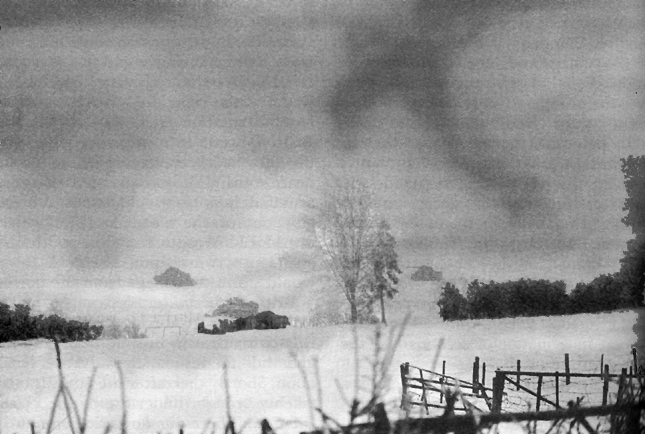
Bastogne mattered because roads met there. Its defenders included the 101st Airborne Division and other American units, with artillery, armour and supporting troops contributing to the defence. Encirclement made supply and evacuation difficult, but it did not turn the town into a story of paratroopers fighting alone.
On 22 December, Brigadier General Anthony McAuliffe rejected a German surrender demand with the famous reply “Nuts!” The message gave the resistance a memorable voice. Supply had to be rationed and wounded men treated inside the encirclement. Defiance was sustained by work at gun positions, aid stations and roadblocks.
Cold affected weapons, vehicles, hands and feet. Snow and ice complicated movement as the campaign continued. Men had to remain effective while exposed, tired and often uncertain about what was happening beyond their immediate position. The work of carrying ammunition or tending a casualty did not become less necessary because the weather made it harder.
Civilians lived inside the same battle. Villages changed hands or came under fire, and atrocities accompanied the German offensive, including the murder of American prisoners near Malmedy. The campaign’s familiar military landmarks cannot contain all of its suffering.
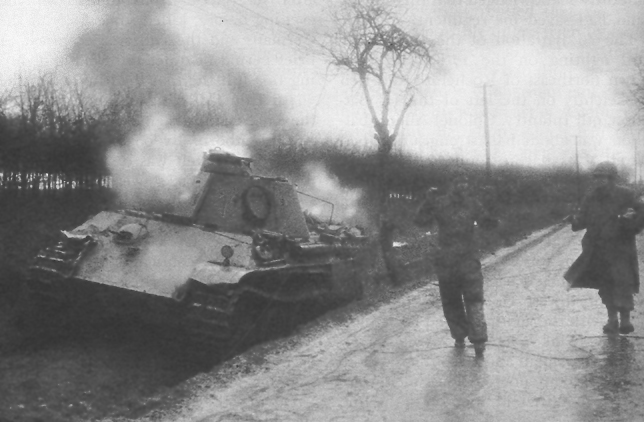
By the time Peiper’s force was trapped around La Gleize, its advance had become a struggle to escape. The surviving men abandoned vehicles and heavy equipment and made their way back on foot. The abandoned armour was a physical record of the offensive’s failed timetable: powerful weapons had travelled west, but could not be supplied, recovered or brought into the battle for which they were intended.
The offensive lost its momentum
As the weather improved, Allied aircraft attacked German movements and helped supply threatened positions. American reinforcements stiffened the front. On 26 December, troops of the 4th Armored Division reached Bastogne from the south, opening a corridor to its defenders.
The first connection to Bastogne still had to be kept open. German pressure continued around the town while supplies and reinforcements moved through the corridor. Relief was a change in the conditions of the battle, not its conclusion. In January, Allied troops fought through the damaged villages again as they drove the salient back. Many of the campaign’s snowbound photographs belong to this costly recovery of the ground lost in December.
By the time the salient had been reduced, German formations had spent tanks, experienced crews and fuel on an offensive that never reached its strategic objective. These resources could not simply be replaced before the next Allied advance. The result was more than a front line restored: Germany’s capacity to defend what remained had been diminished by its attempt to reverse the war.
The winter road is an appropriate image for the battle because so much depended on it. It carried the advancing column, the reinforcement, the ambulance and the fuel truck. Whoever could keep those movements working—and interrupt the enemy’s—helped decide what the front would look like the next morning.
- U.S. Army: Battle of the Bulge
- Battle of the Bulge: chronology and bibliography
- Veterans History Project: Battle of the Bulge collection
Photographic credits and rights are given with each image. Wikipedia overview linked above is available under CC BY-SA.