

Del Prado · Brunswick · 1812
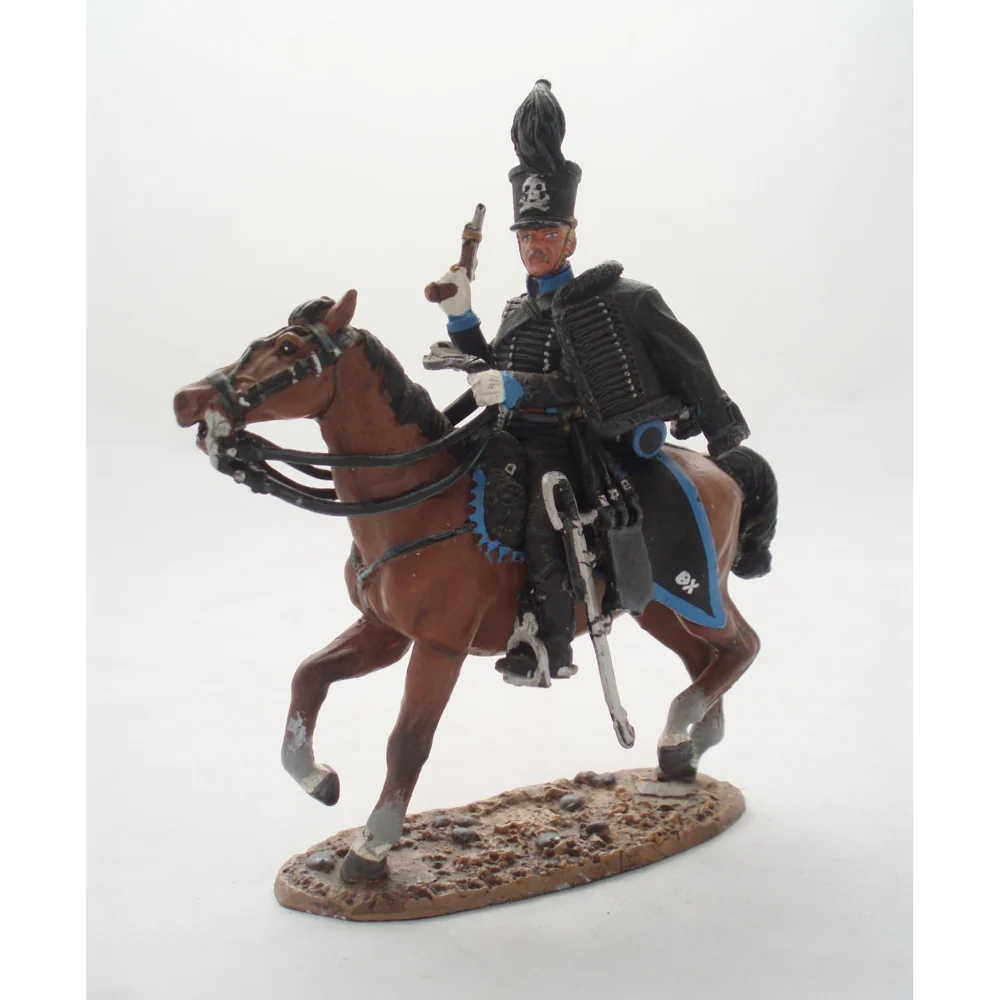
Among brilliant red and blue cavalry uniforms, the Brunswick rider’s black clothing is striking. It carries the memory of a displaced dynasty and a force raised against Napoleon, not simply a preference for darker dress.
- Maker
- Del Prado
- Subject
- Brunswick Hussar, 1812
- Setting
- Brunswick · 1812
- Type
- Painted metal mounted figure
The dark uniform and tall headwear give this hussar a narrow, severe outline above the brown horse. The sword is held upward rather than extended in a charge. Small lighter details matter because they prevent the rider disappearing into a single black shape.
A country under another kingdom
After the Prussian-Saxon defeat in 1806, Brunswick came under French domination and was incorporated into the Kingdom of Westphalia. Duke Frederick William’s 1809 march with his Black Corps became central to the subsequent memory of resistance. The city of Braunschweig’s history explains that political setting.
The Brunswick state museums describe the black uniforms and skull emblems that helped establish the force’s identity. They also examine the later making of the duke into a hero. Uniform, politics and memory are unusually close together in this subject.
The distinction is useful for a collection. This hussar can be placed among other German subjects while retaining Brunswick’s separate identity. “German” is a broad geographic description here; it should not imply the later unified German Empire.
Dark clothing also makes this a good companion to a brightly dressed Austrian or British hussar. The related style of short cavalry dress remains visible, while the colouring tells a different national and political story. The contrast is more informative than grouping all hussars purely by their tall hats.
Seeing detail in black paint
Request a photograph lit from the side. It should show the folds and distinctions rather than turning the torso into a silhouette. Check the raised blade, headwear and saddle edges, then the horse’s legs where they meet the base. Those checks matter more than whether a seller calls the figure “rare.”
This is a cavalry piece whose strongest feature is also its historical clue: the black uniform deserves to be explained, not merely admired.
References and further reading
- City of Braunschweig — The ducal city and Napoleonic occupation
- Brunswick state museums — The Black Duke and historical memory
- Planète Légendaire — figure reference
- Génie Miniature — Del Prado identification index
The photograph identifies the model; condition and packaging vary between examples offered for sale.