

Del Prado · German Fallschirmjäger · 1944
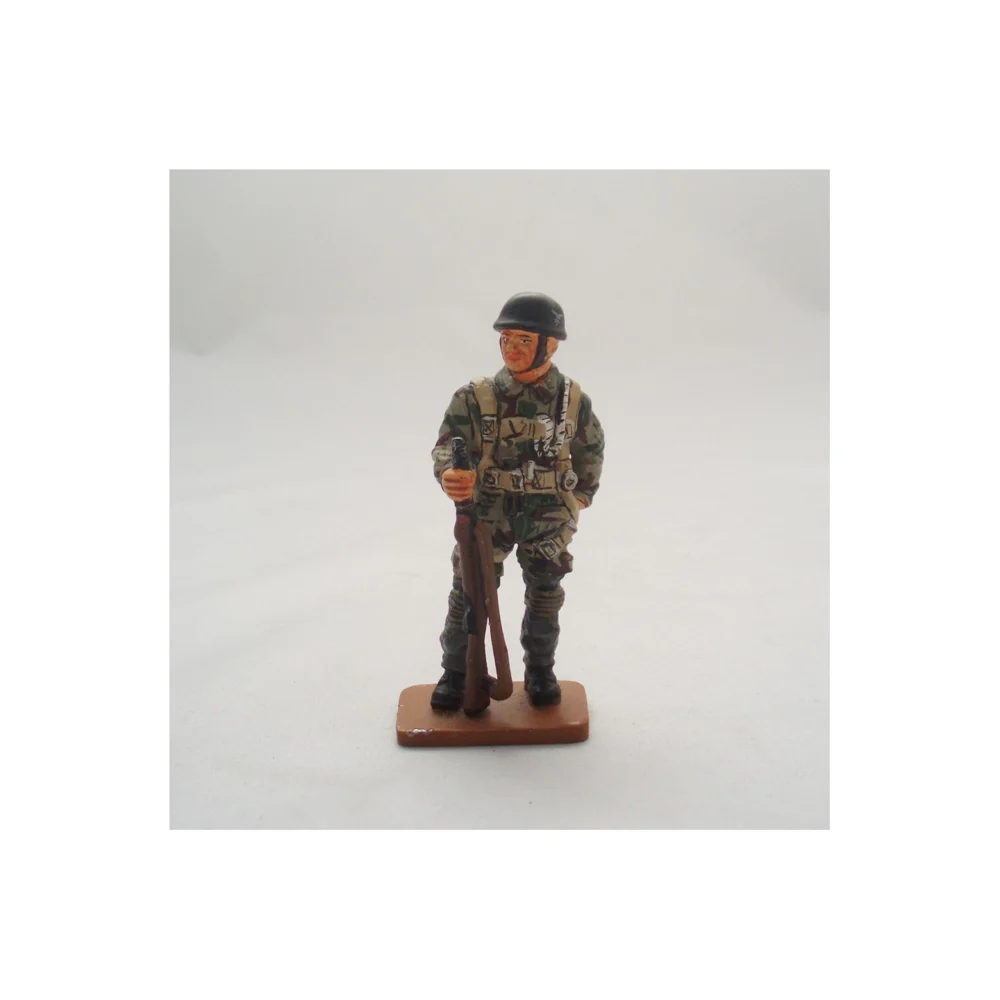
The distinctive helmet and camouflage smock carry the airborne identity. By 1944, however, that identity did not mean the soldier was about to jump: German paratroopers were also fighting prolonged ground battles.
- Maker
- Del Prado
- Subject
- German Paratrooper, 1944
- Setting
- German Fallschirmjäger · 1944
- Type
- Painted metal figure
The helmet’s compact outline is the first feature to compare with an ordinary German infantry figure. Below it, the patterned smock and equipment create a broken surface, while the rifle crosses the front of the body. It is a fighting uniform, but the model gives no reason to place it automatically beneath a parachute.
A branch name is not an action
German Fallschirmjäger belonged to the Luftwaffe, yet their wartime service included extensive fighting as ground troops. The 1944 campaign in Italy is a useful example. German paratroopers fought in the Cassino battles, where mountains, ruined buildings and defensive positions defined the experience far more than an airborne landing.
The British Army’s study of the Italian campaign includes German paratroopers fighting among the ruins of the monastery. The National Army Museum’s campaign overview explains the wider struggle through successive German defensive lines. Together they provide a setting for understanding the type of service, without claiming that this generic miniature depicts a particular man at Cassino.
The smock makes an excellent visual comparison with a British airborne figure of the same broad period. Both use camouflage, but the helmet shapes, equipment and cut of clothing differ. A side-by-side presentation lets those differences emerge without turning the display into a supposed encounter between the two subjects.
Camouflage can also hide restoration. Study the pattern at the elbows and across the chest, where a thick repaint can fill the sculpted folds. On a loose example, a second photograph should show the rifle from the side; a bend toward the camera is easily concealed in a straight frontal view.
A different way to build an airborne shelf
Rather than arranging every paratrooper around a parachute, consider a sequence of uniforms with dates. This figure can then represent the continuing ground-war role of airborne formations. The story becomes broader than a single operation and more faithful to the range of duties hidden behind the word “paratrooper.”
The miniature earns its place through that combination of distinctive equipment and a less obvious historical role. Its helmet identifies the branch; the date helps explain why the branch’s story cannot be reduced to jumping from aircraft.
References and further reading
- British Army Review — The Italian Campaign
- National Army Museum — The battle for Italy
- Planète Légendaire — figure reference
- Génie Miniature — Del Prado identification index
The photograph identifies the model; condition and packaging vary between examples offered for sale.