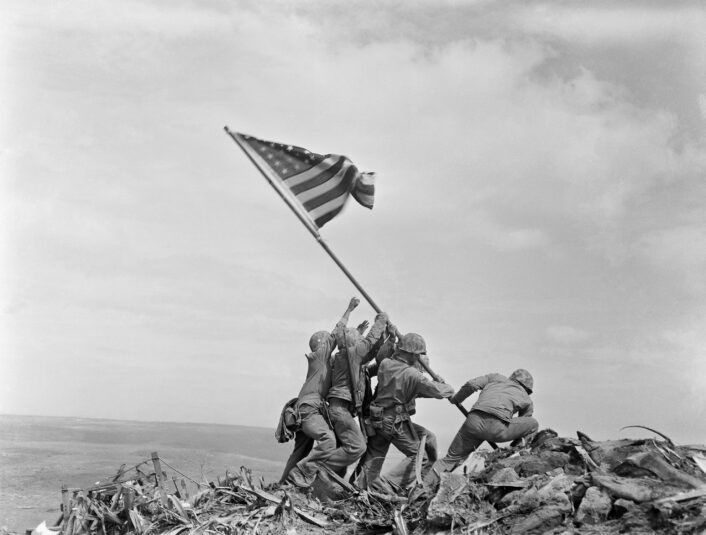
The second flag raising on Mount Suribachi, photographed by Joe Rosenthal on 23 February 1945. Public domain via Wikimedia Commons. The battle continued for weeks after this moment.

Iwo Jima: The Battle Beyond the Flag

On 23 February 1945, while a flag was being raised on Mount Suribachi, Hershel “Woody” Williams was working towards Japanese pillboxes with a flamethrower. The photograph on the summit would become the island’s enduring image. Williams’s task belonged to the other Iwo Jima: the close, dangerous work that continued beyond the reach of that picture.

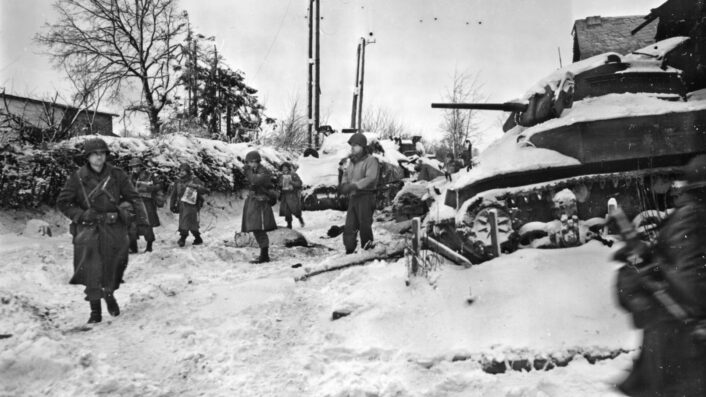
U.S. infantry pass a destroyed Stuart tank during the advance towards St. Vith, January 1945. U.S. Army photograph; public domain via Wikimedia Commons.

The Battle of the Bulge: Roads Through the Winter

A junction was a small place to set against a grand strategy. Yet in December 1944, villages and road crossings in the Ardennes repeatedly consumed the hours on which Germany’s offensive depended. The plan pointed towards Antwerp. The fighting kept returning to a road that would not open, a bridge that could not be used, or a position whose defenders had refused to disappear.

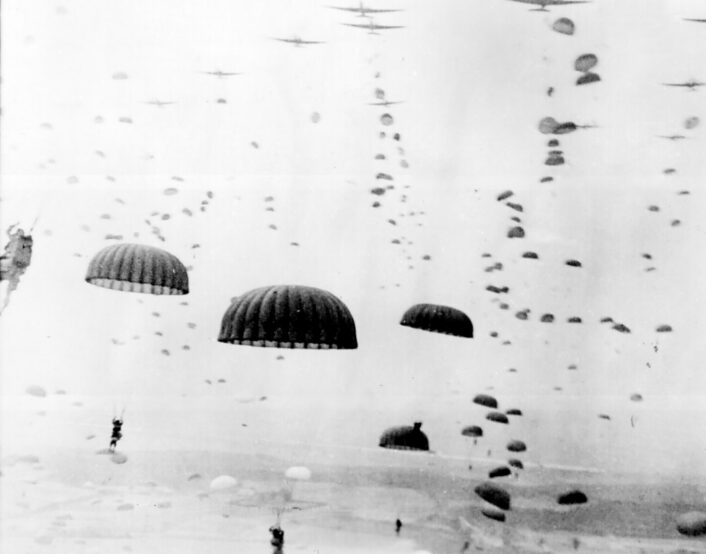
Paratroops descend during Allied airborne operations in the Netherlands, September 1944. U.S. Army photograph; public domain. The image shows the wider operation, not a verified view of Arnhem bridge.

Arnhem: The Bridge at the End of the Road

By 23 September 1944, Sergeant Dennis Smith’s account from Arnhem had narrowed to the essentials: shelling, rain, exhaustion and the need for relief. Six days earlier, aircraft had delivered an army into the Netherlands with the promise of speed. Now the men around Oosterbeek were measuring time by what they could still endure.

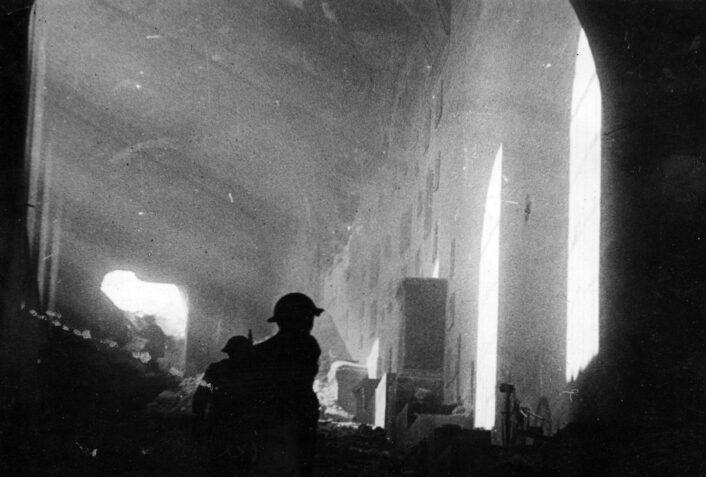
Polish soldiers among the ruins of the Monte Cassino monastery after its capture. Photographer unknown; public domain via Wikimedia Commons.

Monte Cassino: The Mountain Above the Road to Rome

In January 1944, American infantry tried to cross a river below Cassino. In February, bombers destroyed the monastery above it. In March, the town itself was devastated. Only in May did the defensive system finally give way. Those were not four repetitions of one battle: each attempt changed the ground, the armies and the choices available to the next.