

In January 1944, American infantry tried to cross a river below Cassino. In February, bombers destroyed the monastery above it. In March, the town itself was devastated. Only in May did the defensive system finally give way. Those were not four repetitions of one battle: each attempt changed the ground, the armies and the choices available to the next.
By early 1944, the Allied campaign in Italy had become a succession of difficult approaches to prepared positions. Rivers, winter weather and mountains narrowed the choices. The Gustav Line made use of those obstacles, and Cassino became the name attached to months of attempts to break through it.
Highway 6 offered the route through the Liri valley towards Rome. The monastery and its surrounding heights overlooked the approaches, but the problem extended down to rivers and across adjoining ridges. An army could not simply capture the visible summit and assume the rest of the front would fall into place. German defences made the different obstacles support one another.
In January, the U.S. 36th Division attempted the crossing commonly remembered as the Rapido operation, although the river it crossed was the Gari. The attack failed with heavy losses. Boats had to be brought to the water, men carried across under fire and a bridgehead kept supplied from the opposite bank. Reaching the far side did not solve the problem if German fire could cut the fragile connection behind the infantry.
An attack across a valley could come under observation from higher positions. Moving on the heights introduced a different problem: steep approaches, limited routes and the difficulty of carrying ammunition or removing wounded men. Armour could help in places, but a tank could not erase a mountain or make a river crossing simple.
The landings at Anzio on 22 January were intended to threaten the German rear and help unsettle the defensive front. Instead, the beachhead developed into another contained battle. The two operations remained connected in Allied planning, but the hoped-for collapse did not follow. Cassino and Anzio became simultaneous demands upon men, transport and reserves.
The destruction of the abbey
On 15 February, Allied aircraft bombed the monastery. The decision rested on the belief that it contributed to German observation and defence. German troops had not been occupying the abbey itself before the bombing, although they held surrounding positions. Civilians had sought shelter there, and the destruction killed people who were not combatants.
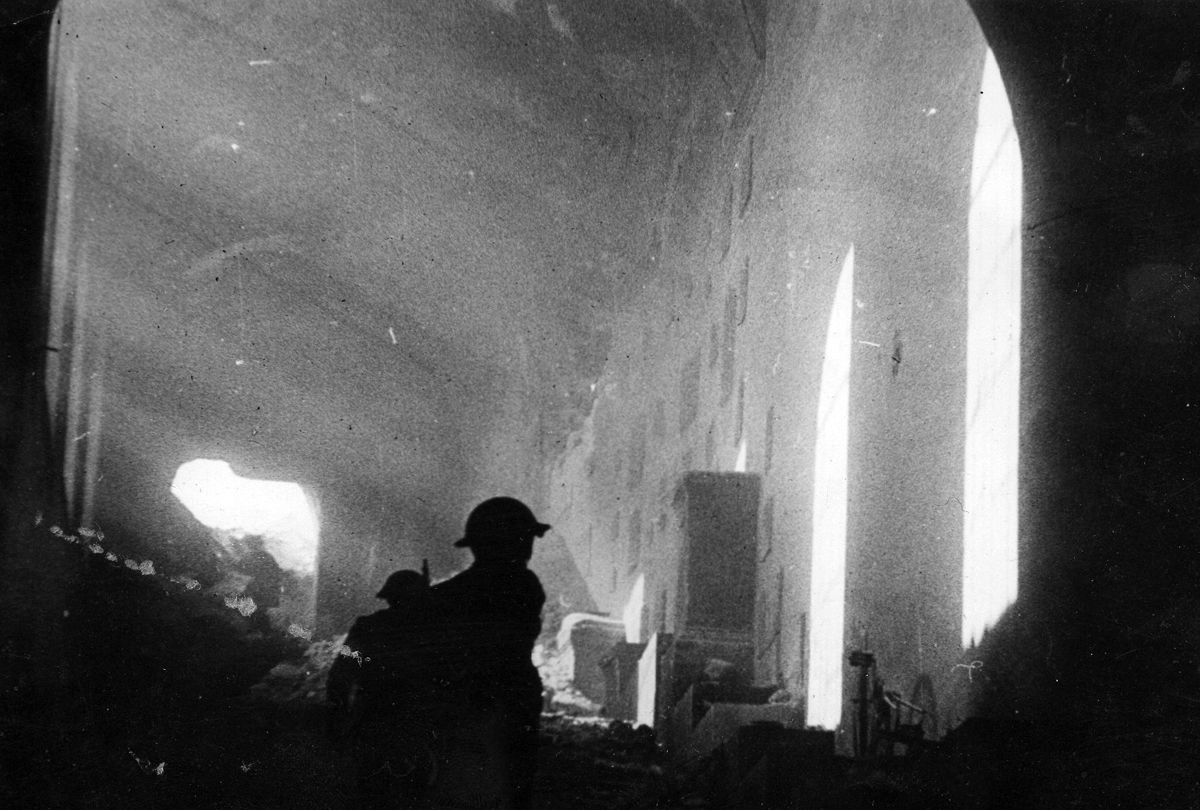
German paratroopers subsequently occupied the abbey ruins. The shattered structure gave them cover it had not provided as an unoccupied monastery, adding a new position to the defences on the mountain. Civilians who had sought shelter there had already paid for the decision to bomb it; the troops sent forward now faced the consequences in another form.
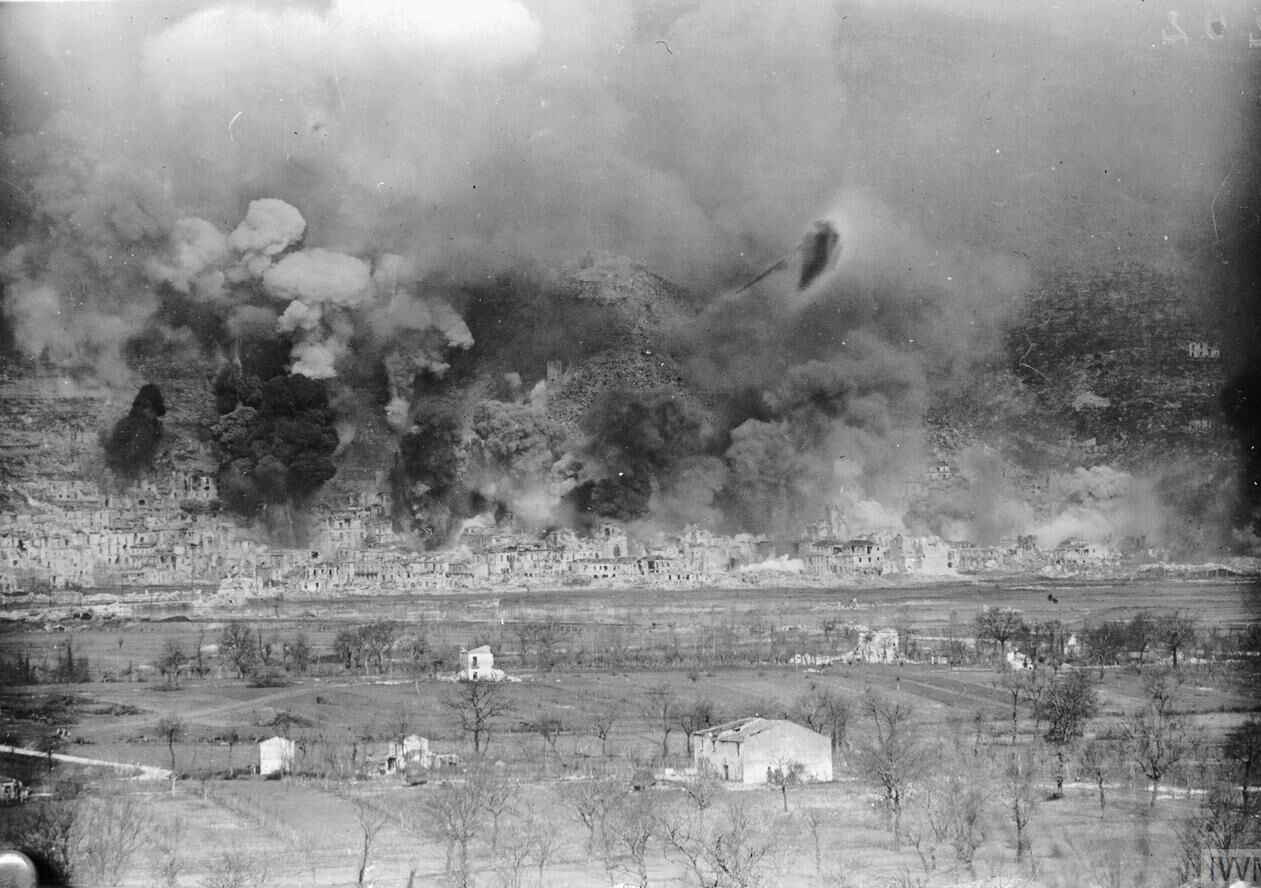
A month later, on 15 March, Allied bombers struck the town below. The bombardment shown here was a separate attack from the destruction of the abbey. Its craters and rubble impeded the tanks and infantry expected to exploit it, while surviving defenders could use the wreckage for cover. A greater weight of explosives had changed the ground without removing the difficulty of advancing over it.
During the March fighting, Gurkhas reached Hangman’s Hill, only a short distance from the monastery. German positions between them and the troops below compromised their supply route. In the town, New Zealanders fought through ruined streets towards the railway station while defenders still held positions capable of interrupting movement. Nearness to the objective was a poor measure of success when the ground behind a forward company remained dangerous.
The fighting between January and May involved repeated assaults and an unusually broad coalition. Americans, British troops, Indians, New Zealanders, French forces including North African soldiers, Poles and others contributed to the campaign. Their experiences differed with the sectors they attacked and the ground they had to cross.
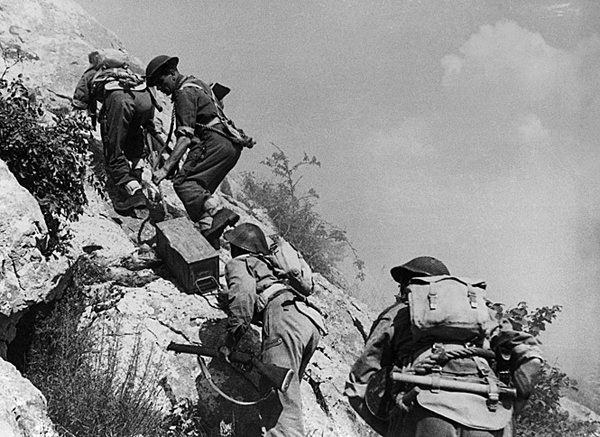
The supply problem followed the infantry up the slopes. Ammunition brought through ports and along roads still had a last stretch to travel on human shoulders or animal backs. Polish soldiers carried it towards positions reached at considerable cost. Wounded men had to be brought down over the same difficult ground, and carrying parties could be caught by the fire that had struck the men they were helping.
By May, the Polish II Corps under Władysław Anders had joined the effort. Many of its men had reached the Mediterranean after Soviet imprisonment or deportation and evacuation through the Middle East. Their route into this army differed sharply from that of the New Zealanders or Americans who had fought here before them. Now they were assigned the heights around the monastery, while French forces, including North African troops, attacked through the mountains farther south.
The victory was wider than the summit
Operation Diadem opened on 11 May across a broad front. British and Indian troops established crossings over the Gari, French forces advanced through the Aurunci Mountains, and the Poles attacked above Cassino. The pressure threatened the defensive system rather than only its most conspicuous landmark. German troops withdrew from the monastery as the wider position became untenable; a Polish patrol entered the abandoned ruins on 18 May.
The flag over the ruins marked an achievement made possible by operations well beyond the summit. River crossings, mountain advances and supply routes had finally combined to open the way. The monastery stood at the centre of the battle’s memory, but the breakthrough belonged to the men fighting across the front.
Rome fell to the Allies on 4 June. Italy’s war continued. Cassino remained behind as a warning against easy descriptions of the campaign: the road on a map had concealed rivers, mountains, demolished streets and the enormous human cost of passing through them.
Photographic credits and rights are given with each image. Wikipedia overview linked above is available under CC BY-SA.