

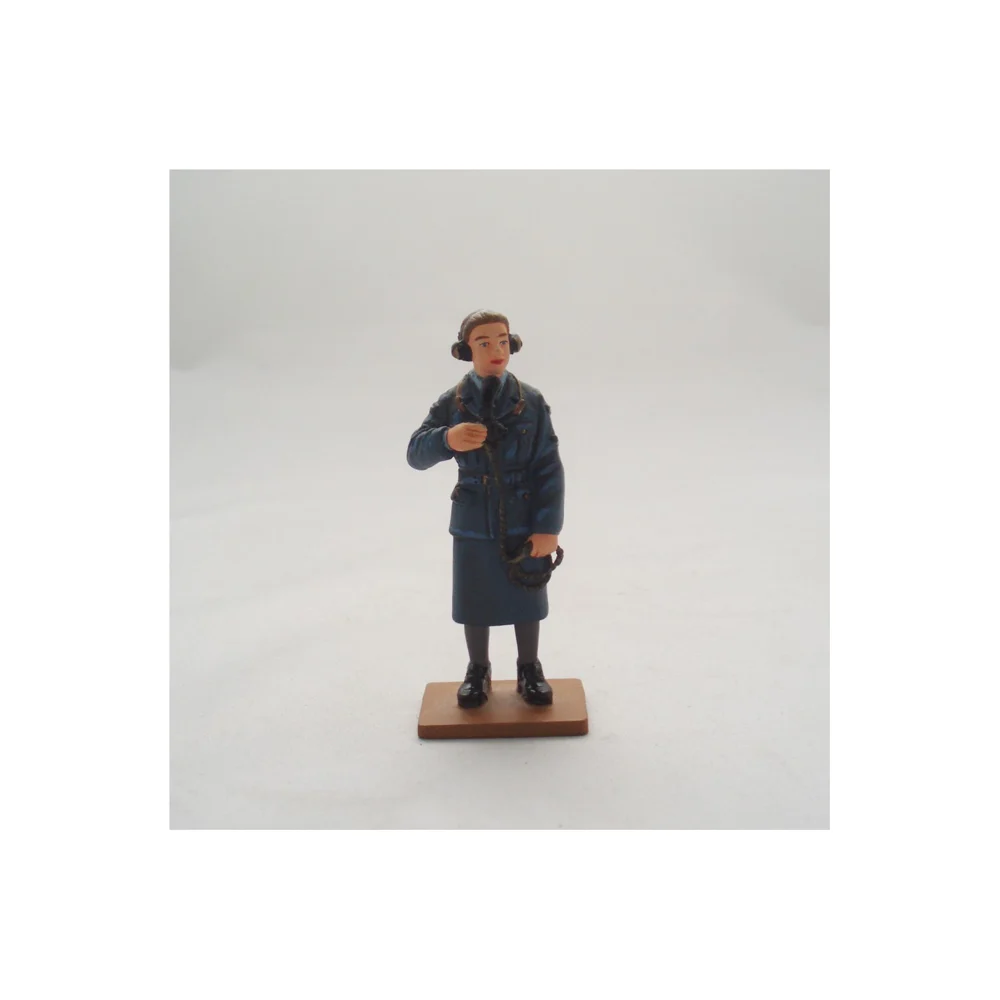
Del Prado · Women’s Auxiliary Air Force · 1942
An air-force uniform does not necessarily mean a pilot. Del Prado’s WAAF airwoman represents the women whose communications, plotting and technical work helped an air force function, even though they were not its combat aircrew.
- Maker
- Del Prado
- Subject
- WAAF Airwoman, 1942
- Setting
- Women’s Auxiliary Air Force · 1942
- Type
- Painted metal figure
The long blue coat makes this a notably different figure from Del Prado’s flying subjects. The hat has a brim, the hands remain close to the body, and there is no parachute harness to establish a flying role. It is a quiet service portrait, with the colour and cut of the clothing doing the identification.
The work behind the sortie
The Women’s Auxiliary Air Force was formed on 28 June 1939. During the war, women served in an expanding range of duties, including communications and technical work. The RAF Museum’s WAAF history is a useful starting point for that development.
One particularly important contribution was in the reporting and control system that supported fighter operations. Information had to be received, plotted and passed onward; aircraft did not find their targets through individual skill alone. The museum’s account of women in the Battle of Britain brings that less visible work into the story.
The figure is dated 1942, so the Battle of Britain supplies background rather than the date of the depicted subject. By then, the service had continued beyond its earliest wartime phase. The miniature need not be assigned to a particular plotting room or trade to represent that wider presence.
On a shelf, that distinction is an advantage. Beside a pilot, she expands the picture from one person and an aircraft to the organisation that sustained flying operations. Beside a naval signals figure or radio operator, she contributes to a display about communication and support across different services.
The coat offers broad surfaces where repainting is easier to notice than on camouflage. Look for even colour, clear folds and clean boundaries at the cuffs and lower edge. The brim and the small projecting details around the hands deserve close photographs, particularly when the figure is sold loose.
This is a useful addition because it changes who appears in the collection. The air war was not populated only by pilots, and a single accurately labelled airwoman makes that fact visible without needing an elaborate scene.
References and further reading
- RAF Museum — Women’s Auxiliary Air Force, 1939–1949
- RAF Museum — Women of Britain and the air-defence system
- RAF Museum — Duty Calls
- Planète Légendaire — figure reference
- Génie Miniature — Del Prado identification index
The photograph identifies the model; condition and packaging vary between examples offered for sale.