

Del Prado · British airborne forces · 1944
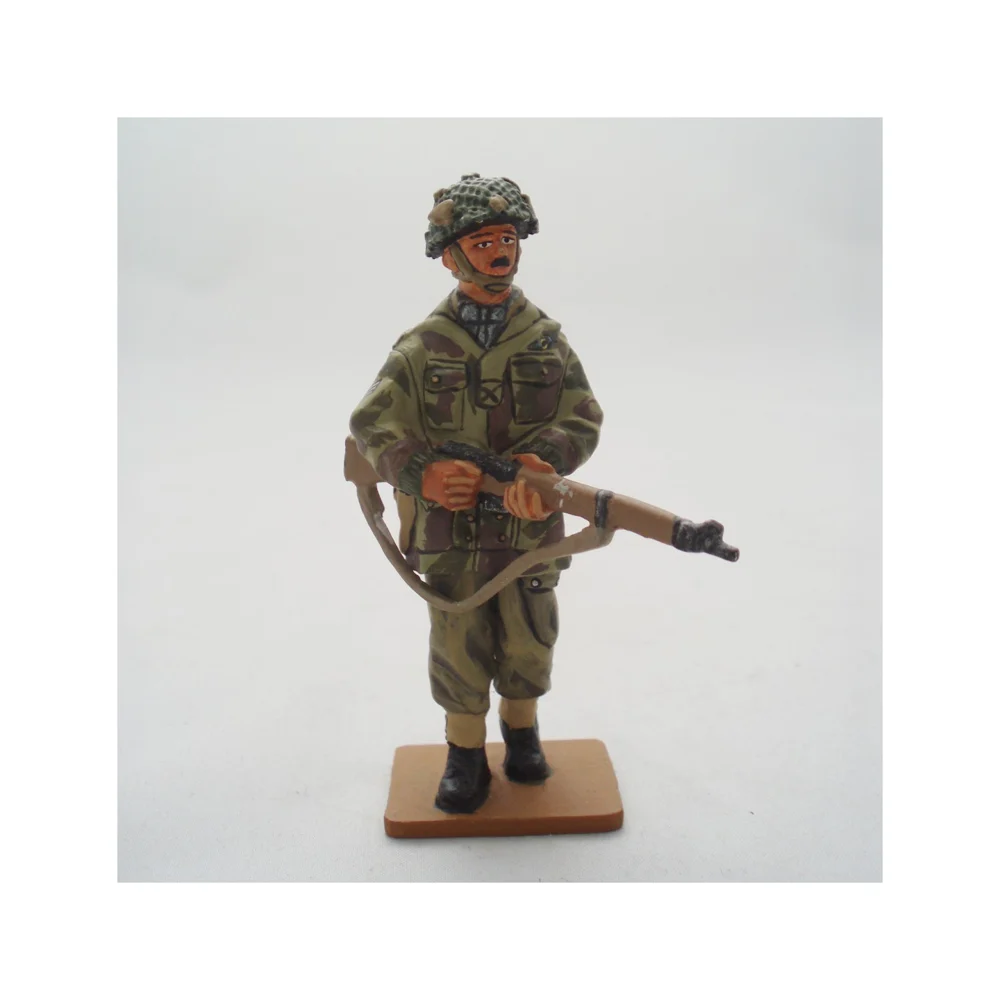
The landing is only the beginning of an airborne operation. Del Prado’s British sergeant, with rifle across his body and equipment ready for movement, is a useful reminder that the objective still had to be reached and held.
- Maker
- Del Prado
- Subject
- British Airborne Sergeant, 1944
- Setting
- British airborne forces · 1944
- Type
- Painted metal figure
The camouflage smock breaks up the body, while the helmet and webbing give the upper half a crowded, practical appearance. The rifle stretches across the figure rather than pointing skyward. Viewed beside a jump-equipped subject, this miniature shifts attention from arrival to the work that followed.
Getting there was not the whole mission
For D-Day, British airborne troops were tasked with helping secure the eastern flank of the invasion. Operations around the Orne included the seizure of bridges by glider-borne troops. The National Archives’ D-Day material places those actions within the larger invasion plan.
That example helps clarify an often-blurred word. “Airborne” includes more than parachuting. Gliders could bring men directly toward an objective, while parachute troops arrived by another method. Both then had to operate on the ground. Del Prado’s figure represents an airborne sergeant, but the pose alone does not establish exactly how he arrived.
The smock and equipment make this a strong comparison piece. Set beside an ordinary British infantryman, it reveals differences that can be overlooked when every khaki figure is grouped together. Set beside the German 1944 paratrooper, it becomes a study of two distinctive airborne silhouettes. Neither arrangement needs to claim a reconstructed encounter.
The visual rhythm is particularly good at a slight angle. The rifle, hands and body separate more clearly than in a strictly frontal line-up. That same angle is useful when buying: it reveals whether the barrel remains straight and whether the attachment around the hands has been repaired.
At the collecting table
Look closely at the helmet rim, the rifle’s end and the transitions between webbing and smock. A camouflage pattern can remain attractive even when small equipment details have been overpainted. Ask for the rear view and base condition as part of the same comparison, especially if the seller has used a stock photograph.
The figure’s appeal is not simply that it represents a famous branch. It offers a soldier ready for the ground phase of an operation, and that makes it a more versatile historical subject than an automatic association with one celebrated landing.
References and further reading
- The National Archives — Operation Overlord and D-Day
- National Army Museum — The Parachute Regiment
- Planète Légendaire — figure reference
- Génie Miniature — Del Prado identification index
The photograph identifies the model; condition and packaging vary between examples offered for sale.