

Del Prado · Free French Air Forces · 1943
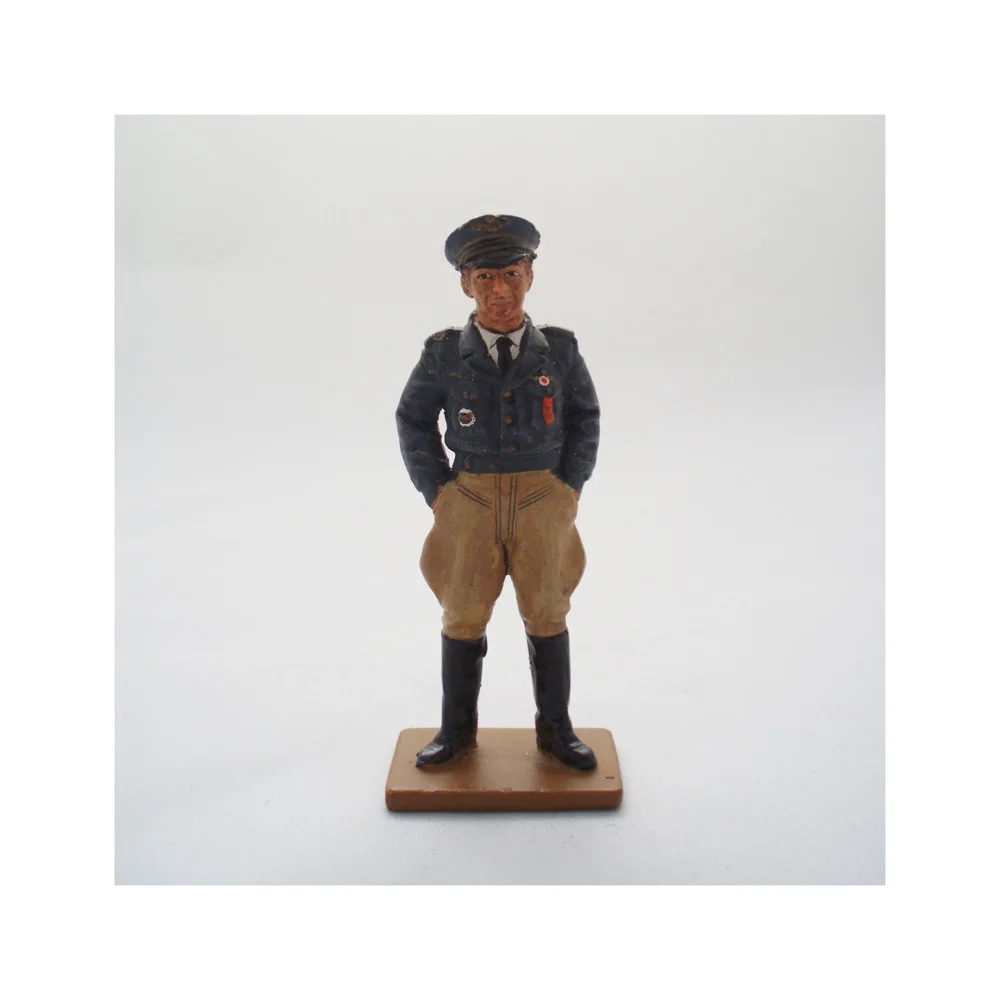
The blue jacket and pale trousers are the first clues: this is an air-force officer, not a generic Free French army commander. His subject connects the collection to the French squadrons that fought within a much larger Allied air organisation.
- Maker
- Del Prado
- Subject
- Free French Air Forces Commander, 1943
- Setting
- Free French Air Forces · 1943
- Type
- Painted metal figure
The pose is restrained, with the hands behind the back and the peaked cap carrying much of the officer’s visual identity. Tall dark boots anchor the pale trousers, while the jacket keeps the upper half unmistakably formal. There is no aircraft or flying equipment to tell the story for him. The interest lies in who the uniform represents.
French names, RAF numbers
The Free French Air Forces, usually abbreviated FAFL, preserved a French military identity while operating alongside the Allies. Units could carry both a French name and an RAF squadron number. Île-de-France became No. 340 Squadron; Lorraine operated as No. 342 Squadron. These were not competing identities. One expressed the national formation, the other its place in an operational system.
The Ordre de la Libération’s air-force history records the creation of Île-de-France at Turnhouse in November 1941. By 1943, the date of the miniature, the Free French air effort had developed far beyond the fragile beginnings of 1940. A figure of an officer can therefore stand for the organisation behind the aircraft as well as the aircrew who flew them.
The small abbreviation with a large meaning
FAFL means Forces aériennes françaises libres. Keeping “Air Forces” in the figure’s label prevents it being mistaken for a ground-army subject when a seller shortens the title to “Free French commander.”
The model is not identified here as a named ace. A generic uniform portrait should not acquire a biography merely because a famous pilot wore similar clothing. Its broader identity is valuable in its own right: it gives the shelf a French aviation subject that can sit beside RAF personnel without becoming indistinguishable from them.
There is a pleasing visual conversation available with Del Prado’s RAF pilot. Compare the officer’s formal stance with the practical equipment of a flying figure. The distinction helps explain why an air force requires command and support as well as machines and pilots; a collection built only around aircraft can make those people disappear.
Reading the miniature before buying
Look for clean separation between the dark boots and trousers, and inspect the cap brim in a side photograph. The broad jacket front is also a good place to spot thick overpainting. The retailer reference names the Free French Air Forces explicitly; retain that wording in your collection notes even if the listing you buy from does not.
References and further reading
- Ordre de la Libération — Armée de l’air
- French Ministry of Armed Forces — Free French Air Forces
- Planète Légendaire — figure reference
- Génie Miniature — Del Prado identification index
The photograph identifies the model; condition and packaging vary between examples offered for sale.