

Del Prado · Greece · Resistance and liberation · 1944
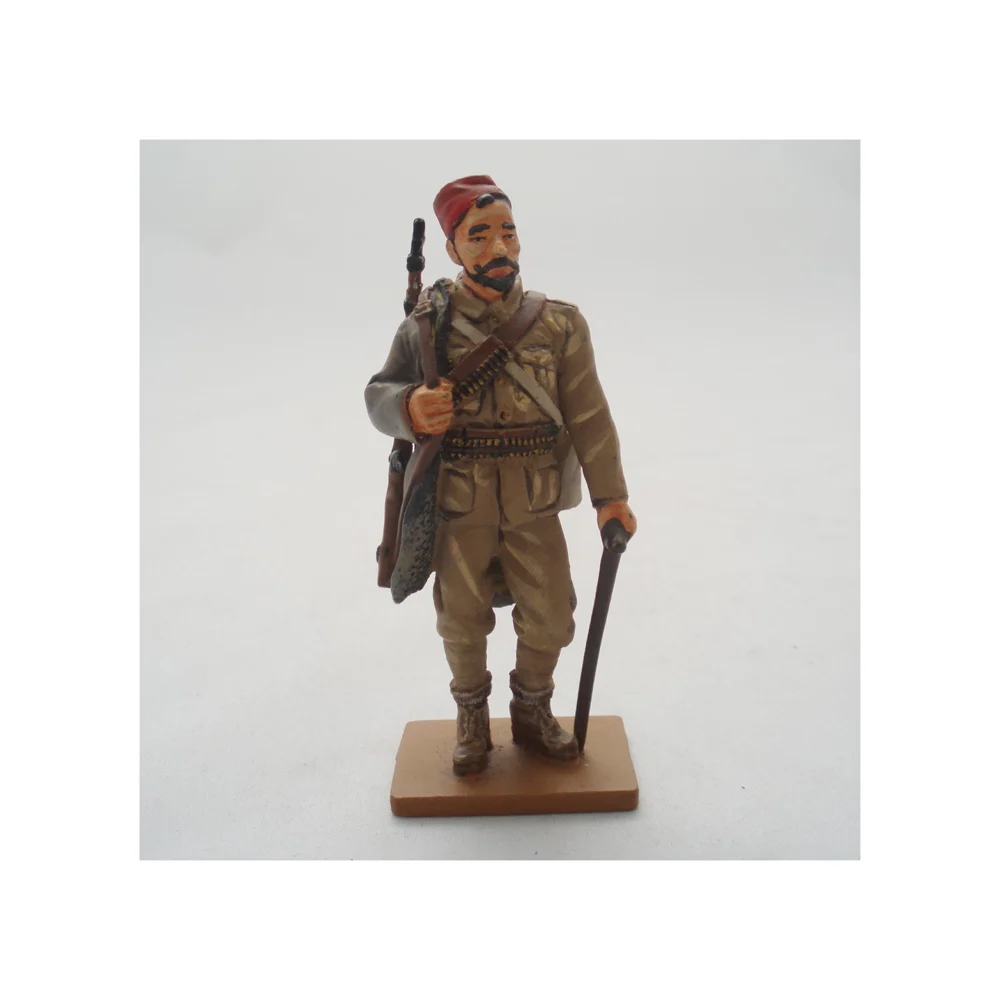
The mixed clothing, beard and long rifle set this partisan apart from the regular soldiers around him. His 1944 date leads into one of the most difficult transitions of the war: liberation from occupation did not bring Greece an uncomplicated peace.
- Maker
- Del Prado
- Subject
- Greek ELAS Partisan, 1944
- Setting
- Greece · Resistance and liberation · 1944
- Type
- Painted metal figure
The figure’s uneven outline is part of its character. The headwear provides a red accent, equipment crosses the torso, and the long objects carried at either side spread the composition beyond the legs. Compared with an officer in regulation dress, it feels less uniform in both senses of the word.
A resistance movement with a political identity
ELAS was the military arm of EAM, the left-led resistance movement. It should not be used as a name for every Greek resistance organisation. The distinction matters especially in 1944, when the approaching end of occupation sharpened disputes over the country’s political future and the control of armed forces.
A contemporary US diplomatic record describes the dispute surrounding the disarmament of ELAS and the treatment of other armed formations. In December, fighting in Athens brought ELAS into conflict with British and Greek government forces. Imperial War Museums holds film documentation of RAF attacks during that fighting.
Those sources complicate the easy ending often given to a wartime display. The departure of the occupier did not resolve the arguments among those who had opposed occupation. This figure can therefore represent resistance while also prompting a more difficult question about what followed liberation.
Keep the organisation in the caption
Greek ELAS partisan, 1944 is more informative than “Greek resistance fighter.” The specific name matters because the resistance was not a single politically unified body.
The model is not identified as a named partisan leader. Its beard and distinctive headwear are visual features, not evidence of an individual biography. That leaves the piece as a general portrait of the identified movement, which is already a substantial historical subject.
Display it where the irregular outline remains visible. The rifle and the long object carried on the other side need space; against a crowded background, both can merge into surrounding figures. An uncluttered placement also makes the contrast with regular military dress easier to see.
Condition and identification
On a loose example, ask for a side photograph of both projecting objects and a clear view of their attachment to the hands. The red headwear and crossed equipment are useful recognition points when a seller supplies only a broad description. Base and rear photographs can help establish whether an apparently complete figure has been repaired.
This is an especially valuable subject for a collection concerned with the people beyond regular armies. Its historical interest lies precisely in the fact that 1944 was not a neat final chapter.
References and further reading
- US Office of the Historian — Contemporary diplomatic record on Greece, 1944
- Imperial War Museums — RAF operations over Athens, December 1944
- Planète Légendaire — figure reference
- Génie Miniature — Del Prado identification index
The photograph identifies the model; condition and packaging vary between examples offered for sale.