

Del Prado · Britain · Cold War · 1960
The wartime SAS is usually pictured beside a heavily armed jeep. Del Prado’s 1960 paratrooper opens a different chapter: the regiment’s postwar revival, its Territorial roots and the practical weight of airborne equipment.
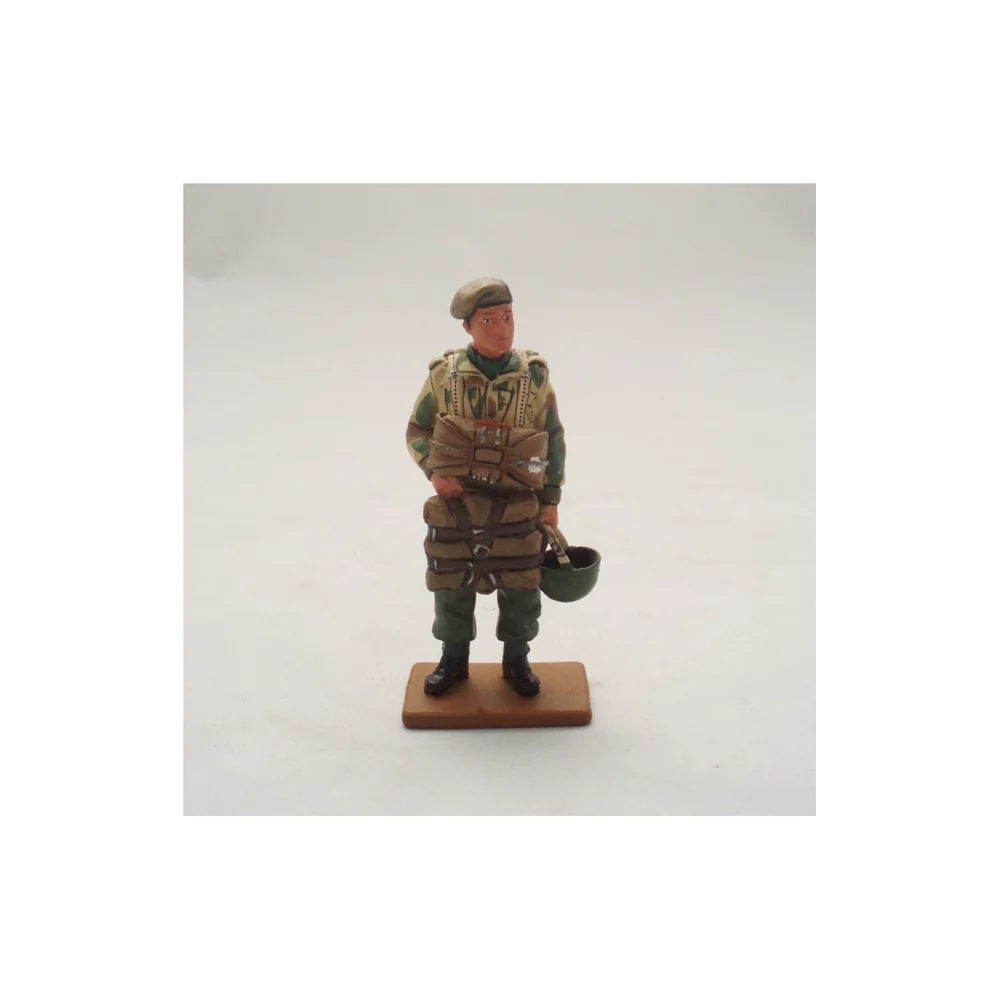
- Maker
- Del Prado
- Subject
- 21 SAS Paratrooper, 1960
- Setting
- Britain · Cold War · 1960
- Type
- Painted metal figure
This is a figure to read from the shoulders downward. The camouflage clothing is interrupted by straps and equipment, and the helmet carried beside the leg makes the outline noticeably wider on one side. The result is a soldier prepared for a task, rather than the lightly equipped desert raider so often used to stand for the entire history of the SAS.
The number before the name
The identification as 21 SAS matters. According to the National Army Museum, the regiment was re-established in the Territorial Army in 1947 as 21 SAS, drawing on the Artists Rifles. The regular 22 SAS followed in 1952, while 23 SAS was formed in 1959. By the date attached to this figure, the name described a postwar family of units, not simply a surviving version of the original wartime formation.
It is tempting to attach every SAS miniature to a famous operation. Here, the more useful approach is to retain the unit and date supplied by the figure reference. They establish a Cold War subject without inventing a particular deployment. A 21 SAS label is not permission to describe this individual as a veteran of a specific 22 SAS operation.
In miniature, the equipment does much of the storytelling. The hanging helmet and the mass of straps give the pose a sense of preparation: someone waiting to move, not already engaged in a firefight. Set it beside a wartime airborne figure and the comparison becomes about the changing burden carried by a soldier. Set it beside a desert raider and the contrast is institutional as well as visual.
A useful comparison piece
The camouflage should remain legible as a pattern across the folds, rather than disappearing into a single dark repaint. Request a clear view of the helmet attachment and both ankles, where protruding parts and the connection to the base deserve attention. Retail descriptions sometimes reduce the name to “English paratrooper”; the combination of pose, equipment and the 21 SAS identification is more helpful than nationality alone.
Its place in a collection is therefore quite specific. It bridges wartime special forces and the later, more familiar public image of the SAS, preserving a less frequently represented stage in between.
References and further reading
- National Army Museum — Special Air Service
- Planète Légendaire — figure reference
- Génie Miniature — Del Prado identification index
The photograph identifies the model; condition and packaging vary between examples offered for sale.