

Del Prado · Relief of Vienna · 1683
The wing and long lance are instantly recognisable. At Vienna, the less visible story is how an allied army reached the ground from which its cavalry could attack.
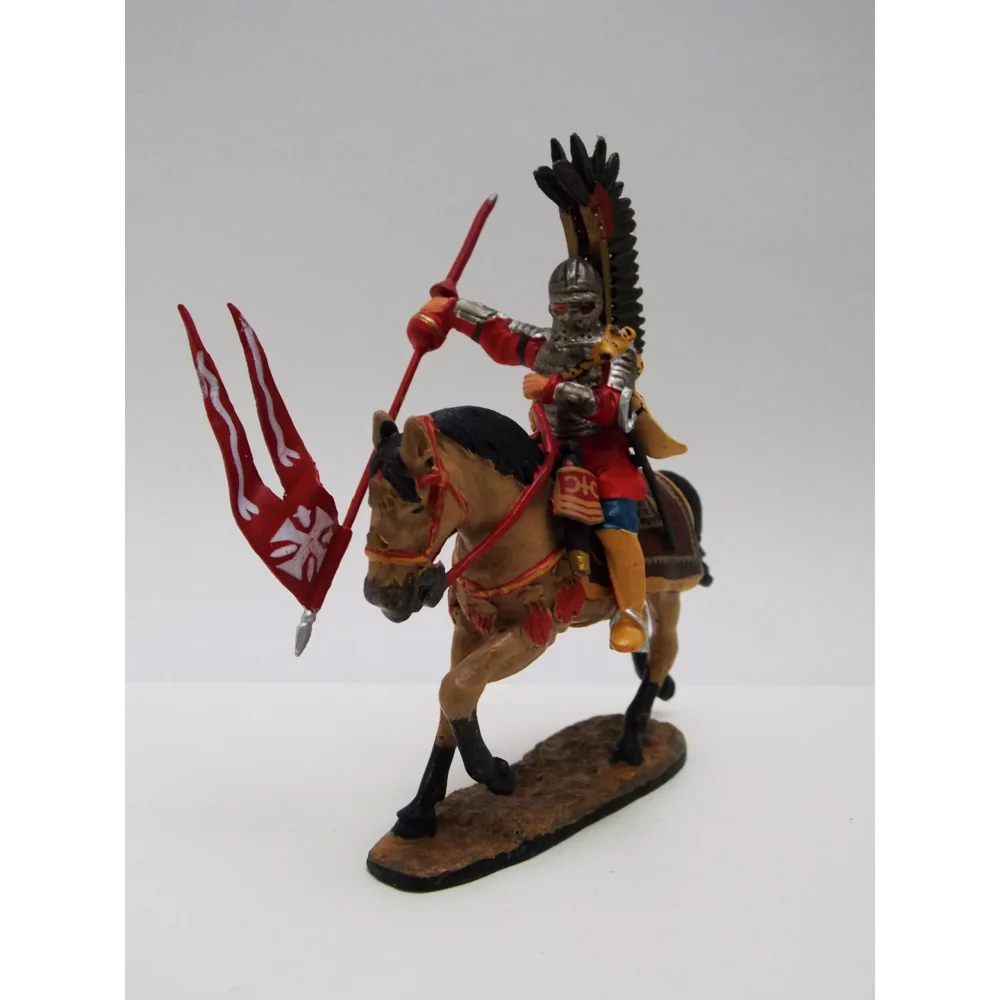
- Maker
- Del Prado
- Subject
- Polish Winged Hussar, Vienna, 1683
- Setting
- Relief of Vienna · 1683
- Type
- Painted metal mounted figure
The rider combines armour, a tall wing and bright red details above a warm-coloured horse. The extended weapon enlarges the composition dramatically. Even among other mounted figures, the silhouette is distinctive enough to draw attention before the label is read.
Vienna was a coalition victory
On 12 September 1683, the relief army defeated the Ottoman besiegers of Vienna. Polish forces under John III Sobieski fought alongside Austrian and German contingents. The Wilanów Palace Museum’s account follows the fighting through difficult ground and the preparation for the later cavalry attack.
That matters because the famous charge can consume the whole story. Before mounted troops could exploit the situation, the allied advance had to develop through the hills and contested approaches. The cavalry’s dramatic arrival was part of a battle, not a substitute for everything that preceded it.
The museum describes preliminary attacks used to test the ground. This is an especially useful detail beside a model dominated by a long lance: even an imposing formation needed to know whether the terrain would permit its movement.
The rider is not automatically Sobieski. A generic hussar allows the article to focus on the cavalry formation rather than attaching a famous commander’s name to an unidentified face. The national and battle setting provide plenty of context without inventing an individual biography.
For a display, leave enough room for the wing and weapon to be seen separately. A dense row of neighbouring lances can turn the most distinctive details into a tangle. This figure benefits from being viewed slightly from the side, where horse, armour and wing form separate layers.
Before buying, ask for a photograph that includes the full weapon and the top of the wing. Cropped images can hide missing tips. The attachment points deserve attention too, since repairs may be more obvious from behind than from the front.
Its historical value grows when the spectacular silhouette leads into the coalition, the terrain and the sequence of the battle.
References and further reading
- Museum of King Jan III’s Palace at Wilanów — Battle of Vienna
- Planète Légendaire — figure reference
- Génie Miniature — Del Prado identification index
The photograph identifies the model; condition and packaging vary between examples offered for sale.