

Del Prado · Great Northern War · 1709
A raised sword and a moving horse suggest an open cavalry fight. At Poltava, however, mounted action belonged to a battlefield shaped by earthworks, routes and a larger struggle for control.
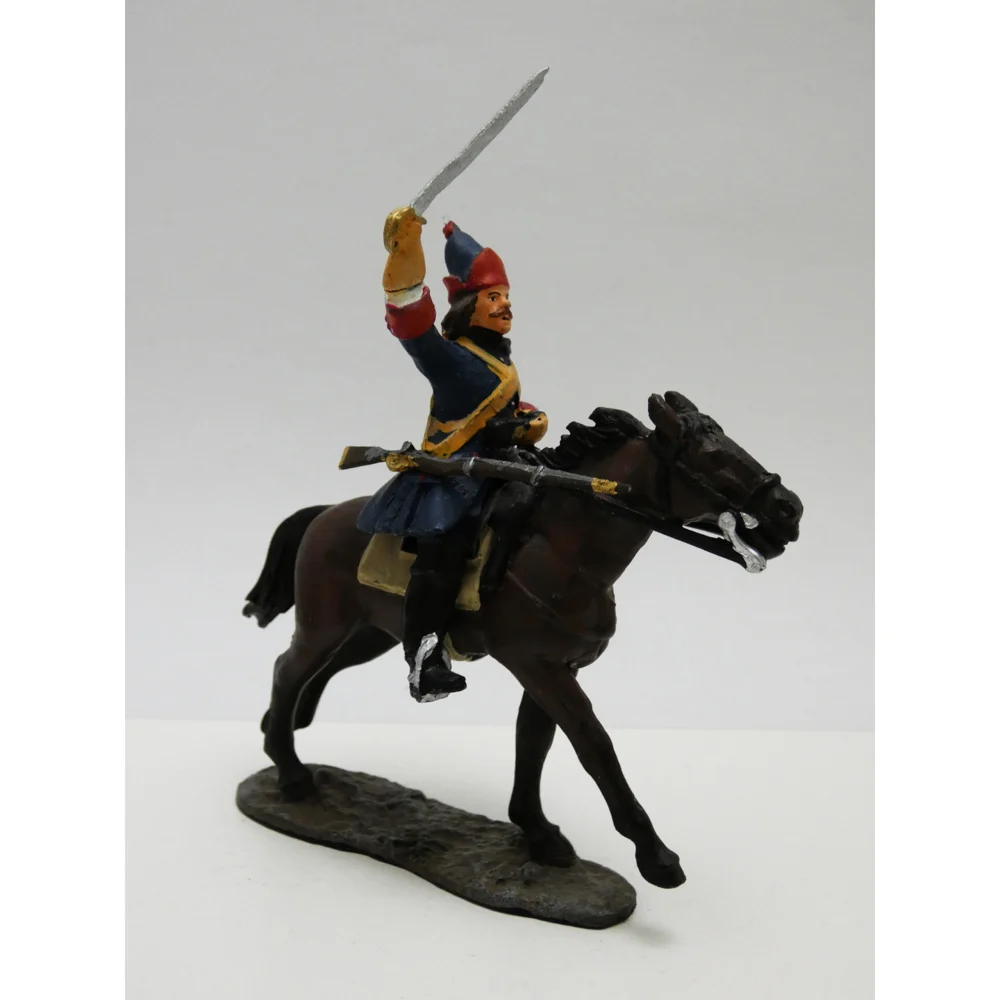
- Maker
- Del Prado
- Subject
- Peter the Great’s Dragoon, Poltava, 1709
- Setting
- Great Northern War · 1709
- Type
- Painted metal mounted figure
The dark blue coat, red accents and tricorn place this rider in an earlier military world than the Napoleonic dragoons. The horse’s forward movement and the lifted curved blade make the pose active without requiring an elaborate scenic base.
The battlefield was already prepared
In 1709, Charles XII’s Swedish army confronted Peter I’s Russian forces at Poltava during the Great Northern War. The opening fighting involved Russian redoubts and cavalry, before the main battle developed. The Battle of Poltava Museum’s exhibition account separates those phases rather than presenting the action as one uninterrupted clash.
That sequence matters for the miniature. Cavalry did not operate on an empty tabletop. Its choices were shaped by fortifications, the movement of infantry and the need to understand what was happening elsewhere. The raised sword is a clear focal point, but the ground around the rider belongs in the historical explanation.
Peter’s victory became one of the defining events of his reign. The museum also discusses battle imagery commissioned under the ruler. Such images helped give the event a lasting form; they should be read as representations made for a purpose, not as photographs of every formation’s exact movement.
The date 1709 is worth keeping prominent. A tricorn and blue coat alone can lead a loose miniature into an overly broad eighteenth-century category. The campaign setting distinguishes it from later French, British or Prussian subjects with superficially similar headgear.
Placed near the winged hussar dated 1683, the figure can introduce different mounted traditions only a generation apart. It is a comparison of armies and equipment, not evidence that the two specific subjects fought together.
The sword and the horse’s projecting limbs need clear photographs before purchase. Check the tricorn’s edges as well: damage there changes the outline of the rider’s head. A complete silhouette is especially important in a sculpt built around movement.
This is a useful early eighteenth-century anchor for the collection, connecting the mounted figure to a battle in which preparation and the shape of the ground mattered as much as the appearance of the cavalry.
References and further reading
- Battle of Poltava Museum — The battle exhibition
- Planète Légendaire — figure reference
- Génie Miniature — Del Prado identification index
The photograph identifies the model; condition and packaging vary between examples offered for sale.