

Del Prado · France · 1806–1812
The rearing horse and shining breastplate make an immediate impression. The more interesting story lies behind the spectacle: heavy cavalry depended on control and cohesion as much as courage.
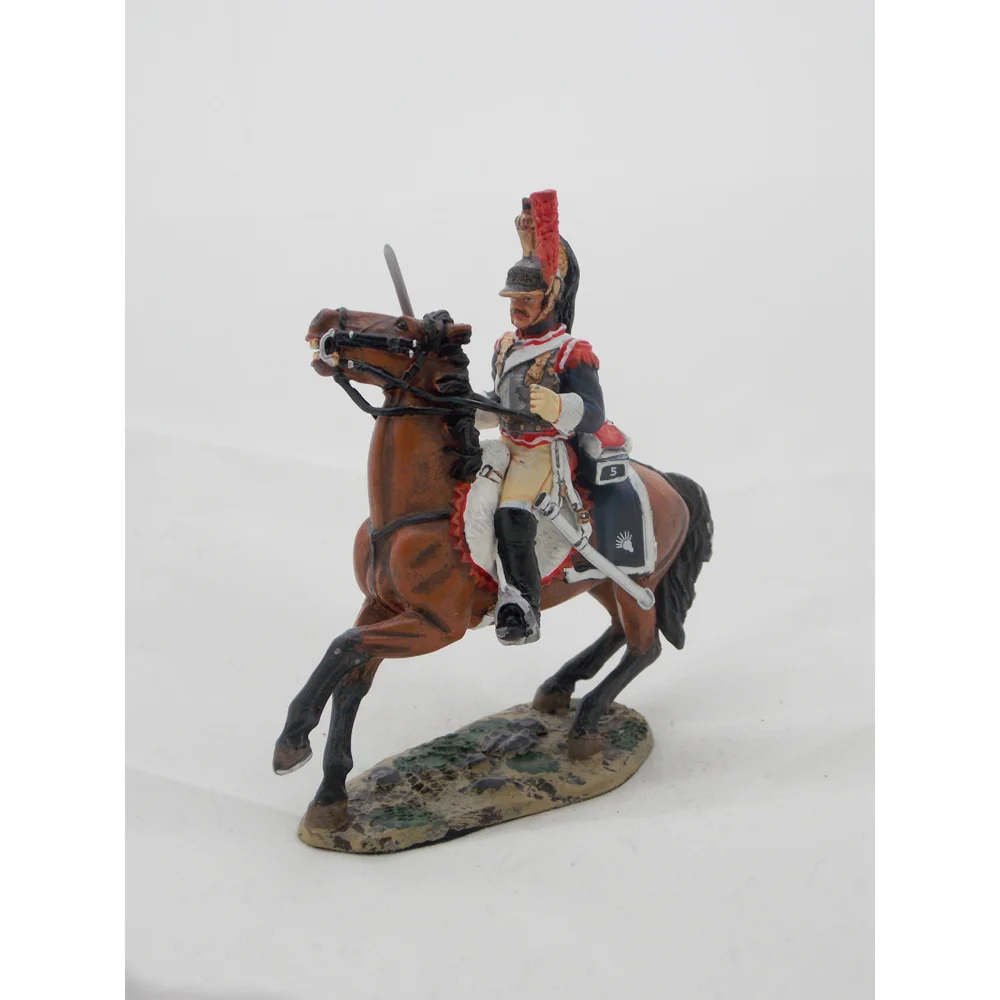
- Maker
- Del Prado
- Subject
- French 5th Cuirassier, 1806–1812
- Setting
- France · 1806–1812
- Type
- Painted metal mounted figure
The metallic cuirass anchors the rider visually, while the red plume and raised sword carry the composition upward. Against the bay horse, the pale trousers and armour are easy to distinguish. This is one of the mounted range’s most theatrical poses, and it makes a useful starting point for questioning the familiar image of an unstoppable cavalry charge.
The horse was not a projectile
A charge required men and horses to remain organised. The approach, the distance at which speed increased and the condition of the formation all mattered. The Fondation Napoléon’s study of cavalry tactics describes a controlled process rather than a continuous gallop from the moment a regiment began moving.
An intact infantry square presented a different problem from men already shaken or retreating. Heavy cavalry could exploit disorder, but appearance alone did not confer the ability to ride through disciplined infantry. That distinction gives the miniature more historical interest than the vague label “shock troops”.
The 1806–1812 span also covers years in which replacing horses and maintaining regiments became a constant burden. A mounted formation existed only while animals could be fed, fitted with equipment and kept serviceable. The figure freezes the most impressive instant; the regiment’s daily life included all the work required to make that instant possible.
That comparison becomes especially clear beside Del Prado’s carabinier dated 1800, who belongs to the earlier, unarmoured appearance of his corps. A pair of figures can therefore show both a difference between formations and a change through time.
The dramatic horse needs a little space around it. Crowding another rider against the raised sword or forelegs weakens the silhouette and risks contact with fragile parts. In listing photographs, ask for the side that reveals the full blade, tail and connection between horse and base.
With the title and date retained, this is more than a generic armoured horseman. It becomes a compact illustration of the attraction—and the practical limitations—of Napoleonic heavy cavalry.
References and further reading
- Fondation Napoléon — Cavalry organisation and tactics
- Planète Légendaire — figure reference
- Génie Miniature — Del Prado identification index
The photograph identifies the model; condition and packaging vary between examples offered for sale.