

Del Prado · Russian campaign · 1812
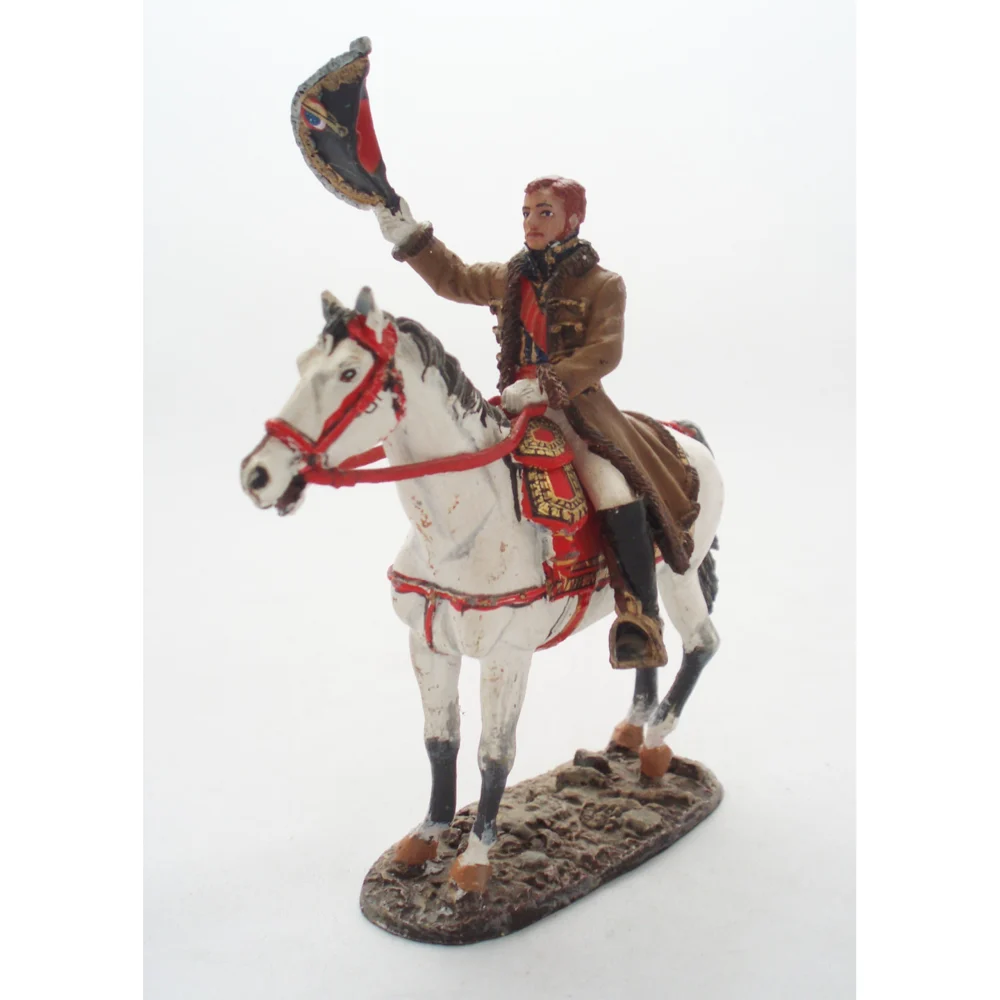
Ney lifts his hat above a pale horse, an open gesture in a portrait associated with one of the army’s hardest years. The 1812 date turns a marshal’s likeness into a story of endurance.
- Maker
- Del Prado
- Subject
- Marshal Ney on Horseback, 1812
- Setting
- Russian campaign · 1812
- Type
- Painted metal mounted figure
The uncovered red-haired head is the figure’s most personal detail. Gold trim lifts the subdued coat, while the raised bicorne gives the rider a broad, easily read outline. There is no snow on the base and no specific episode fixed by the sculpt. It should be understood as Ney in the year of the Russian campaign, rather than a literal reconstruction of one famous scene.
Ney’s military career began well below the rank shown here. He entered the cavalry before the Revolution and rose through the wars that transformed the French army. By the imperial period his reputation rested strongly on personal bravery and an ability to remain close to the fighting.
The difficult end of the column
During the retreat from Russia, the rearguard had to keep an enemy from overwhelming an army already struggling to move. Ney’s conduct in that role became central to his later reputation. The Fondation Napoléon biography places this episode within a career that also included severe reverses.
The task is worth imagining without turning it into legend. A rearguard could not simply stand indefinitely, nor could it leave too quickly. It had to gain time, disengage and do the same again. That sequence explains why the last troops in a retreat could acquire a reputation disproportionate to their numbers.
The pale horse gives the composition a brightness that can otherwise seem at odds with the campaign. That tension is useful: military portraits frequently preserve command and confidence even when the event remembered was a disaster. The object and the history are doing different things.
Set beside Kutuzov, Ney offers a comparison across the same campaign without pretending the two men met in the poses shown. One figure opens the question of Russian command decisions; the other draws attention to the retreating army’s struggle to survive.
Check the raised hat and hand carefully on a second-hand example. The uncovered face also deserves a sharp photograph, since thick retouching can erase the character that distinguishes this rider from an anonymous officer.
References and further reading
- Fondation Napoléon — Michel Ney
- Fondation Napoléon — The retreat from Russia
- Planète Légendaire — figure reference
- Génie Miniature — Del Prado identification index
The photograph identifies the model; condition and packaging vary between examples offered for sale.