

Del Prado · Waterloo campaign · 1815
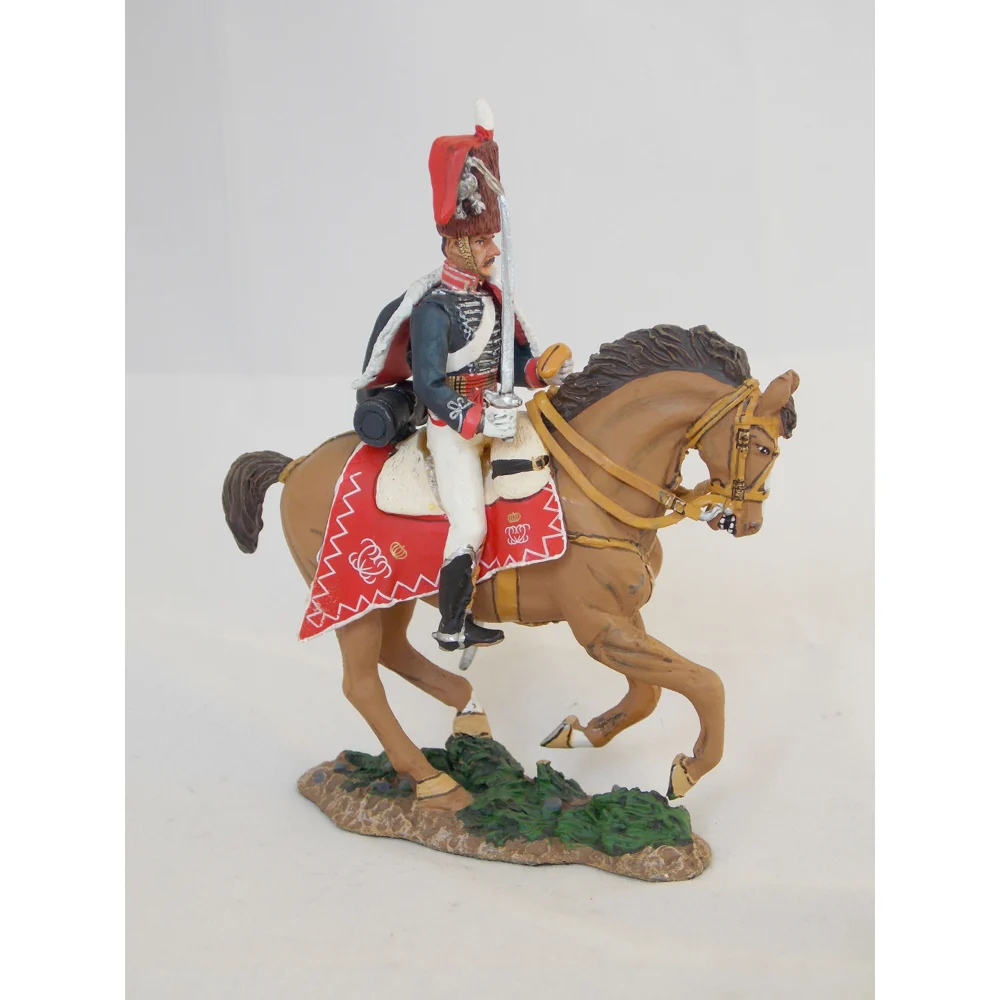
The red headgear and braided blue coat make this hussar conspicuous. His regiment’s Waterloo story offers something less obvious than a charge: the importance of bringing back the right news.
- Maker
- Del Prado
- Subject
- British 10th Hussars Corporal, 1815
- Setting
- Waterloo campaign · 1815
- Type
- Painted metal mounted figure
The rider holds his sword upright over a brown horse. Pale trousers break up the dark coat and saddle furniture, while the red headgear gives the miniature its strongest colour accent. This is a corporal, not a general, and that modest rank is part of the subject’s appeal.
A regiment that changed its appearance
The 10th had begun as dragoons and later became light dragoons. In 1806 it became the first British regiment converted to hussars, under the patronage of the Prince of Wales. The elaborate dress therefore belongs to a specific regimental transformation, rather than an unchanged uniform stretching back to the unit’s foundation.
The National Army Museum’s regimental history records another revealing episode: during the Waterloo campaign, a patrol from the regiment brought Wellington information about the Prussian retreat. Mounted troops helped commanders understand a moving battlefield as well as act upon it.
That is the thread to follow when looking at this corporal. The model does not portray the identified messenger, but it represents the sort of cavalry organisation within which scouting and reporting took place. A commander’s decision could depend on work performed far from the main line of battle.
Look beyond the sabre
The drawn weapon is the miniature’s dramatic feature. Yet the horse’s value also lay in covering ground, observing movement and returning with information. A small display label about the regiment’s patrol work can give the figure a different story from the neighbouring heavy cavalry.
The hussar clothing makes another productive comparison with the Brunswick rider. Similar fashionable elements did not erase national differences, and both figures should retain their own dates. The British corporal belongs to 1815; the Brunswick example in this group is dated 1812.
When examining a sale photograph, check that the upright blade has not been shortened and that the headgear retains its crisp outline. The braiding should remain distinct from the blue coat. Strong lighting can make pale paint look almost white, so avoid assigning extra uniform detail from colour alone.
This is a useful figure for a Waterloo collection precisely because its regimental story can begin before the armies assembled on the final battlefield.
References and further reading
- National Army Museum — 10th Royal Hussars
- Planète Légendaire — figure reference
- Génie Miniature — Del Prado identification index
The photograph identifies the model; condition and packaging vary between examples offered for sale.