

Del Prado · French Army · 1939–1940
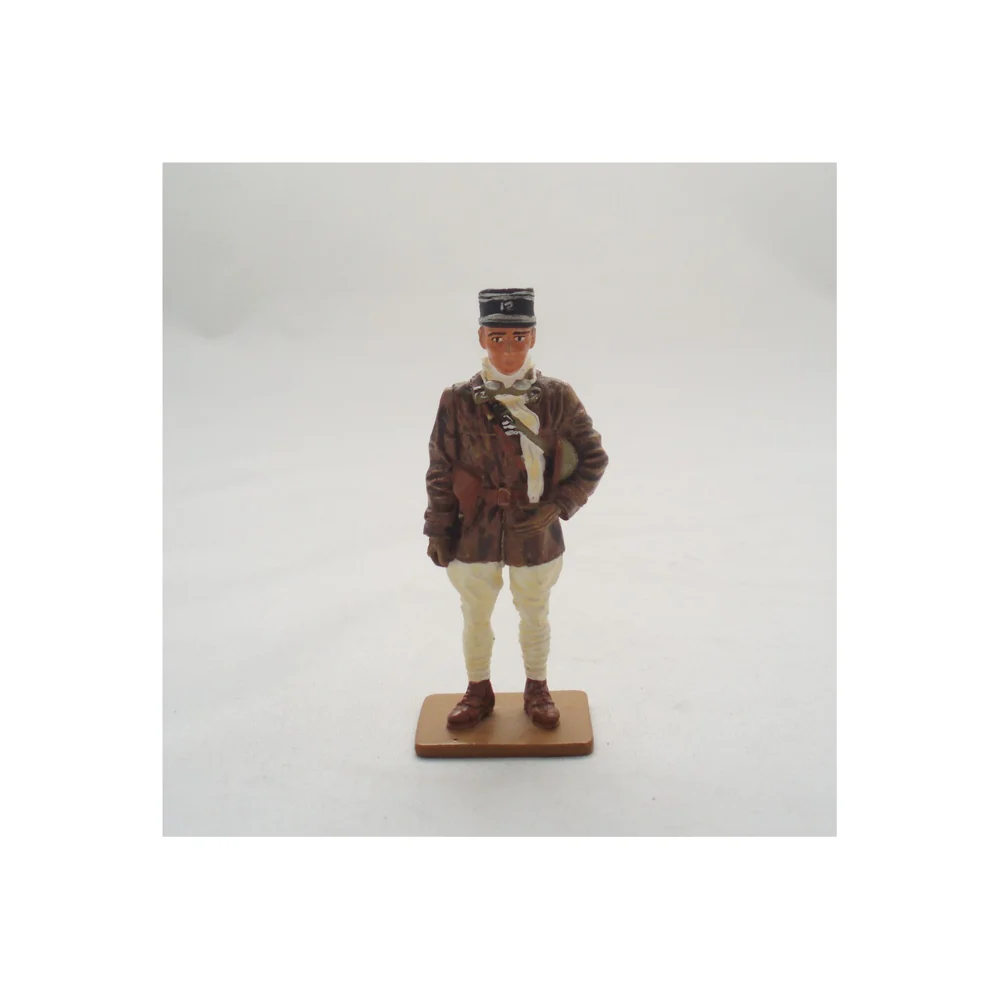
The leather jacket gives this captain a very different appearance from a marching infantryman. It also opens a revealing question about French armour in 1940: how much work could one commander be expected to do inside a tank?
- Maker
- Del Prado
- Subject
- French Tank Captain, 1939–40
- Setting
- French Army · 1939–1940
- Type
- Painted metal figure
The pale trousers, tall boots and dark jacket create three clear bands of colour. A kepi completes the silhouette. Del Prado presents the officer outside his vehicle, which is fortunate for the collector: the clothing would be almost invisible if the figure were buried in a turret hatch.
The crowded job of commanding
The Char B1 bis offers a striking example of the workload inside a French tank. Its driver also aimed and fired the hull-mounted 75 mm gun. In the turret, the commander had to observe, issue orders and operate the turret armament. The Tank Museum’s vehicle account emphasises that division of labour.
A list of armour thicknesses and gun calibres can therefore miss something important. A weapon has to be found, aimed, loaded and fired by people who are also trying to understand what is happening around them. The commander’s workload was part of the vehicle’s effectiveness, just as surely as its mechanical specifications.
This does not identify Del Prado’s captain as a B1 bis crewman. The vehicle is a historical example that helps explain why a tank officer is worth studying in his own right. The figure is a generic French tank captain, not a portrait of a named commander attached to a famous action.
The reference dates vary between 1939 and 1940, so this entry uses 1939–40. That is a better fit than pretending the surviving retailer wording establishes an exact campaign day. It places the figure around the outbreak of war and the French campaign without converting uncertainty into an invented event.
Let the clothing remain visible
The jacket is the model’s strongest surface. Look for the folds and belt remaining clear beneath the paint, and compare the finish across the front and sleeves. Uneven glossy patches can indicate touching-up, although photographs alone may not settle the question. The kepi rim and boot tops are useful secondary checks.
Beside a French tank model, this officer gives the machine a human reference point. Beside another armoured officer, he becomes a comparison of national clothing and presentation. Either arrangement is more informative than leaving him as an unidentified “French officer” at the back of the shelf.
References and further reading
- The Tank Museum — Char B1 bis
- Planète Légendaire — figure reference
- Génie Miniature — Del Prado identification index
The photograph identifies the model; condition and packaging vary between examples offered for sale.