

Del Prado · Austrian Army · 1805
A cavalry regiment needed more than swords. This trumpeter makes the act of communication visible: an order had to reach moving riders through noise, distance and the confusion of horses.
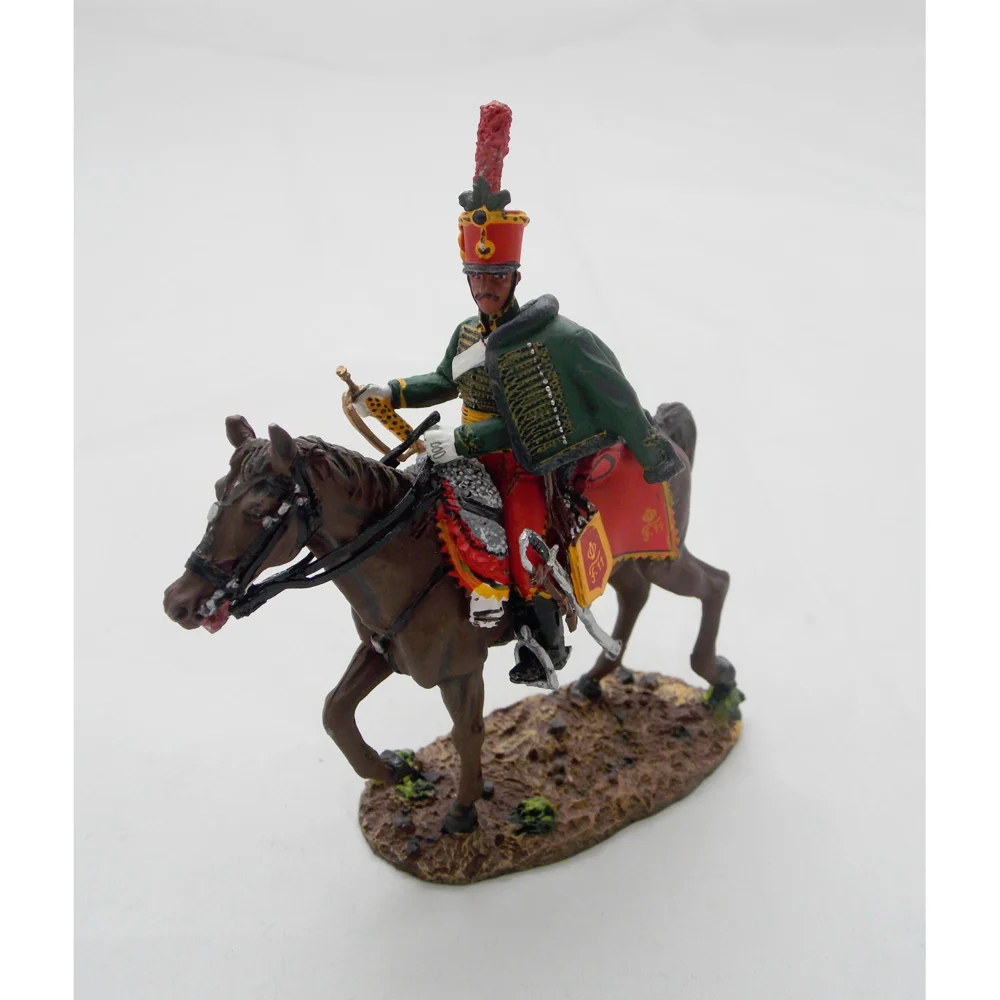
- Maker
- Del Prado
- Subject
- Austrian 5th Hussars Trumpeter, 1805
- Setting
- Austrian Army · 1805
- Type
- Painted metal mounted figure
The trumpet is lifted toward the face, while the richly coloured clothing and tall plume draw the eye upward. Red and green dominate the model. The horse is animated without obscuring the instrument, so the figure’s duty remains the first thing the viewer understands.
The retailer’s fuller description identifies the 5th Hussars, a detail easily lost when a listing is shortened to “Austrian trumpeter.” Retaining the regiment and date makes this a more useful catalog entry than an attractive but unnamed musician.
Music with a practical job
Cavalry signals were not merely a soundtrack for parade. A trumpet could carry a command farther than an ordinary shouted instruction. The National Army Museum’s discussion of mounted actions even records a charge beginning so eagerly that the trumpeter barely had time to sound the intended movement. The example is from a later British action, but it illustrates why a mounted musician belongs inside the operational story.
In this miniature the instrument changes the pose completely. The rider’s hand is occupied with sound rather than a weapon, and the horse carries a specialist whose work supports the group. That makes him a useful interruption in a line of sword-bearing figures.
The 1805 setting belongs to the campaign ending at Austerlitz. Austria’s defeat there preceded another confrontation in 1809. Keeping those dates separate lets this musician sit beside the 1809 uhlan as part of a sequence, rather than pretending both figures portray one battle.
Colour that needs a closer look
The braided clothing and instrument offer small surfaces where heavy repainting can hide detail. Compare the separation of the trumpet from the face, the plume tip and the horse’s ears. Check the rear as well: a vivid frontal photograph can conceal damage to the saddle furniture or tail.
In a cabinet, give the trumpeter a position where the instrument faces the viewer. He supplies both visual variety and a practical reminder that cavalry manoeuvre depended on men being able to hear and recognise the next order.
References and further reading
- National Army Museum — Famous cavalry charges and trumpet signals
- World of the Habsburgs — Austria in the Napoleonic wars
- Planète Légendaire — figure reference
- Génie Miniature — Del Prado identification index
The photograph identifies the model; condition and packaging vary between examples offered for sale.