

Del Prado · Portugal · 1806–1810
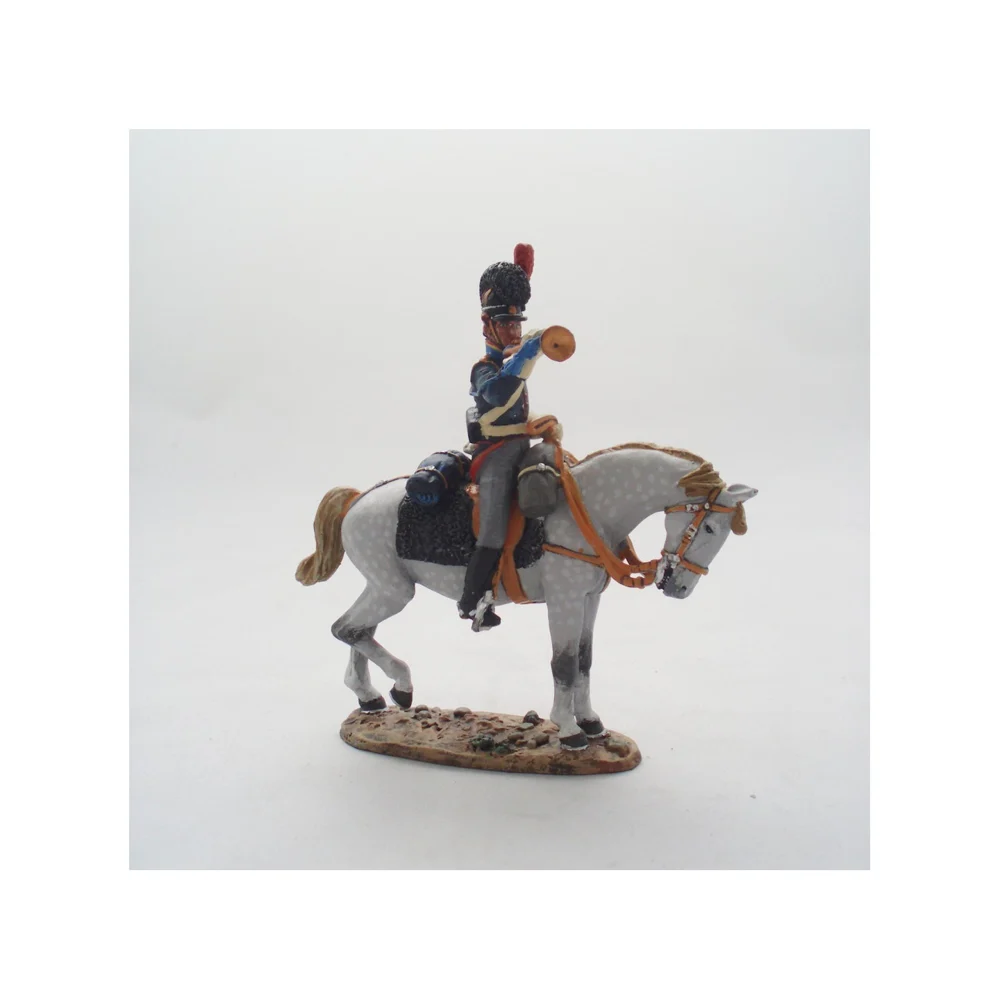
The trumpet and pale horse make this rider stand apart from a row of cavalrymen. His Portuguese identity matters just as much: the Peninsular army was never exclusively British.
- Maker
- Del Prado
- Subject
- Portuguese Cavalry Trumpeter, 1806–1810
- Setting
- Portugal · 1806–1810
- Type
- Painted metal mounted figure
The raised instrument directs attention toward the rider’s face. Dark clothing contrasts with the grey horse, and the coloured saddlecloth keeps the two visually connected. Unlike a sword-bearing trooper, the trumpeter is represented carrying out a task that serves the formation around him.
Portugal was an army, not just a backdrop
The Peninsular War began with the invasion of Portugal in 1807 and developed into a prolonged conflict involving Portuguese, Spanish and British forces against Napoleon’s armies. The National Army Museum’s account makes the allied composition of Wellington’s army explicit.
The figure’s date range, 1806–1810, crosses the beginning of that upheaval. It should not be reduced to a later victory such as Salamanca in 1812. Instead it offers a Portuguese uniform subject from the years in which the conflict and the alliance were taking shape.
Listen to the role
A trumpeter carried information through sound. The instrument belongs to the practical work of keeping mounted troops coordinated, as well as to the visual and musical identity of a regiment.
The pose makes that function easy to explain. One hand is committed to the instrument while the rider still has to remain balanced and control his mount. In miniature, the contrast between a sounding trumpeter and a trooper holding a sword can communicate two different jobs without a long caption.
No specific Portuguese regiment is assigned here because the retailer reference does not establish one. The broader identification remains useful and avoids turning the colour of a small painted detail into an unsupported regimental claim.
A good figure for an allied grouping
Place him beside Wellington or another Portuguese subject with the nationality clearly labelled. The display then acknowledges a participant in the army rather than treating every mounted figure in the Peninsula as British.
When buying, examine the trumpet’s connection to the hand and the edge of the headwear. The pale horse will show repairs or uneven touching-up more clearly than a dark mount, especially in a side photograph. Check the tail and legs as carefully as the rider.
This is a modest but useful expansion of a Napoleonic shelf: a different nationality, a specialist duty and a date range that leads into the war rather than jumping immediately to its conclusion.
References and further reading
- National Army Museum — The Peninsular War
- Planète Légendaire — figure reference
- Génie Miniature — Del Prado identification index
The photograph identifies the model; condition and packaging vary between examples offered for sale.