

“I was scared stiff,” Sapper John Haines remembered in an account preserved by NZ History. Private Ivan Divehall remembered excitement. The same parachutes could produce both reactions. On the morning of 20 May 1941, German troops descended over Crete, and the men watching them had only moments to turn astonishment into action. The invasion would be decided by airfields and command decisions, but it began as a profoundly personal encounter with an unfamiliar way of war.
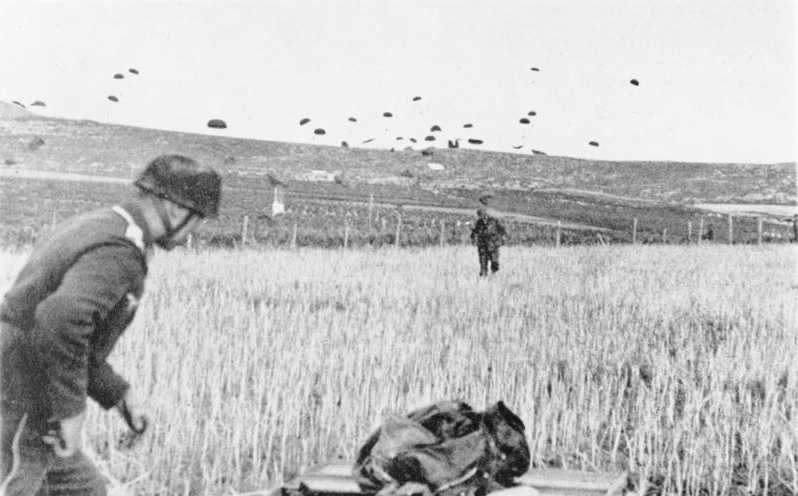
The defenders’ first reactions soon gave way to firing. Some German troops landed among defended positions, separated from comrades and weapons containers, and were killed before they could organise. Elsewhere they found enough cover to gather and attack. By evening, the invasion had gained footholds, but it had not secured the means to sustain an army on the island.
British, New Zealand, Australian and Greek forces defended Crete, together with Cretan civilians who entered the fighting. Many Allied troops had recently been evacuated from mainland Greece. They had escaped one defeat, but the equipment and preparation available for another battle were uneven.
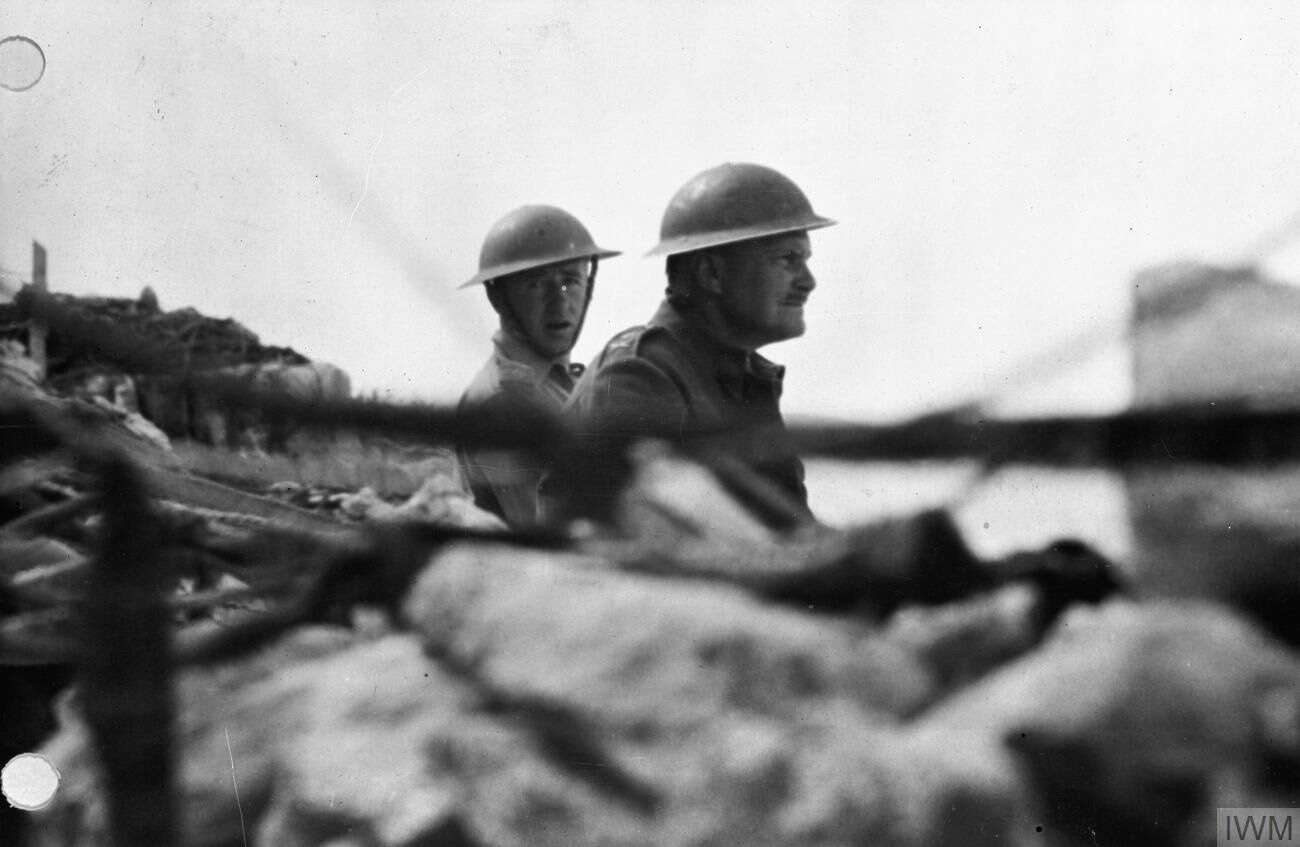
General Bernard Freyberg knew an attack was coming, helped by intelligence from decrypted German communications. Warning, however, was not equivalent to knowing precisely where the decisive effort would succeed. The threat of a landing from the sea competed for attention with the danger from the air. Troops assigned to watch a coast could not simultaneously stand at every possible parachute landing ground.
The German plan depended on turning an airborne landing into a sustained occupation. Parachutists alone could not provide everything an army needed. An airfield would allow transports to land reinforcements and heavier supplies. That practical requirement gave Maleme, on the northern coast, an importance out of proportion to its size.
Maleme and the limits of knowledge
At Maleme, that uncertainty became a command crisis. The airstrip lay beneath Point 107, whose possession helped determine whether aircraft could land safely. As telephone and wireless contact failed, reports from the forward positions became fragmentary. Officers trying to judge the battle could hear the fighting without knowing which companies were still holding.
Lieutenant-Colonel Leslie Andrew’s 22nd Battalion held the key ground around the airfield and Point 107. He could not reliably contact forward companies. Support was requested; the response was shaped by mistaken impressions about the fighting elsewhere. A small counterattack with the available tanks failed. In those circumstances, Andrew judged that his position was becoming untenable.
Andrew’s superior, Brigadier James Hargest, believed the neighbouring 23rd Battalion was already heavily engaged and did not provide the reinforcement requested. Some forward men had in fact continued holding their positions without knowing what the battalion headquarters intended. When the withdrawal became apparent, they too pulled back. The loss of contact had helped turn a difficult defence into the abandonment of the ground overlooking the airstrip.
The German force west of the airfield had benefited from ground that offered concealment, including the Tavronitis riverbed. The distinction between landing among defended positions and landing where men could gather themselves mattered enormously. The invasion was not one uniform carpet of parachutes. It was a collection of local situations, some disastrous, one increasingly promising.
During the first night, the withdrawal from Hill 107 weakened Allied control of the airfield. German commanders concentrated their available effort there. Once transports could bring men into Maleme, a fragile foothold began to acquire the means to expand. The air operation was becoming a land battle with an air bridge behind it.
An attempt to recover Maleme with the 20th and 28th Māori Battalions was delayed until the attack was exposed to daylight on 22 May. By then the Germans had strengthened their foothold. The counterattack met troops on the ground and aircraft overhead, and failed to recover the airfield. The opportunity available on the first night could not be recreated simply by sending men towards the same place two days later.
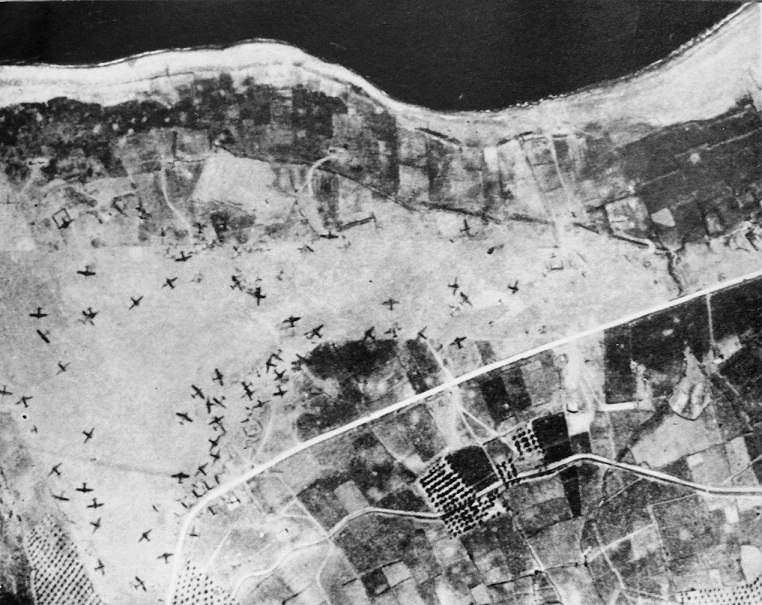
The wrecked transports at Maleme testify to the cost of using the airfield. Losses did not prevent the air bridge from working: each successful arrival brought men or supplies that the original airborne force could not have carried. Counterattacks failed to restore the Allied position, and resistance farther east could delay the expanding German force without closing its route onto the island.
Victory at a price
The Allied withdrawal turned towards the south coast, over the island’s difficult interior. Men who had escaped from Greece only weeks earlier were again moving towards ships, often exhausted and short of equipment. The Royal Navy carried thousands away under air attack, losing vessels and men in the effort. Others reached the coast too late or remained to become prisoners.
Cretan resistance should not be reduced to a picturesque detail beside the airborne operation. Civilians had fought during the invasion and suffered brutal German reprisals afterwards. Occupation extended the consequences of the battle into villages and households. The end of the twelve-day campaign was a military boundary, not the end of the island’s ordeal.
Germany captured Crete, but its airborne forces paid heavily. The operation demonstrated what air transport could make possible while exposing the vulnerability of men descending into prepared defences. Hitler became reluctant to risk another airborne assault on a comparable scale; German parachute formations would subsequently spend much of the war fighting as ground troops.
The Allies drew a different lesson from the same event. Airborne forces could seize important ground behind an enemy line, provided the force could be concentrated, supplied and linked with other operations. Crete therefore belongs in the history of later airborne campaigns as both an example and a warning.
Its turning point was not simply a dramatic descent beneath parachutes. It was the moment control of one airfield allowed isolated attackers to become an army that could be reinforced.
Photographic credits and rights are given with each image. Wikipedia overview linked above is available under CC BY-SA.