

Del Prado · Peninsular War · 1812
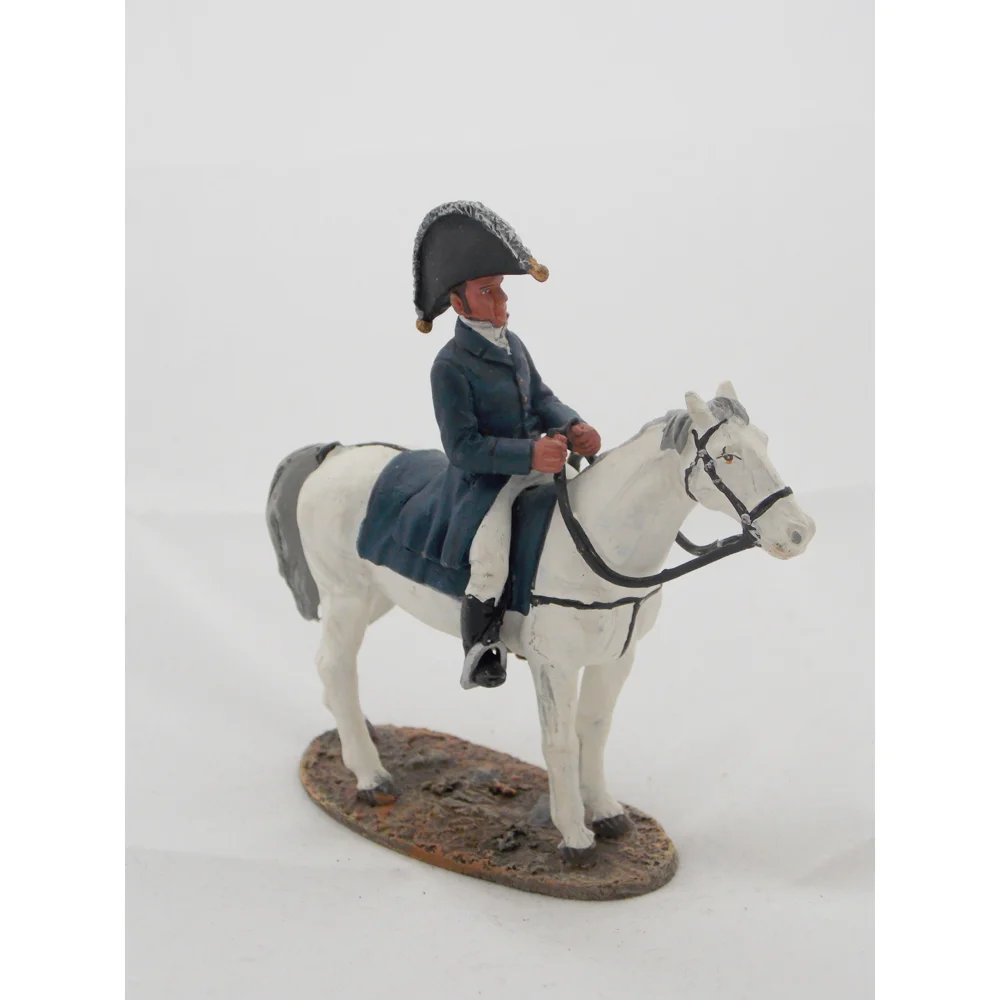
The plain coat and quiet grey horse make a restrained portrait of Wellington. The 1812 date points toward Salamanca, where he showed that patience could prepare the way for a sudden attack.
- Maker
- Del Prado
- Subject
- Wellington on Horseback, 1812
- Setting
- Peninsular War · 1812
- Type
- Painted metal mounted figure
There is little of Murat’s conspicuous decoration here. Wellington sits in a long, subdued coat beneath a bicorne, the horse providing the main contrast in tone. The sculpt’s calm character makes it suitable for a commander whose reputation is often associated with careful observation.
When the opponent overextended
At Salamanca on 22 July 1812, Marshal Marmont misread Wellington’s movements and extended his forces. Wellington recognised the opening and attacked. The National Army Museum’s battle account describes the rapid blows against the French left and the cavalry’s contribution to the defeat.
The victory challenges the shorthand description of Wellington as simply a defensive commander. Choosing when not to attack could make the eventual attack more effective. That is a useful story to place beside a miniature whose pose contains no obvious action.
The familiar title “Duke of Wellington” is commonly used for the figure, although the dukedom came later, in 1814. Keeping the article’s subject as Wellington in 1812 avoids implying he already held every later honour.
The pale horse should likewise not automatically be identified as Copenhagen. A grey painted mount does not justify attaching the name of Wellington’s famous Waterloo horse. The catalog photograph is evidence for the miniature’s appearance, not for an individual animal’s biography.
A commander among the cavalry
Set beside a trumpeter and a trooper, Wellington can become part of a small study of command, communication and execution. The figures do not need to represent the same instant for that comparison to be useful; a clear label can distinguish an illustrative grouping from a reconstructed scene.
The bicorne edges, reins and horse’s ears are the details to inspect before purchase. The plain coat makes thick overpainting easy to notice if a photograph is well lit.
The model’s restraint is its strength. It invites the story of the decision before the movement—a good fit for Salamanca, where recognising the moment mattered as much as possessing troops capable of exploiting it.
References and further reading
- National Army Museum — The Battle of Salamanca
- National Army Museum — The Peninsular War
- Planète Légendaire — figure reference
- Génie Miniature — Del Prado identification index
The photograph identifies the model; condition and packaging vary between examples offered for sale.