

Del Prado · Figure study
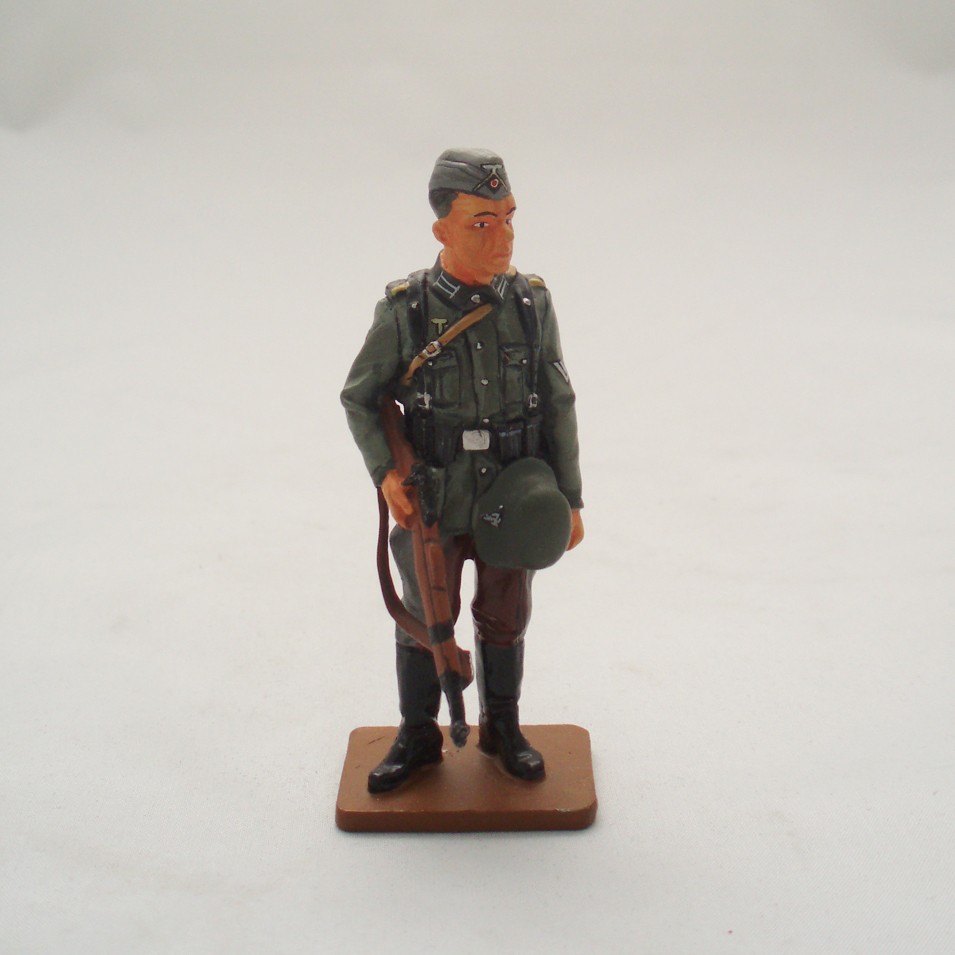
A helmet carried at the side changes this figure’s character. The soft cap, tall boots and slung rifle suggest a pause between tasks, making the Del Prado cavalry reconnaissance subject useful for scenes away from the firing line.
What the photograph actually shows
The figure stands on a reddish rectangular base. His head turns to one side, a rifle runs down the opposite side of the body, and the carried helmet forms a large rounded shape beside the thigh. The tunic, breeches and boots have distinct painted tones. Those features make a practical comparison list when a seller’s photograph is small or poorly lit.
The subject is cataloged as “Obergefreiter, Cavalry Reconnaissance, Germany, 1941.” That identifies the intended rank, branch and period. It does not identify a named soldier, establish a particular patrol route or prove that every visible piece of equipment belongs to a specific regiment.
Reconnaissance was not just an armoured-car job
The US Intelligence Bulletin’s March 1946 account of German horse cavalry and transport describes a wartime mixture of mounted, bicycle and mechanized elements. It also records renewed use of independent cavalry units late in the war. Mechanization did not simply remove horses from the German army in 1941.
Read this as a contemporary intelligence source about the wider organization, rather than evidence for the miniature’s exact unit. Its useful contribution is the mixed picture: different forms of mobility coexisted. The figure can introduce that subject without requiring a horse on the same base.
A better scene than another firing line
A road junction with a signpost, a vehicle halt or a map table gives the turned head a purpose. Position a second figure where he appears to be looking. Leave the helmet visible; a wall or vehicle placed tightly against that side hides the detail that distinguishes the pose.
Use an unoccupied patch of ground around the figure rather than filling every gap. In this case empty display space reads as a pause in movement. A label naming the subject and date keeps the scene grounded without inventing dialogue or a battle association.
Condition checks specific to this pose
- Look along the rifle and sling from both sides. A projecting part can be bent or repaired without being obvious in a frontal view.
- Compare the helmet’s outline and its attachment near the hand.
- Check the cap edges, boot toes and corners of the base for exposed metal.
- Request a base inscription and packaging photograph before accepting a seller’s issue number. A stock photograph cannot confirm the condition of the example being sold.
Buying it as a reference figure
The strongest reason to add this subject is the contrast with helmets-on combat poses. It offers a view of dress and carried equipment that can be harder to read on a crouching or firing miniature. Compare it with the Del Prado Blenheim cavalryman to explore how the idea of cavalry changed across the publisher’s different collections.