

Del Prado · Figure study
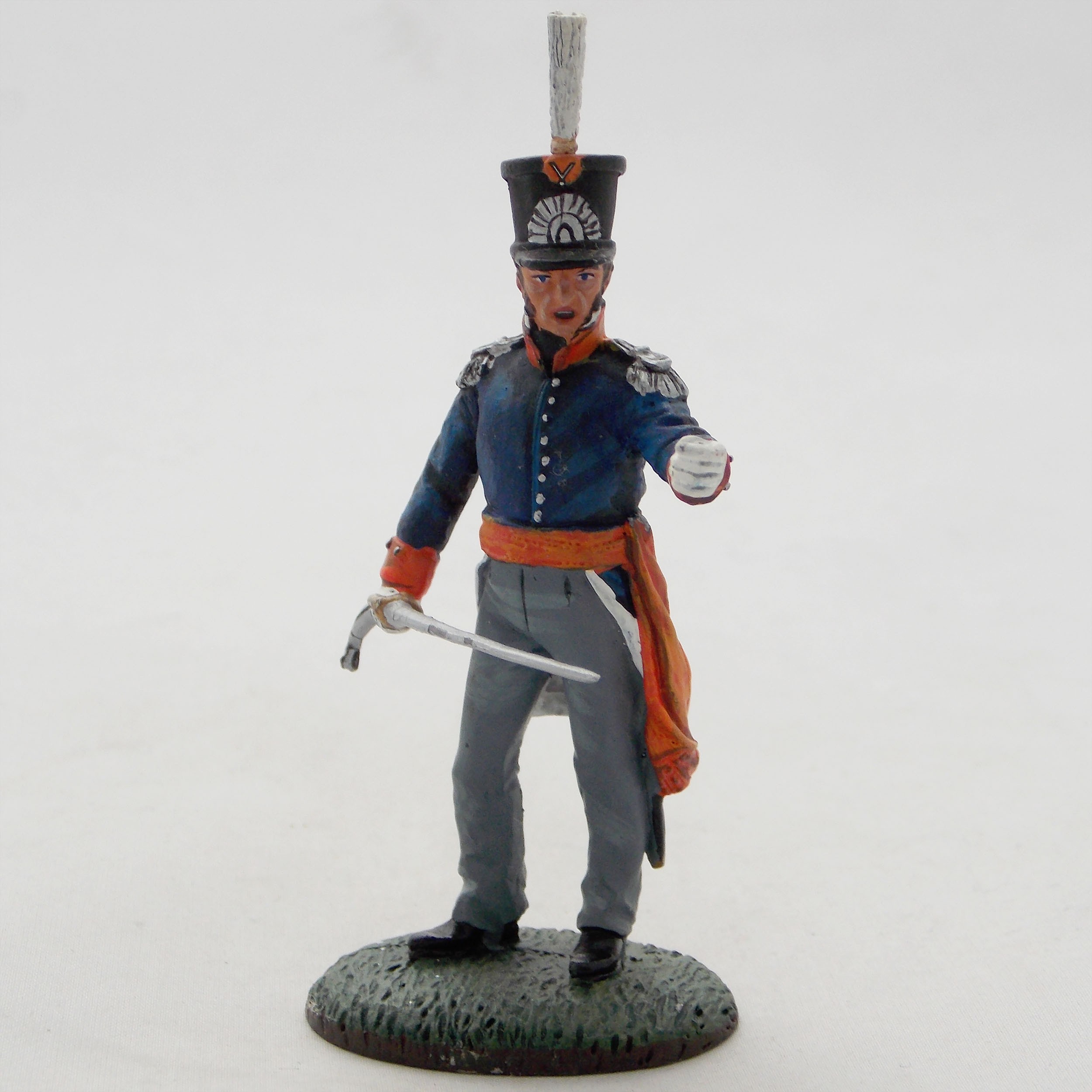
The orange sash is the first thing to notice; the outstretched gloved hand is the second. Del Prado’s Dutch militia field officer is a command figure on foot, with enough movement to direct a small group without needing a horse or a large scenic base.
Identifying the model
The reference photograph shows a dark blue coat, grey trousers, a tall shako with a pale plume and a drawn sabre held across the body. The orange sash falls down one side, balancing the extended arm on the other. The oval base has a textured green-grey surface.
The LastDodo collector catalog records “Field Officer, Dutch Militia, 1815” as NA087. Treat this as a useful catalog cross-reference. For a purchase, confirm the actual base and packaging rather than relying solely on the code copied into a listing.
The Dutch contribution to 1815
Waterloo was a coalition victory. The National Army Museum’s battle account describes Wellington’s multinational army and the arrival of the Prussians on 18 June. A collection containing only British and French figures leaves out part of that story.
Dutch militia should not be dismissed as a purely garrison force. The Dutch Ministry of Defence’s account of Evert de Niet records his service in a militia battalion and participation at Waterloo. That is a specific historical example; it does not make the Del Prado officer a portrait of de Niet, who was a fusilier.
The miniature’s label supplies an army, role and date. It does not establish this officer’s battalion or place him at a particular part of the battlefield. Keep that distinction when writing a display caption.
Use the gesture to organize the display
The pointing hand creates a direction. Place the men being addressed in front of that hand, and angle the officer slightly toward them. The result reads as an instruction being given, rather than a row of unrelated figures facing the viewer.
A low viewpoint makes the sash and sabre visible. A tall wall or dense group immediately in front of the officer obscures both. An open position behind a few infantry figures suits the model better than burying it in a massed formation.
The fragile details are part of the appeal
Check the plume from the front and side, the extended fingers, the sabre blade and guard, and the lower end of the sash. These details project from the body. Ask whether anything has been straightened, glued or repainted, and inspect the junctions rather than judging the overall shine of the photograph.
For mixed-manufacturer displays, compare the officer’s height to eye level and the thickness of the base. “Napoleonic” describes the subject; it does not guarantee a physical match with every other Napoleonic range.
A useful counterpoint to the Old Guard
Pair the article with the Old Guard grenadier sergeant study to compare command gestures and national dress. Keep the dates separate: an 1812 label and an 1815 label describe different moments, even when both figures belong on a broader Napoleonic shelf.