

Del Prado · Israel · October War · 1973
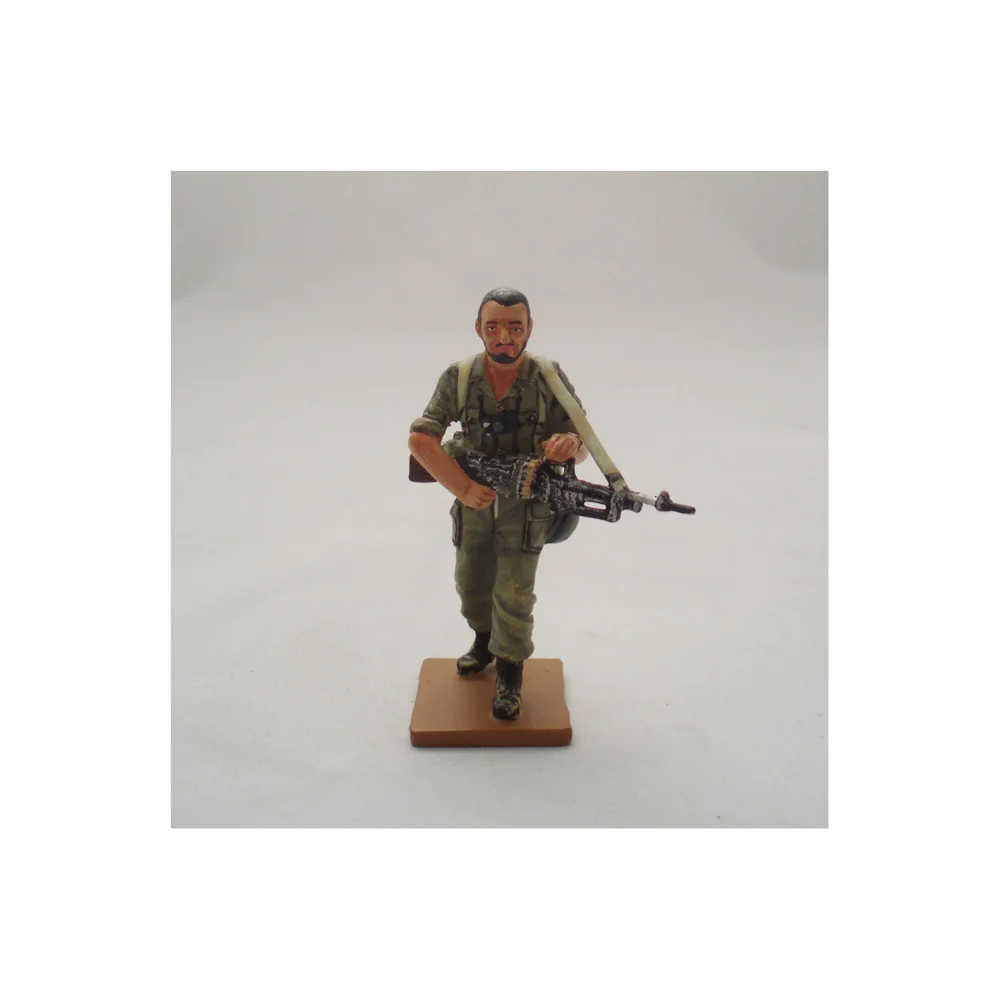
A machine gun, short sleeves and a forward-moving stance give this figure a different presence from Del Prado’s formal uniform portraits. The 1973 date places him in a conflict often remembered through tanks, although the fighting was never only an armoured contest.
- Maker
- Del Prado
- Subject
- Israeli Infantryman, 1973
- Setting
- Israel · October War · 1973
- Type
- Painted metal figure
The weapon stretches across the front of the figure and carries much of the composition. Its projecting barrel and folded support contrast with the compact equipment around the waist. With no helmet on the head to dominate the silhouette, the eye goes first to the gun and then to the soldier carrying it.
October, not June
Egypt and Syria attacked Israeli positions on 6 October 1973, opening the war known as the Yom Kippur War or October War. Fighting developed on the Sinai and Golan fronts. The US Office of the Historian describes both the military crisis and the international diplomacy surrounding it.
The date distinguishes this miniature from the Six-Day War of 1967. Those conflicts should not be treated as one interchangeable desert campaign. For a collector, a clear year on the label is a small intervention that prevents a large historical blur.
The machine-gun subject also changes the emphasis of a display. Put beside an armoured vehicle, he draws attention back to the men who fought on the ground around it. Put beside another infantry figure, the long weapon makes a useful comparison with the much smaller silhouette of an ordinary rifle. The sculpt does not establish a named unit or a particular engagement, so neither is assigned here.
The figure’s strongest visual detail
Follow the line of the weapon from the hands to the muzzle. The projecting parts are essential to the pose, and they are also the parts most easily bent or lost on an unboxed example.
The miniature is more persuasive when its equipment can be seen clearly. Leave space beside it rather than crowding another figure against the barrel. A low, uncluttered display lets the relationship between hands, weapon and body remain readable; tall scenery immediately behind the gun can make those details disappear.
Buying from the photograph
A seller’s frontal view may conceal a bent barrel because the damage runs toward or away from the lens. A second angle is particularly useful here. Inspect the support beneath the weapon, the hands and the contact points at the base, then compare the pose with the reference image above.
This is a strong addition to a postwar grouping because its subject is immediately different from a dress-uniform officer. Keep the historical caption specific and the presentation simple, and the figure provides a clear entry into the collection’s 1970s chapter.
References and further reading
- US Office of the Historian — The Arab-Israeli War of 1973
- Planète Légendaire — figure reference
- Génie Miniature — Del Prado identification index
The photograph identifies the model; condition and packaging vary between examples offered for sale.