

Del Prado · Vietnam · 1975
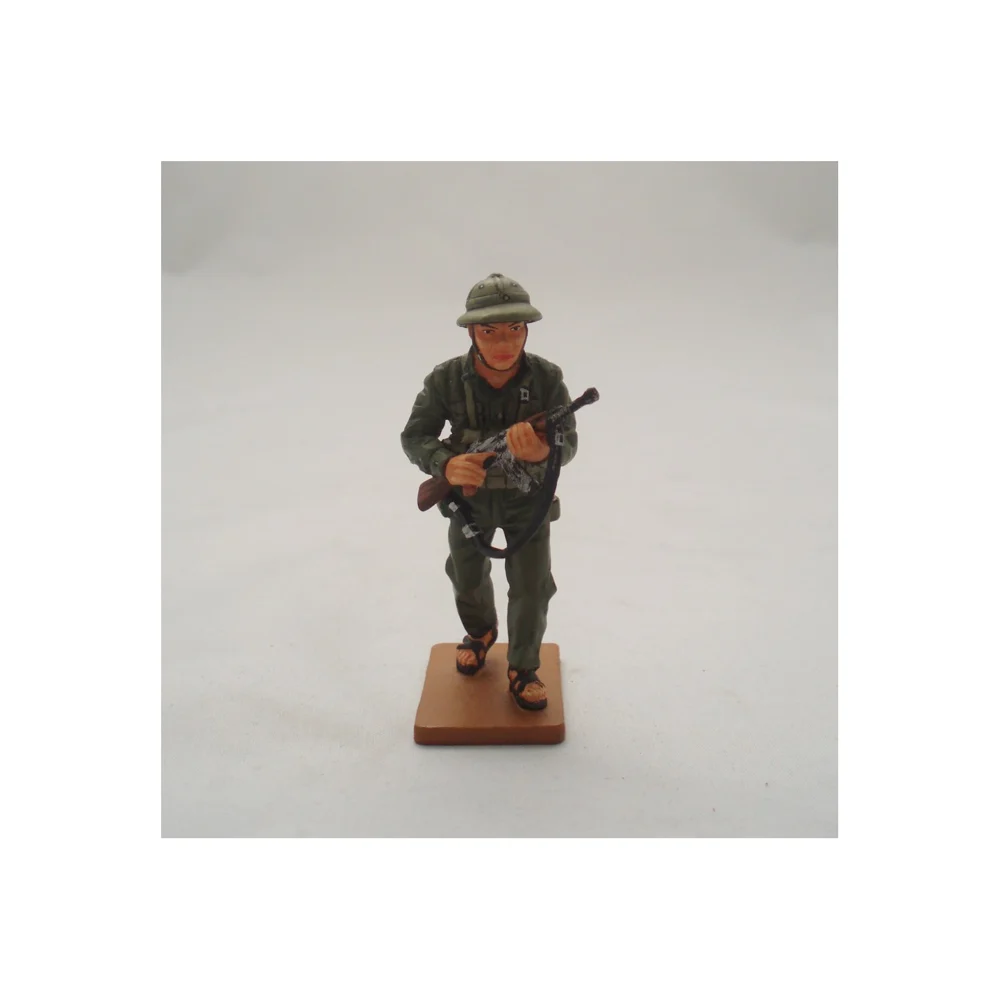
The pith helmet and rifle identify a regular soldier in Del Prado’s late-war Vietnam subject. The date is the key: 1975 belongs to the final campaign, two years after the agreement that ended direct American military involvement.
- Maker
- Del Prado
- Subject
- North Vietnamese Army Soldier, 1975
- Setting
- Vietnam · 1975
- Type
- Painted metal figure
The figure is compact and purposeful. The rifle crosses the body, the helmet gives the head a broad outline, and the equipment remains close to the uniform. There is little theatrical motion. It is the sort of miniature whose meaning depends on retaining its full identification rather than reducing it to “Vietnam soldier.”
1973 did not end the fighting
The Paris settlement and American withdrawal in 1973 did not produce a lasting peace between North and South Vietnam. The final offensive came in 1975. Saigon fell on 30 April, following the American evacuation; formal reunification followed in 1976. The US National Archives’ account of the fall of Saigon provides the immediate setting for the war’s end.
Those separate dates are useful on a shelf. They prevent the American departure, the end of the fighting and the creation of a unified state from being compressed into a single event. They also explain why a figure dated 1975 belongs in a Vietnam collection even when most of the other subjects represent American service in the 1960s.
The model’s uniform and equipment are best treated as a reference portrait, not proof that this individual participated in a particular photographed moment in Saigon. The date supplies a historical frame, but the miniature is not identified as a named soldier.
Visually, the pith helmet offers a strong contrast with the American boonie hat of Del Prado’s 1971 airborne sergeant. Pairing those two figures makes differences in headwear and carried equipment immediately accessible. Keep their dates visible, however: a comparison of figures is not necessarily a reconstruction of two men meeting in the same action.
Check the weapon before the paintwork
The rifle crosses several parts of the body, which can make a repair blend into a frontal photograph. Request a side view of the barrel, stock and hands. Then inspect the helmet rim and the junction between the legs and base. These checks are more useful than relying on an auction title’s broad claim of “excellent condition.”
This piece gives the Vietnam grouping an ending that American subjects alone cannot supply. Its strongest contribution is historical breadth: the final campaign seen through a soldier of the army that continued fighting after the United States had left.
References and further reading
- US National Archives — The Fall of Saigon
- US Office of the Historian — Vietnam
- Planète Légendaire — figure reference
- Génie Miniature — Del Prado identification index
The photograph identifies the model; condition and packaging vary between examples offered for sale.