

Del Prado · French Indochina · 1952
The red beret and camouflage are familiar, but the year is easy to overlook. This Del Prado colonial paratrooper belongs to 1952, when the experience of an air-supplied position at Na San still lay ahead of the catastrophe at Dien Bien Phu.
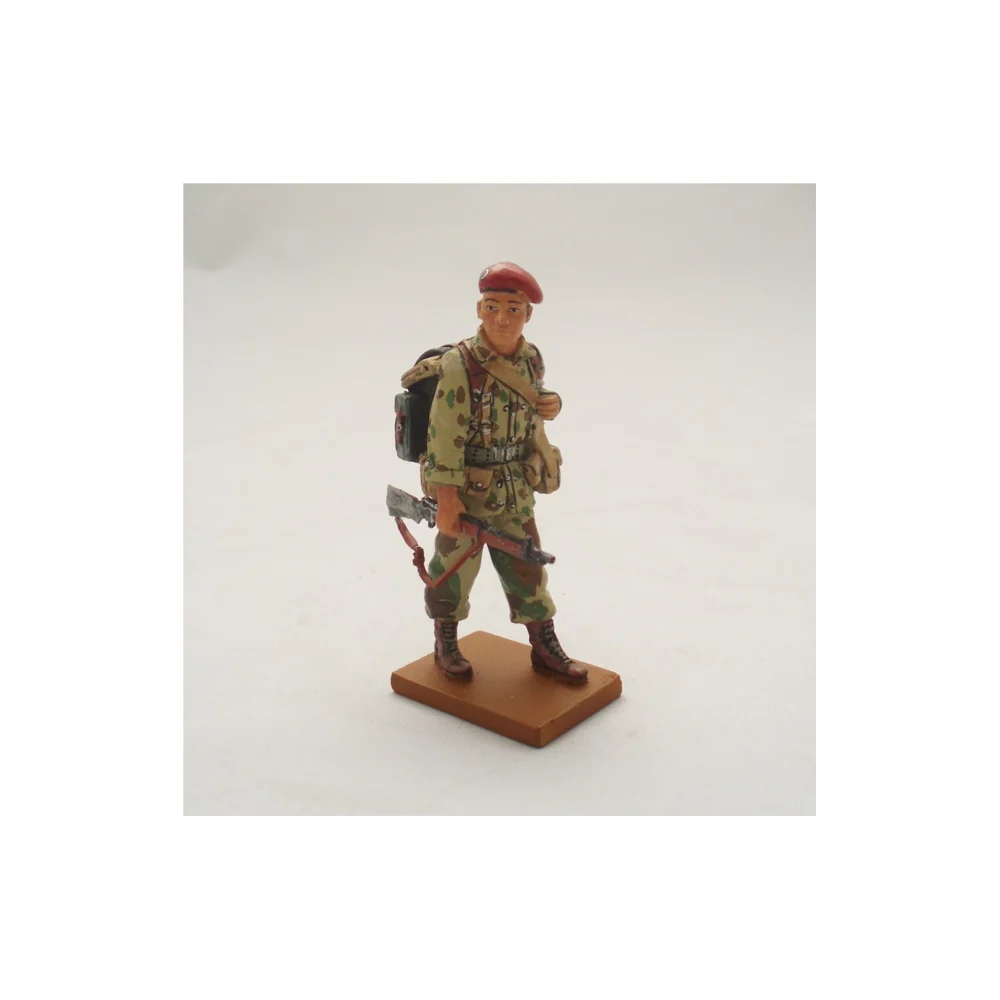
- Maker
- Del Prado
- Subject
- French Colonial Paratrooper, Indochina 1952
- Setting
- French Indochina · 1952
- Type
- Painted metal figure
There is a deliberate asymmetry to the pose. The head and bright beret sit above a patterned uniform, while the weapon extends downward beside the legs. It is a figure that reads well in isolation: the headwear supplies the focus and the camouflage gives the larger surfaces their texture.
The reference describes a soldier of a BPC, a bataillon de parachutistes coloniaux. That identifies a type of formation, not a specific numbered battalion. The distinction is worth keeping when the subject is placed among better-known named units.
The lesson of Na San
The First Indochina War grew out of the struggle over French colonial rule and Vietnamese independence. In 1952, French forces established an air-supplied defensive position at Na San. Its apparent success helped shape the thinking that later produced another remote fortified position at Dien Bien Phu. The French Ministry of Armed Forces’ historical account treats Na San as an important predecessor, not the same battle under a different name.
That connection gives the miniature its most interesting context. A 1952 soldier cannot be understood only through the outcome of 1954. At the earlier date, the later disaster had not happened; decisions were being made from experience that seemed to offer a workable answer. A display arranged chronologically can make that uncertainty visible in a way that a single “Indochina” label cannot.
Camouflage is particularly useful for comparing examples. Look for the pattern continuing coherently across the jacket and trousers, rather than large repainted patches obscuring the folds. The beret’s edge and the weapon are more exposed than the torso. A loose figure may still be attractive with minor base wear, but missing equipment changes its outline.
For a collection, the piece provides a link between wartime airborne subjects and the conflicts that followed 1945. It also asks for a different historical caption. The setting is a colonial war with competing political aims, not an extension of the liberation campaigns in western Europe.
Give it room beside a dated label and, if possible, a map reference to northern Indochina. That simple context is more informative than surrounding it with an assortment of Vietnam-era figures from several different decades.
References and further reading
- Chemins de mémoire — Dien Bien Phu and the precedent of Na San
- Planète Légendaire — figure reference
- Génie Miniature — Del Prado identification index
The photograph identifies the model; condition and packaging vary between examples offered for sale.