

Del Prado · France · 1814
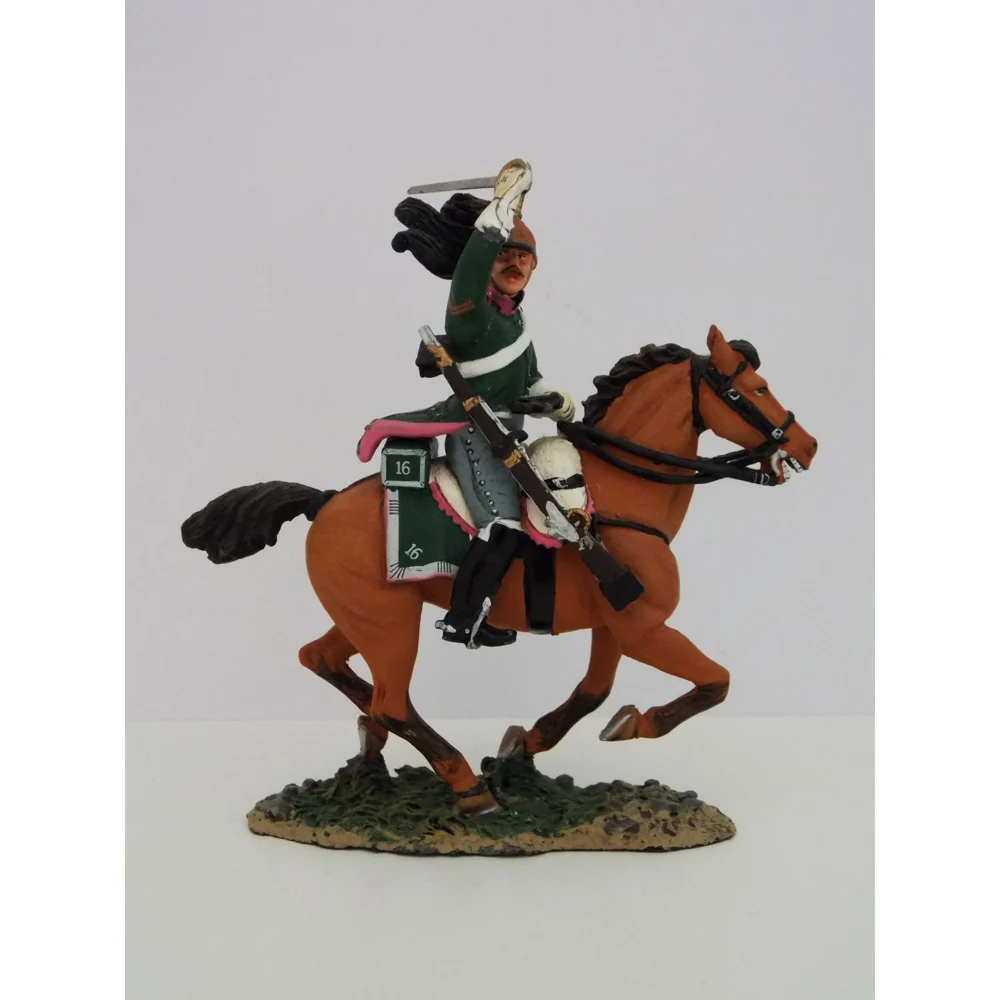
The green coat and raised sword suggest confidence. The date tells a harder story: in 1814, Napoleon’s army was defending France after the losses of Russia and Germany.
- Maker
- Del Prado
- Subject
- French 16th Dragoon, 1814
- Setting
- France · 1814
- Type
- Painted metal mounted figure
The horse moves forward with one foreleg raised, while the rider lifts his blade above the helmet. Green clothing and saddle furniture tie the two halves of the miniature together. It is an energetic sculpt, but its energy should not be confused with an uncomplicated moment of imperial success.
The war had come home
The 1814 campaign followed the collapse of Napoleon’s position in Germany. Allied armies entered France, and the surviving imperial forces fought a series of actions before the emperor’s abdication. The Fondation Napoléon’s study of the army’s late-war burden describes the exhaustion and disorganisation that shaped this final defence.
The 16th Dragoons figure represents a line-cavalry subject rather than a member of the Imperial Guard. That distinction is worth preserving. A display of late imperial France can otherwise become dominated by Guard uniforms and famous commanders, leaving ordinary numbered regiments almost invisible.
Dragoons had evolved from troops who used horses principally for mobility into conventional cavalry. By the Napoleonic period the name did not mean that a rider was merely an infantryman waiting to dismount. The horse, helmet and drawn sword make that mounted identity clear here.
The raised weapon and advancing horse make a good contrast with the stationary Prussian dragoon in the catalog. Comparing them reveals two ways of presenting cavalry: one emphasises action, the other the uniform. Both benefit from retaining the exact national and regimental title.
Check the moving parts of the composition
The blade, horse’s ears and lifted foreleg are the most exposed features. A side view should show the sword’s full length and the rider’s seat. Examine the green paint around the belt and cuffs as well; heavy retouching can blur those small divisions.
This figure is useful because it puts an ordinary cavalry regiment into the final campaign, where the story is not simply the last appearance of Napoleon and his marshals.
References and further reading
- Fondation Napoléon — The Imperial Guard as an instrument of war, including 1814
- National Army Museum — Cavalry roles
- Planète Légendaire — figure reference
- Génie Miniature — Del Prado identification index
The photograph identifies the model; condition and packaging vary between examples offered for sale.