

Del Prado · Seventeenth century · Republic of Venice
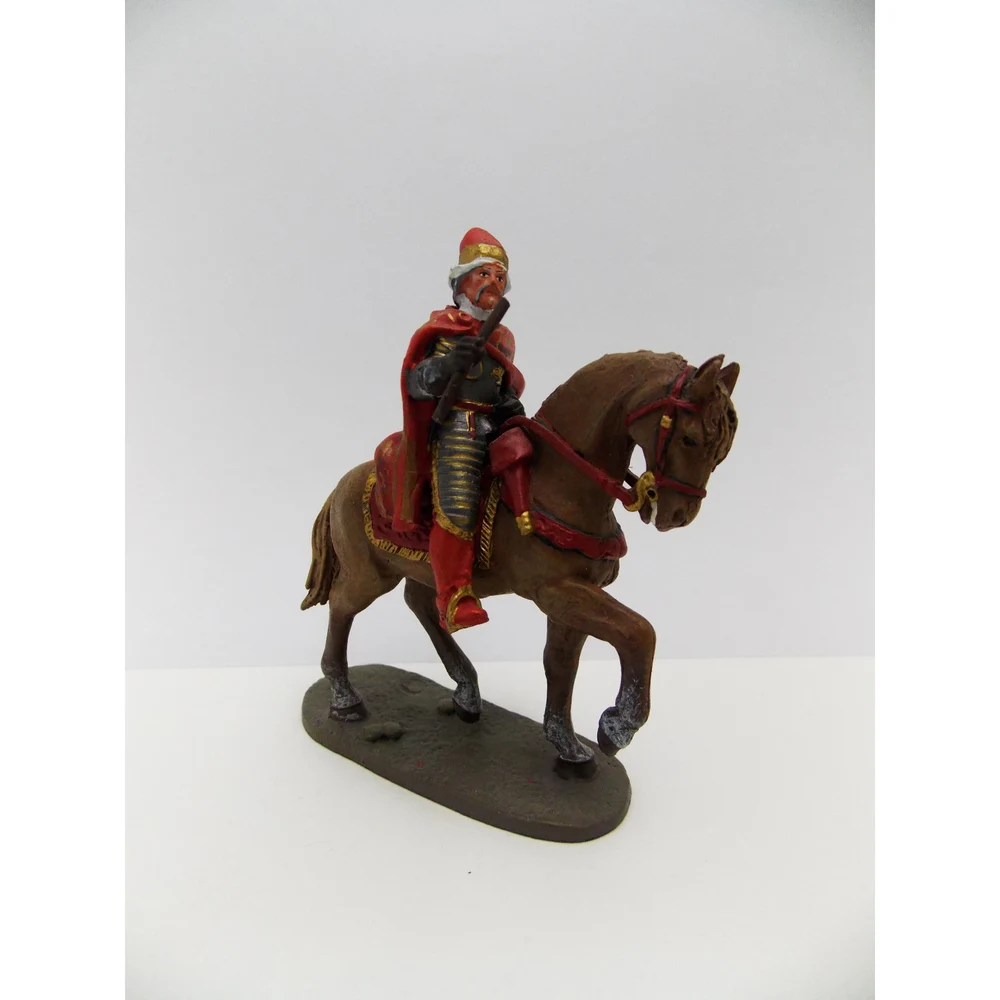
Red clothing, armour and a walking horse make Morosini an imposing mounted portrait. Del Prado’s cavalry series includes this Venetian naval commander and doge, showing how a mounted figure can represent status as well as battlefield service.
- Maker
- Del Prado
- Subject
- Francesco Morosini on Horseback
- Setting
- Seventeenth century · Republic of Venice
- Type
- Painted metal mounted figure
The commander and the doge
Francesco Morosini lived from 1619 to 1694 and became Doge of Venice in 1688. His military career included campaigns against the Ottoman Empire and the conquest of much of the Peloponnese. Museo Correr’s exhibition on his life places military documents, weapons and naval material around that career.
The dates in the dealer title are his lifespan, not a precise date for the miniature’s costume. A collection label should make that distinction. The mounted portrait belongs broadly to his seventeenth-century world without requiring an invented year or battle.
Armour and red cloth above the saddle
The photograph shows Morosini in metal-coloured armour with prominent red clothing and decorated headgear. His brown horse steps forward with one foreleg lifted. The rider remains upright, creating a composed portrait rather than the exaggerated movement of a cavalry charge.
Look at the outline of the upper body and the distribution of red fabric when comparing examples. Those features distinguish the figure from a generic cuirassier. The horse’s stance and the shape of the saddle furniture are equally important to identifying a complete matching model.
Checking rider and horse together
Inspect the headgear, hands and edges of the armour, then check the horse’s ears, raised leg and tail. Ask for the far side of the model as well as its more photogenic side. A repair hidden by the rider’s clothing can disappear in a single frontal image.
The red areas and metallic paint make this a strong centrepiece for a seventeenth-century group. Leave space around the horse’s head so its downward angle remains readable beside taller cavalry poses.
A Venetian sailor from the medieval series offers a thematic link across time, provided the centuries are clearly separated on the labels. The comparison can introduce Venice as a maritime power through two very different people. Photograph Morosini from slightly below the rider’s chest to retain the horse’s proportions and avoid letting the decorated headgear dominate the entire composition.
References and further reading
- Museo Correr — Francesco Morosini
- Mokarex — Del Prado History of Cavalry identification index
- Planète Légendaire — figure reference
- Génie Miniature — Del Prado identification index
The photograph identifies the model; condition and packaging vary between examples offered for sale.