

Del Prado · English Civil War · 1640s
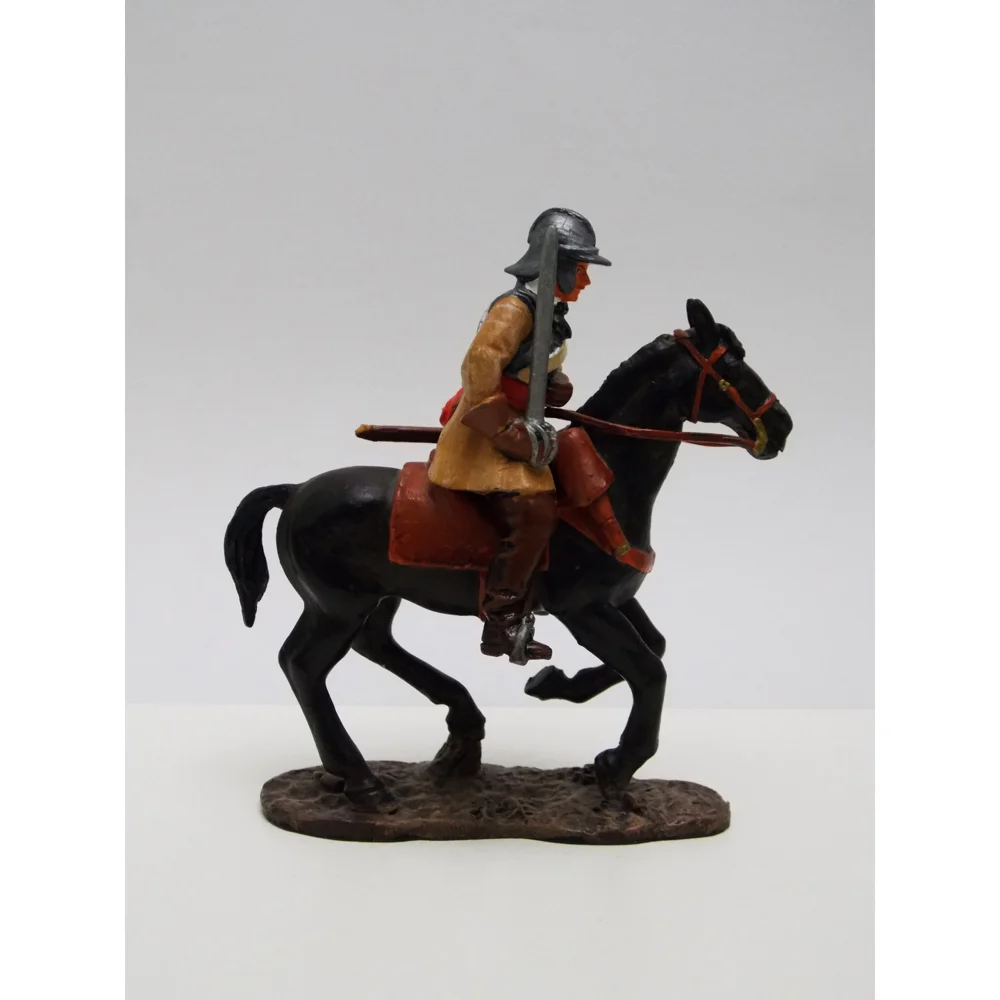
Helmet, armour and a practical coat give this horseman a compact, workmanlike appearance. The story behind the Ironsides is not simply religious conviction or a severe expression, but the ability to remain a useful force after action began.
- Maker
- Del Prado
- Subject
- Cromwell’s Ironside
- Setting
- English Civil War · 1640s
- Type
- Painted metal mounted figure
The rider’s helmet and metallic body protection stand above a dark horse. His sword extends beside and behind him rather than rising into a grand gesture. Compared with the mounted Rupert, the figure feels contained, though a sculpt’s mood should never be mistaken for a complete explanation of an army’s character.
Equipment was shared across the divide
The Cromwell Museum’s guide to soldiers explains practical cavalry equipment such as buff coats, armour and helmets. These items were not a simple party badge. Similar protection could be found on both sides of the Civil War.
That is a useful starting point for this model. A helmet does not make a man Parliamentarian by itself, just as flowing hair does not establish a Royalist. The figure’s identification comes from its stated subject, while its equipment belongs to a wider military world.
Cromwell began the war with a cavalry troop and rose to command the horse of the New Model Army under Fairfax. The museum’s account of his military career helps distinguish that progression from the misleading image of him commanding the entire army from the outset.
The quieter pose gives the collector room to discuss organisation rather than only the moment of impact. Mounted troops had to act as a body, respond to orders and remain available after an encounter. A rider who appears controlled can introduce that subject without claiming to illustrate a documented drill.
Place the figure beside Rupert with both names visible and the pair becomes an opening into a complicated war. Avoid turning the contrast into a costume shorthand in which one side was colourful and the other uniformly plain. Real equipment and personal circumstances were less tidy.
Inspect the helmet edges and sword in listing photographs. The blade’s lower position makes it easy to lose against the horse. Armour should retain its shape beneath the paint; a thick metallic repaint can hide surface damage.
The miniature is most rewarding when the familiar nickname leads to questions about the men and organisation behind it.
References and further reading
- Cromwell Museum — Soldiers and equipment
- Cromwell Museum — Cromwell as a soldier
- Planète Légendaire — figure reference
- Génie Miniature — Del Prado identification index
The photograph identifies the model; condition and packaging vary between examples offered for sale.