

Del Prado · British India · 1888
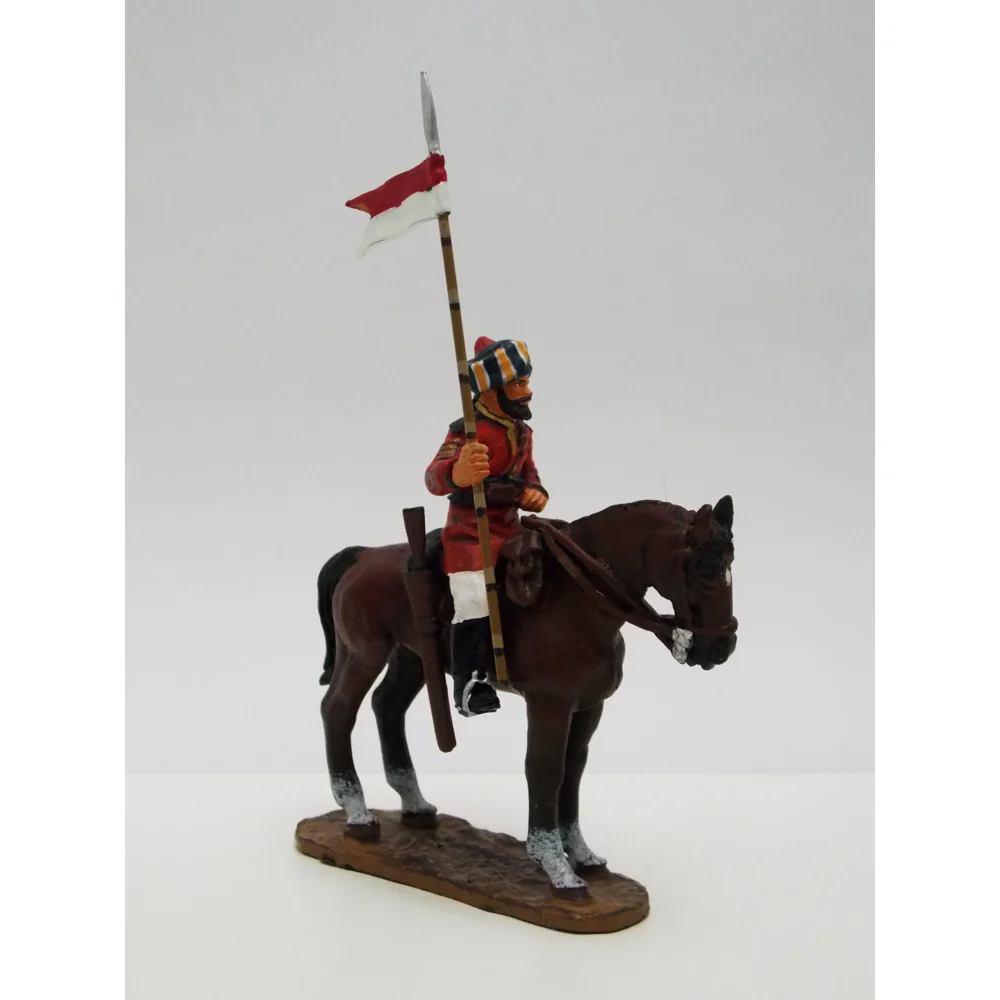
The long lance and turban make an immediate visual statement. The name “Bengal Lancer” needs more care: it describes a military setting, not one uniform shared by every rider or a modern national boundary.
- Maker
- Del Prado
- Subject
- Bengal Lancer, 1888
- Setting
- British India · 1888
- Type
- Painted metal mounted figure
The dark horse creates a strong background for the rider and the tall lance. A red-and-white pennant supplies the brightest movement in the upper part of the figure. The vertical weapon makes the sculpt look taller than many other mounted subjects even though the horse remains the foundation of the composition.
A broad name, a specific date
The 1888 setting belongs to British India. “Bengal” in a cavalry title should not be read as a straightforward statement that the rider came from the territory of present-day Bangladesh. Military institutions, recruitment and administrative geography do not map neatly onto modern borders.
The National Army Museum’s collection includes an image titled “Indian Troops. Bengal Lancers”. Such contemporary and later representations are useful for comparison, but a broad caption does not supply the missing regimental number for this miniature.
That is why this entry retains Del Prado’s general subject rather than assigning a more impressive-sounding regiment. The turban, lance and colour arrangement identify the model visually; they are not sufficient evidence for an individual soldier’s service history.
The model also offers a contrast with the British 21st Lancer dated 1898. Both carry the weapon that gives the cavalry type its name, but the uniforms and institutional backgrounds differ. “Lancer” describes an arm and tradition, not one nationality.
The ten-year gap between the two figures should remain visible in a display caption. A comparative shelf can bring them together without implying they belonged to the same regiment or shared the same campaign.
For collecting, examine the full lance for a shortened tip, a bend or a repair at the hand. The pennant’s edges are another vulnerable point. A photograph of the back can reveal the costume more clearly than a front view dominated by the weapon.
This rider is a strong visual addition, but its most useful catalog feature is restraint: a clear date, an honest subject name and a photograph that lets another collector identify the same miniature without invented particulars.
References and further reading
- National Army Museum — Indian Troops: Bengal Lancers
- Planète Légendaire — figure reference
- Génie Miniature — Del Prado identification index
The photograph identifies the model; condition and packaging vary between examples offered for sale.