

Del Prado · Holy Roman Empire · circa 1175
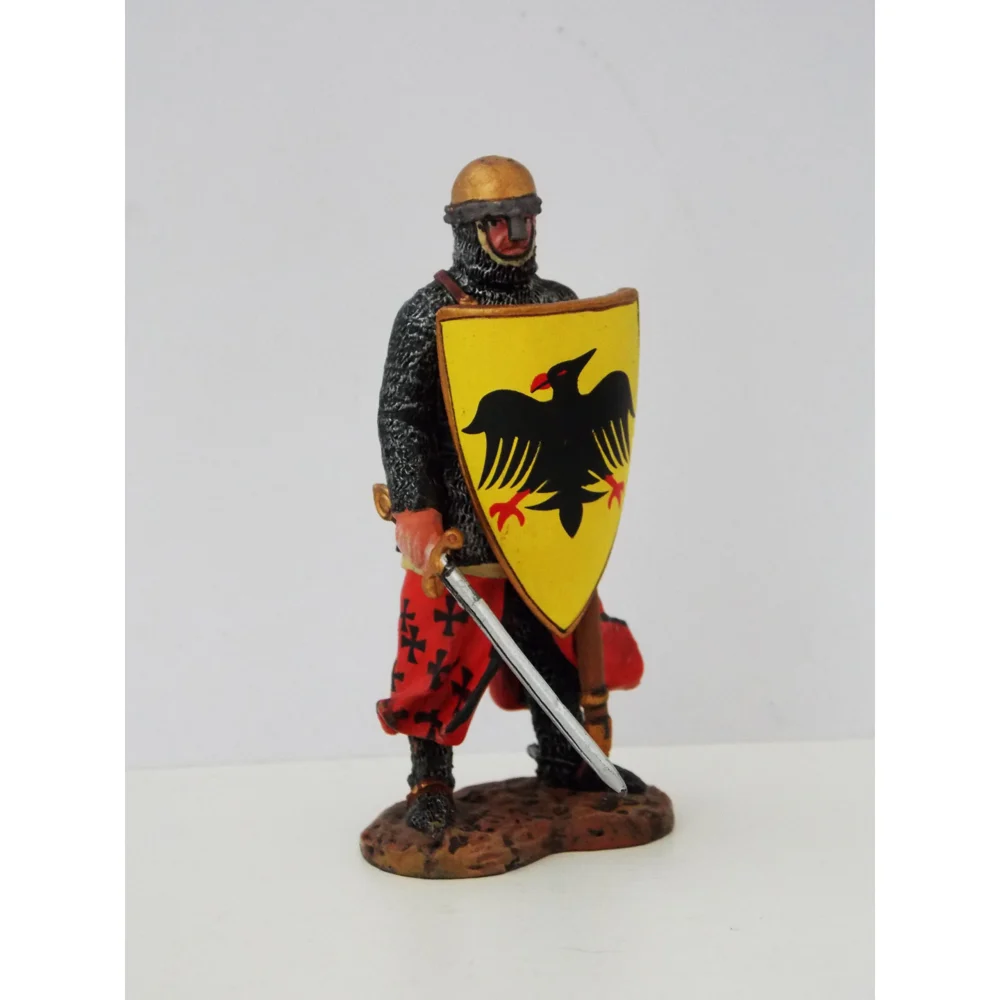
The eagle shield makes the imperial identity immediate, but the date puts this Barbarossa before his most famous crusading episode. Around 1175, his struggle was in Italy, where imperial ambition met the resistance of the Lombard cities.
- Maker
- Del Prado
- Subject
- Frederick Barbarossa, circa 1175
- Setting
- Holy Roman Empire · circa 1175
- Type
- Painted metal figure
The yellow shield is the visual centre of the miniature. Its black eagle sits against a bright field, balanced by the mail covering the body and the sword held point-down. Red cloth adds another strong colour. It is a deliberately legible portrait of authority, not a reconstruction of an identifiable instant in battle.
The emperor and the cities
Frederick I became emperor in 1155. His efforts to enforce imperial authority in northern Italy brought him into repeated conflict with the cities there. Around the figure’s date, the unsuccessful siege of Alessandria in 1174–75 preceded the defeat at Legnano in 1176. Treccani’s historical entry places those events within the larger struggle.
That sequence gives the model a sharper setting than “medieval emperor.” The famous later crusade and Frederick’s death in 1190 were still in the future. A figure labelled circa 1175 belongs to an earlier phase of his career, when the contest with the Italian cities remained unresolved.
Mail rather than a suit of plate
The armour provides another way to locate the subject in time. Mail covers the figure rather than the fully enclosing plate armour associated with later medieval knights. The Metropolitan Museum of Art’s discussion of mail explains its long importance in European armour before plate protection became more extensive.
Del Prado makes that surface readable through repeated texture. The shield and coloured cloth interrupt it, preventing the figure from becoming one continuous metallic shape. The heraldic presentation helps identify the intended ruler, but it should not be mistaken for proof of his exact appearance or equipment on a particular day.
For display, turn the miniature enough to show both the shield face and the sword. A strictly frontal line-up can let the shield conceal much of the body. The small adjustment reveals why the sculpt works: bright heraldry in front, armour behind, and the sword completing the vertical line.
Inspect the sword tip, shield edge and projecting helmet details before buying. The textured mail can disguise minor surface wear, but a damaged shield changes the figure’s strongest feature. This is a compact imperial portrait with a useful historical tension: an image of authority placed at a moment when that authority was being contested.
References and further reading
- Treccani — Frederick I Barbarossa
- Metropolitan Museum of Art — Mail armour
- Planète Légendaire — figure reference
- Génie Miniature — Del Prado identification index
The photograph identifies the model; condition and packaging vary between examples offered for sale.