

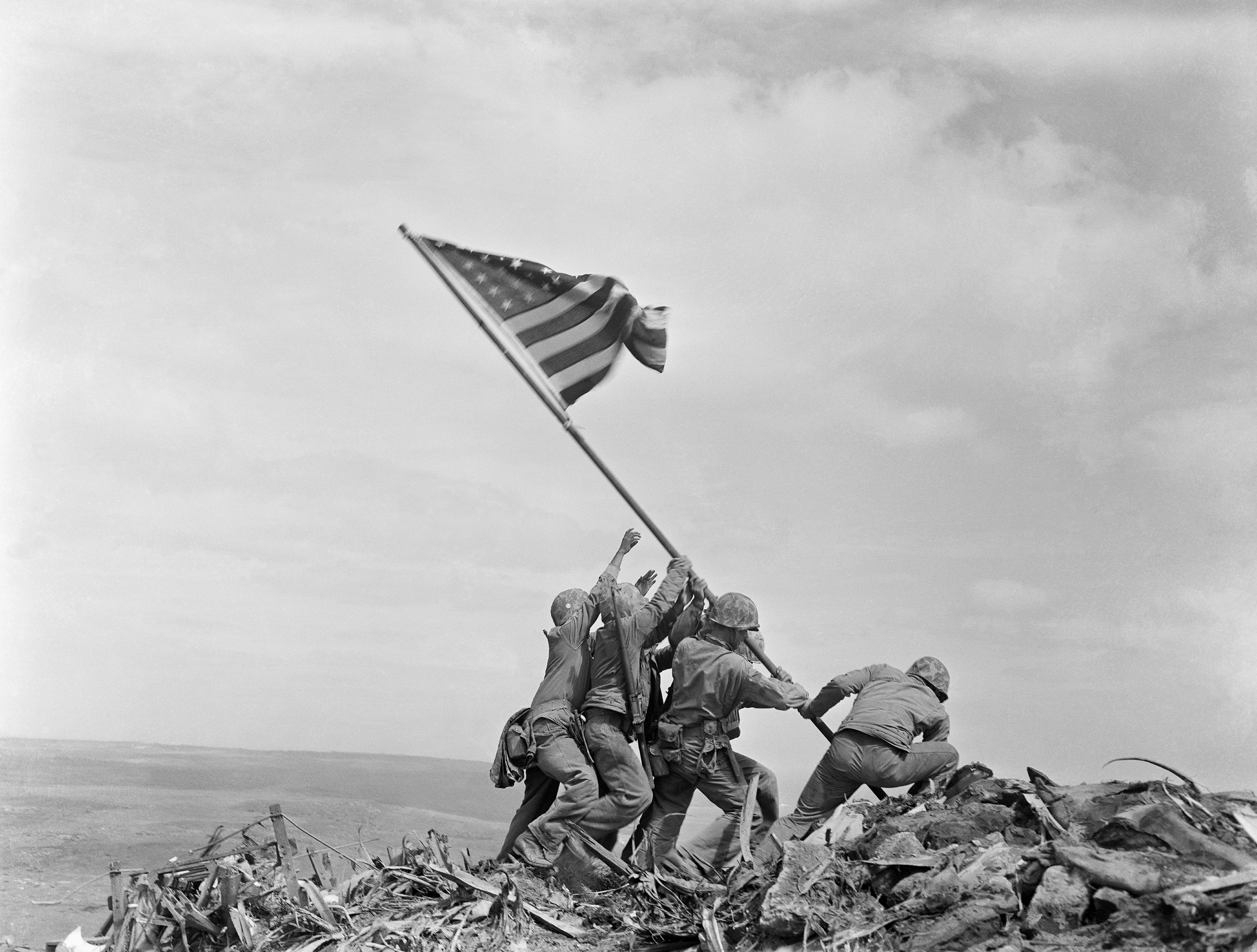
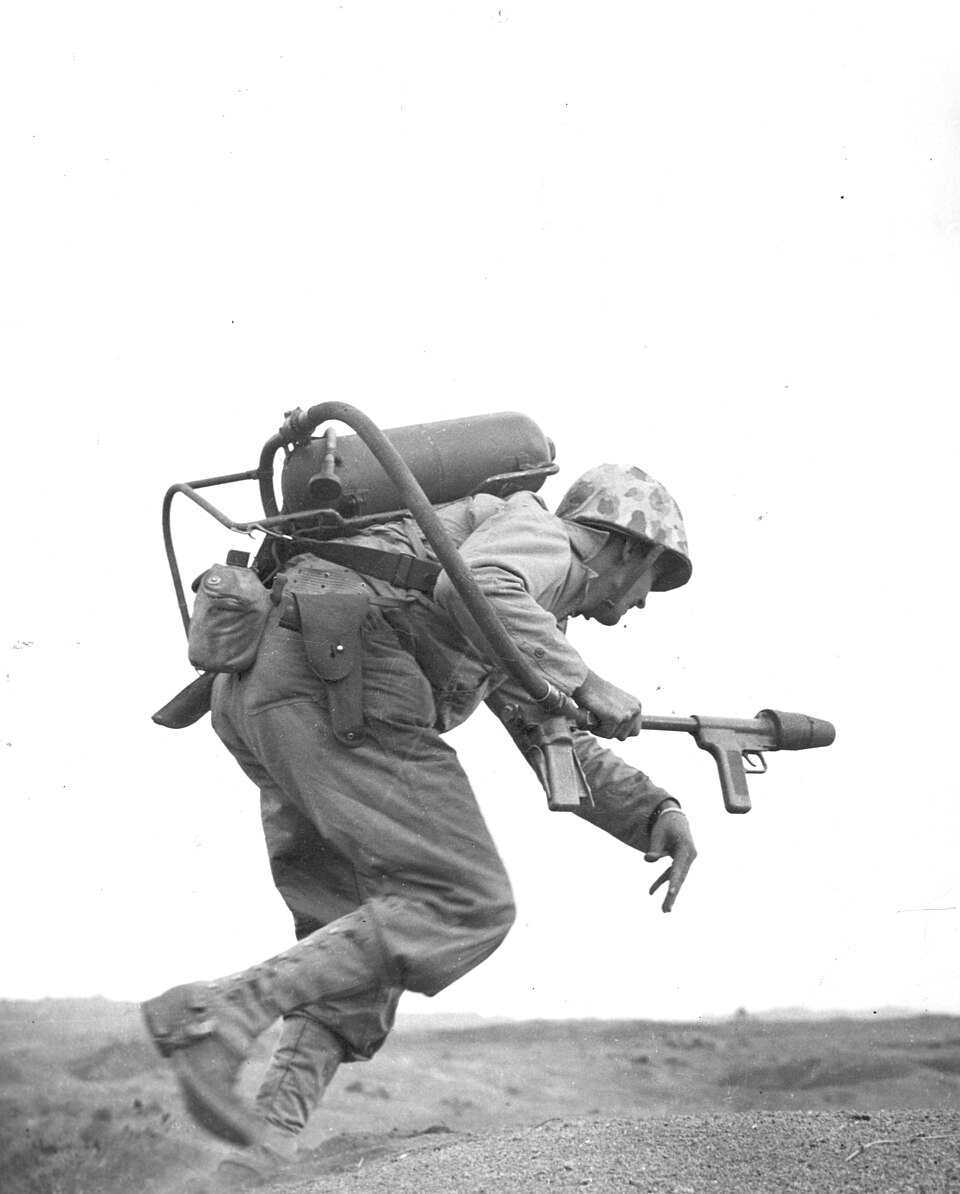
On 23 February 1945, while a flag was being raised on Mount Suribachi, Hershel “Woody” Williams was working towards Japanese pillboxes with a flamethrower. The photograph on the summit would become the island’s enduring image. Williams’s task belonged to the other Iwo Jima: the close, dangerous work that continued beyond the reach of that picture.
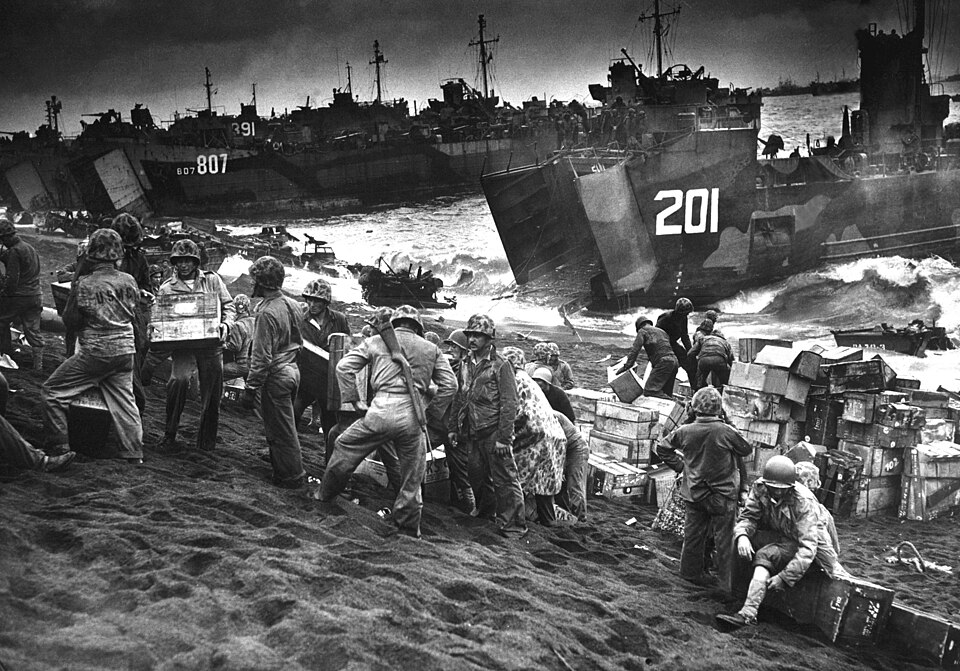
The first Marines had come ashore on 19 February. Iwo Jima lay between the bomber bases in the Marianas and Japan, its airfields giving a small island unusual strategic weight. On the beaches, loose volcanic material made movement difficult. Beyond them lay a defence prepared to survive the bombardment and fight from cover. The brief distance inland could conceal a much longer struggle.
Williams had landed on 21 February, two days after the first assault. In his account preserved by the National WWII Museum, he remembered crawling towards the positions and hearing bullets strike the tank on his back. Four other Marines supported his action. It continued for hours, requiring repeated movement rather than one uninterrupted advance.
“I can remember bullets ricocheting off my air tank.”
Hershel “Woody” Williams, recalling Iwo Jima — National WWII Museum oral-history account
A defence built to endure
General Tadamichi Kuribayashi had organised a system of bunkers, caves, tunnels and protected firing positions. Rather than stake everything on destroying the landing at the water’s edge, the defence sought to impose a prolonged battle after the Americans came ashore.
Kuribayashi had discouraged the kind of mass counterattack that might expose his garrison to American firepower. He sought a prolonged defence from positions connected and concealed beneath the battered surface. The island could not expect effective relief by sea or air. Its defenders were committed to making the conquest costly rather than preserving an army for another campaign.
American naval gunfire and aircraft brought enormous destructive power, but concealed positions could remain dangerous after the visible landscape had been battered. Taking ground did not necessarily mean that every position within it had been silenced. Marines had to identify and reduce strongpoints at close range, often with support from tanks, engineers and specialised weapons.
Tanks offered protection and firepower that an infantryman could not carry, but mines and restricted approaches exposed them to destruction. Infantry had to locate the positions holding up movement and work with supporting weapons to reduce them. Where tunnels allowed defenders to return, apparently cleared ground needed watching. The island demanded repeated checking of places that a map might already colour as captured.
A map can show an arrow moving north across the island. It cannot show how often the men beneath that arrow had to stop, locate fire, find cover and arrange support. Small changes in terrain could conceal a firing position. A short movement could expose a unit to an angle it had not previously faced.
Every advance increased the traffic from the beach. Ammunition, water and equipment had to be unloaded, sorted and carried forward across ground where vehicles and stores competed for space. The landing area remained exposed to fire. Shore parties were sustaining the assault within the same small battlefield, rather than working in a secure rear area.
Casualties travelled in the opposite direction. Men had to be reached, treated and moved to evacuation points while the positions that had wounded them might still be firing. The same folds in the ground that sheltered an attacker could complicate the work of a stretcher party. Taking a strongpoint did not immediately turn the approach to it into a safe road.
Meanwhile, the flag raised on Suribachi on 23 February had already given the battle an image of progress. Joe Rosenthal photographed the second, larger flag being put in place. North of the mountain, however, the struggle continued through fortified ground for weeks. The photograph reached a public still learning the island’s name while Marines were discovering how much remained to be fought over.
In the north, names such as Hill 382, the Turkey Knob and the Amphitheater entered the Marines’ vocabulary. Together they formed part of the ground remembered as the Meatgrinder. Positions could support one another across an approach, catching an assault from the flank after it had moved beyond the threat immediately ahead. The capture of one piece of ground could expose men to another firing point rather than bringing a pause.
Williams’s action brought him the Medal of Honor, but he returned to the fight and was wounded in March. His later recollections also described the continuing effects of combat. The official recognition fixed attention on a few hours; it could not contain either the support of the men beside him or the years of memory that followed.
What the island cost
Iwo Jima was declared secure on 26 March. Nearly 7,000 Americans had been killed, and the Japanese garrison had been almost entirely destroyed. Further resistance and the recovery of survivors continued beyond the date used to mark the main battle’s conclusion.
The island’s later role has generated a difficult debate about necessity and cost. Emergency landings and fighter operations were genuine uses. They do not establish, by themselves, what would have happened under a different plan. Historians must distinguish what the airfields did from claims about exactly how many lives their capture saved. The men lost during the assault deserve an argument more careful than a balance sheet assembled after the event.
Iwo Jima’s history is larger than either a strategic argument or a single photograph. It is the story of a fortified island, men committed to taking or holding it, and the terrible distance between an operation’s expected duration and what the ground actually demanded.
- National WWII Museum: Battle of Iwo Jima
- Battle of Iwo Jima: chronology and bibliography
- Woody Williams: account of the pillbox assault
Photographic credits and rights are given with each image. Wikipedia overview linked above is available under CC BY-SA.