

Del Prado · Peninsular War · Spain, 1812
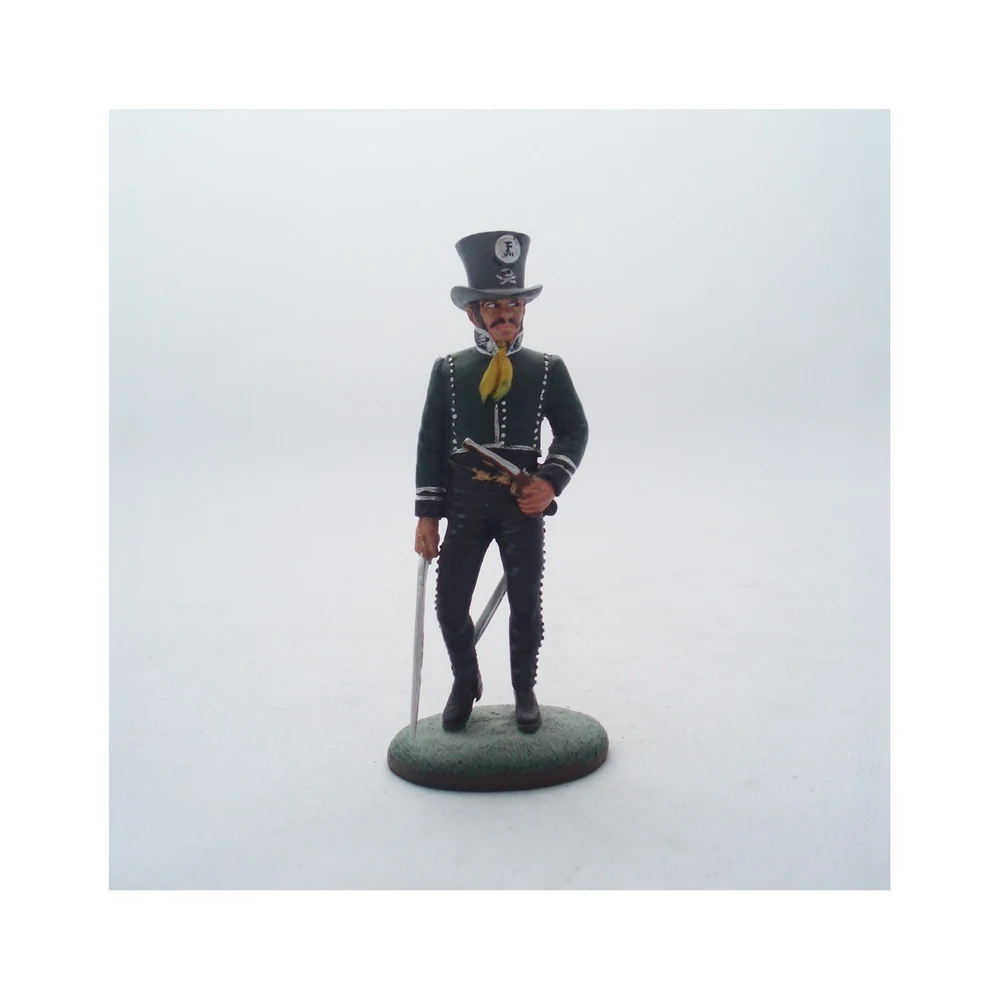
The tall hat, dark civilian-style clothing and yellow neckcloth set this guerrilla leader apart from regular infantry. Del Prado’s 1812 subject gives the Peninsular War a presence beyond the familiar ranks of uniformed armies.
- Maker
- Del Prado
- Subject
- Spanish Guerrilla Leader 1812
- Setting
- Peninsular War · Spain, 1812
- Type
- Painted metal figure
War away from the main armies
French forces in the Iberian Peninsula had to hold territory and protect communications while also fighting British, Portuguese and Spanish armies. Guerrilla resistance added another demand on their manpower. The conflict was therefore broader than the large battles usually used to organise a military display.
The dealer identifies this figure as a Spanish guerrilla leader of 1812. The title names a role, not a documented individual. It is better to retain that anonymous identity than to assign the miniature to a famous leader simply because his clothing appears distinctive.
Clothes rather than a parade uniform
The reference shows a tall cylindrical hat, a dark jacket and trousers, and a bright yellow neckcloth. One arm rests across the front of the body while the other supports a long weapon at the side. A pale belt line supplies another small contrast against the dark clothing.
The combination makes the subject easy to recognise without a brightly coloured military coat. Compare the hat profile and crossed arm with any proposed match. The exact shade of the jacket is less dependable in poorly lit auction photographs.
Building a Peninsular comparison
Inspect the hat brim, weapon muzzle and raised arm. The gap between arm and torso can conceal a join or repair, so ask for a view from each side. Pale paint at the neck and waist makes retouching easier to spot.
This figure works beside a regular Spanish, Portuguese or British soldier as a comparison of different kinds of participants in the war. Keep enough space around the hat that it remains visible among shakos and plumes.
A restrained setting suits the sculpt. A low wall or plain groundwork can suggest a place to stand without inventing a particular raid. Avoid automatically grouping every irregular figure into a single unit: the point of the comparison is the variety of people involved, not an undocumented shared organisation.
For an inventory, record the full date and role alongside a clear front photograph. That prevents the figure later being reduced to an unidentified armed civilian when separated from its display label.
References and further reading
- National Army Museum — Peninsular War
- Planète Légendaire — figure reference
- Génie Miniature — Del Prado identification index
The photograph identifies the model; condition and packaging vary between examples offered for sale.