

Del Prado · Britain · 1814
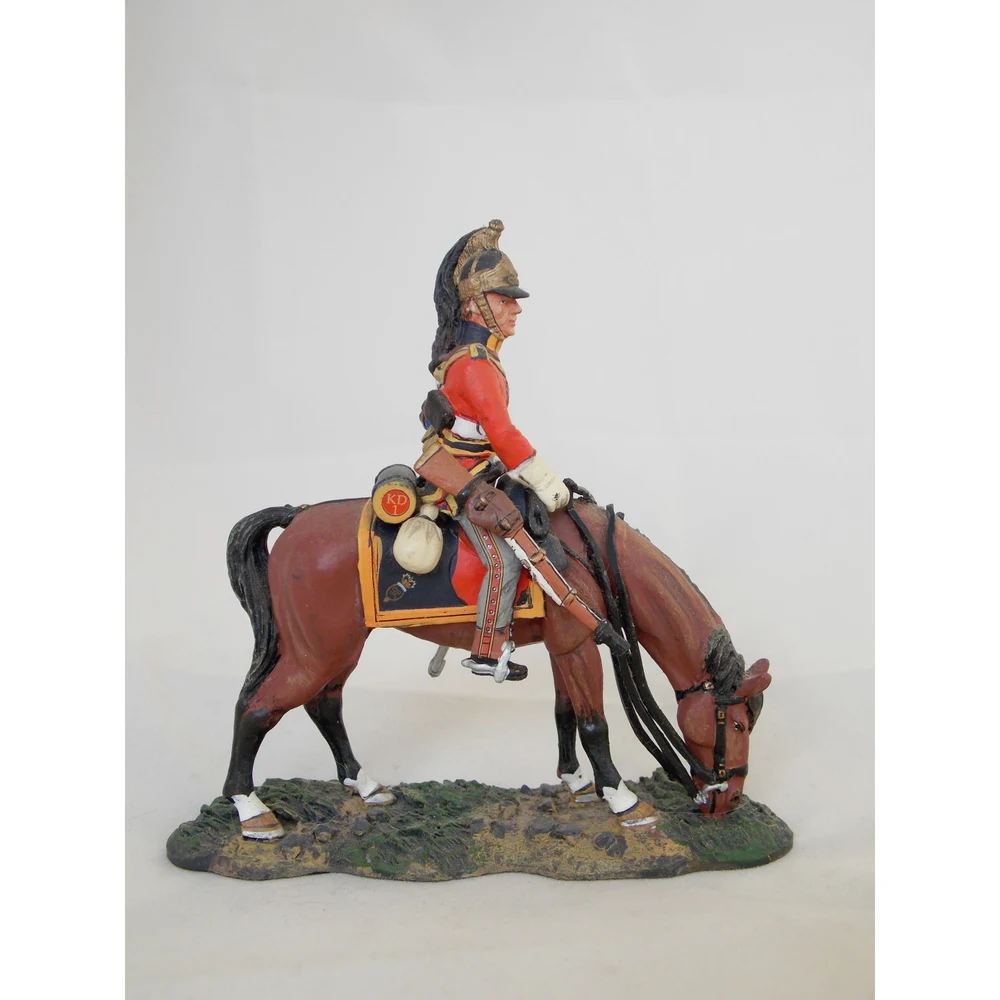
A red-coated trooper sits above a grazing horse, giving this Royal Dragoon a surprisingly quiet presence. Del Prado dates the subject to 1814, one year before the regiment’s celebrated capture of a French eagle at Waterloo.
- Maker
- Del Prado
- Subject
- 1st Royal Dragoons Trooper, 1814
- Setting
- Britain · 1814
- Type
- Painted metal mounted figure
The horse’s lowered head is the composition’s most individual feature. It brings the viewer down from the helmet and red coat to the animal supporting the soldier. The pale breeches and darker boots divide the rider’s outline clearly, while the saddle equipment adds detail without overpowering the relaxed pose.
A famous regiment, an earlier date
The 1st Royal Dragoons belonged to the Union Brigade at Waterloo in 1815. Their capture of the French 105th Regiment’s eagle became a regimental landmark, although the respective roles of Alexander Kennedy Clark and Francis Stiles were disputed. That later history helps explain the regiment’s familiarity to collectors.
This miniature is dated 1814. It is a trooper, not a standard bearer, and its resting horse does not depict the eagle’s capture. Keeping those distinctions clear allows the model to have a story of its own instead of becoming an illustration of the regiment’s most famous later moment.
A useful contrast on the shelf
Set this trooper beside the existing Inniskilling Dragoon of 1815. The red coats invite comparison, while the different regimental names and horse poses keep the two subjects distinct. A small group containing both quiet and active mounts usually reads more naturally than an uninterrupted line of identical movement.
Check the lowered muzzle, ears and reins when examining a loose figure. Ask for a close view of the horse’s front legs and the attachment to the base. The low head can conceal damage when it is photographed against a dark tabletop.
The rider’s helmet and any projecting fittings should also be visible from both sides. Do not assume that a matching red coat establishes a correct horse-and-rider pairing. The reference photograph, the full model description and any surviving underside inscription together provide a stronger identification.
Give the horse a little clear ground in front. That simple spacing choice preserves the sculpt’s quiet character and keeps the most distinctive feature from disappearing behind another base.
References and further reading
- National Army Museum — Save the Colours!
- National Army Museum — Famous cavalry charges
- Planète Légendaire — figure reference
- Génie Miniature — Del Prado identification index
The photograph identifies the model; condition and packaging vary between examples offered for sale.