

Del Prado · Figure study
Blue braiding and red trousers make this hussar an arresting contrast to the field-grey and khaki soldiers nearby. The figure opens a route into Austria-Hungary’s army through a uniform that still carries the visual language of cavalry tradition.
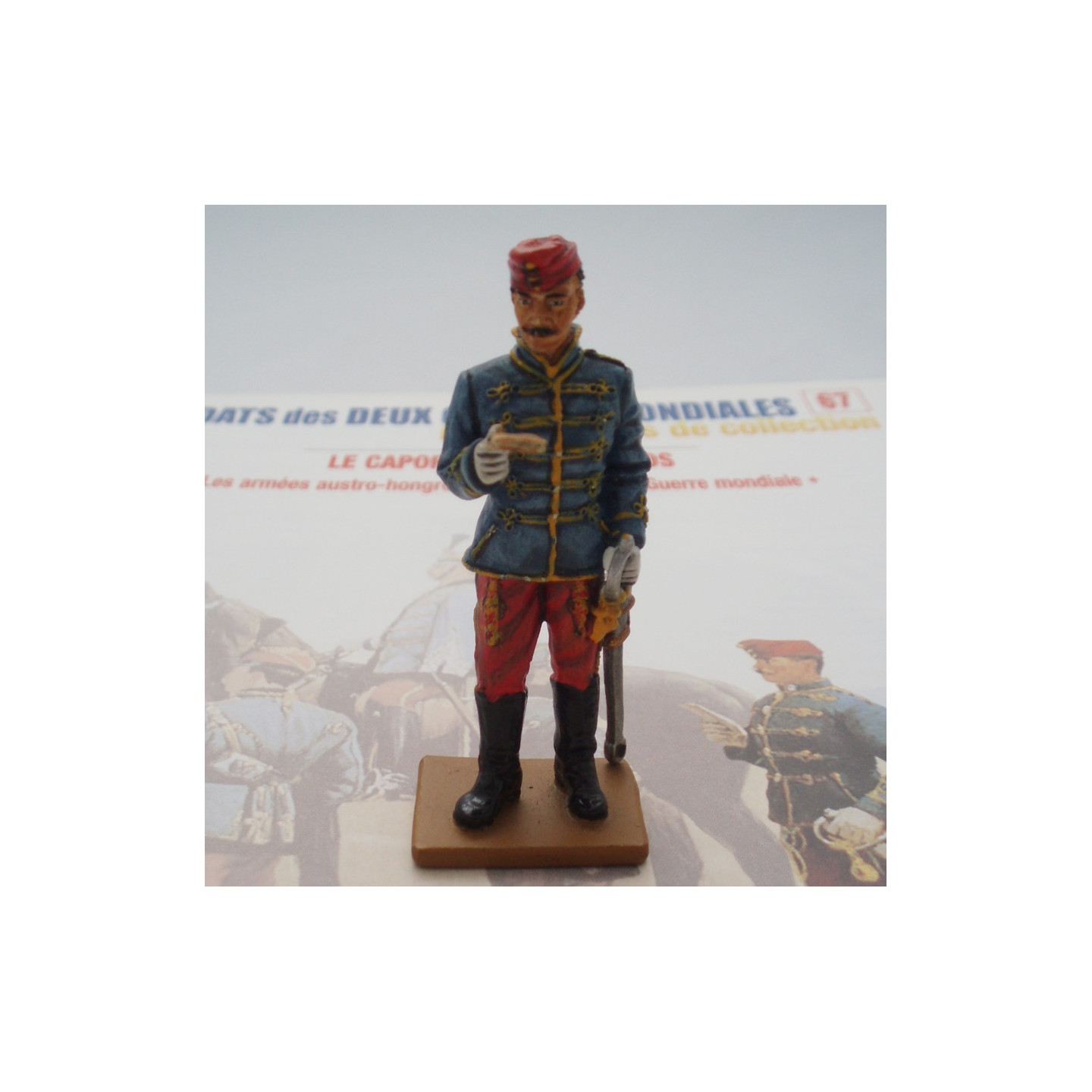
More than one national identity
The Rainer Regimental Museum’s account explains the coexistence of the common army, Austrian Landwehr and Hungarian Honvéd, with several languages represented in military service. “Austro-Hungarian” therefore describes a complex state and military system. The miniature’s hussar identity should not be flattened into a generic German cavalryman simply because the armies were wartime allies.
Cavalry still had a battlefield role
The scholarly 1914–1918 Online study of cavalry describes major mounted encounters on the Eastern Front, including the Austro-Russian engagement at Jaroslavic in August 1914. The story is more complicated than an immediate disappearance of cavalry when war began. At the same time, a brightly dressed miniature is not proof that every field deployment used precisely this appearance.
A useful comparison, not a generic parade
Set the hussar beside a field-uniformed infantryman from the same era and explain the difference in role and dress. Inspect the sword, braiding and hands in a purchase photograph; heavy repainting can blur the detail that makes the figure distinctive. Keep the period identification broad unless the original booklet supports a particular regiment. Its strongest contribution is the combination of cavalry tradition and the multinational army behind it.