

Del Prado · Figure study · SOL045
The most interesting accessory here is paper. With a folded map at his side, Del Prado’s Royal Flying Corps sergeant introduces the information-gathering work of early aviation without needing a miniature aircraft to explain the subject.
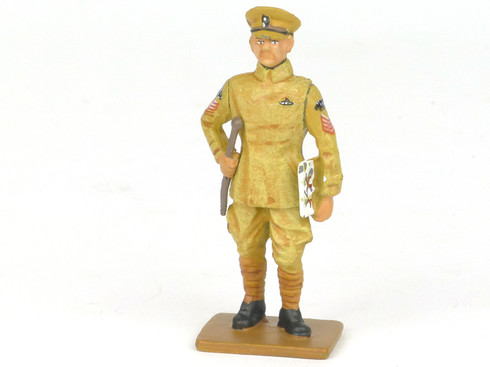
Read the map, chevrons and uniform together
The figure wears a peaked cap, khaki tunic and trousers, puttees and dark footwear. Coloured chevrons stand out on the sleeves, and a small wing-shaped marking appears on the breast. One hand rests beside a dark stick; the other holds a pale folded sheet with coloured markings. The reference photograph supports calling that accessory a map, but its markings cannot identify a real location.
The body is almost square to the viewer, so the accessories supply the story. This makes it a useful figure for a briefing scene. It also means that damaged fingers, a missing stick or a repainted map change the model’s character more than their small size might suggest.
What the product record establishes
Trains and Toy Soldiers identifies SOL045 as a British Flying Corps sergeant from the First World War, in the Soldiers of the 20th Century collection. It describes a painted metal figure at 1:30 scale. That is a retailer’s specification; it is not a measured guarantee that the figure will match another manufacturer’s pilot.
The record does not supply a named airman or squadron. The safest collection entry keeps those fields open. A sergeant’s rank also does not automatically make the subject a mechanic: the small painted breast marking and original booklet deserve attention before assigning a specific flying or ground trade.
Seeing an army turn
The RAF Museum’s 1914 chronology records a consequential reconnaissance report on 3 September. RFC observations identified the changed direction of the German First Army’s march. The information passed through Sir John French to Joffre and helped reveal the exposed flank ahead of the Marne counterattack.
The map accessory gives that episode a tangible point of entry. Aircraft were useful because someone could observe movement, return or transmit a report, and get information to a commander in time to use it. A collecting scene can show one link in that process without pretending this unnamed sergeant flew the recorded mission.
A three-part briefing scene
- Give the map an audience. Place an officer or another airman beside the extended sheet rather than behind the sergeant.
- Keep the setting modest. A table and a case can imply a working airfield without introducing an aircraft from the wrong period.
- Check physical fit. Compare eye level and base thickness before mixing nominal scales. The figure’s puttees and cap should remain visible above the scenery.
When inspecting a loose example, ask for a sharp view of both hands, the map edge, sleeve markings and underside inscription. Keep the packaging title with the photograph; it is more useful for a future identification than a note that merely says “old pilot.”
Find this set
Currently available on eBay
Matching SOL045 listings, lowest displayed price first. Includes shipping when quoted.