

Del Prado · Napoleonic Wars · France, 1805
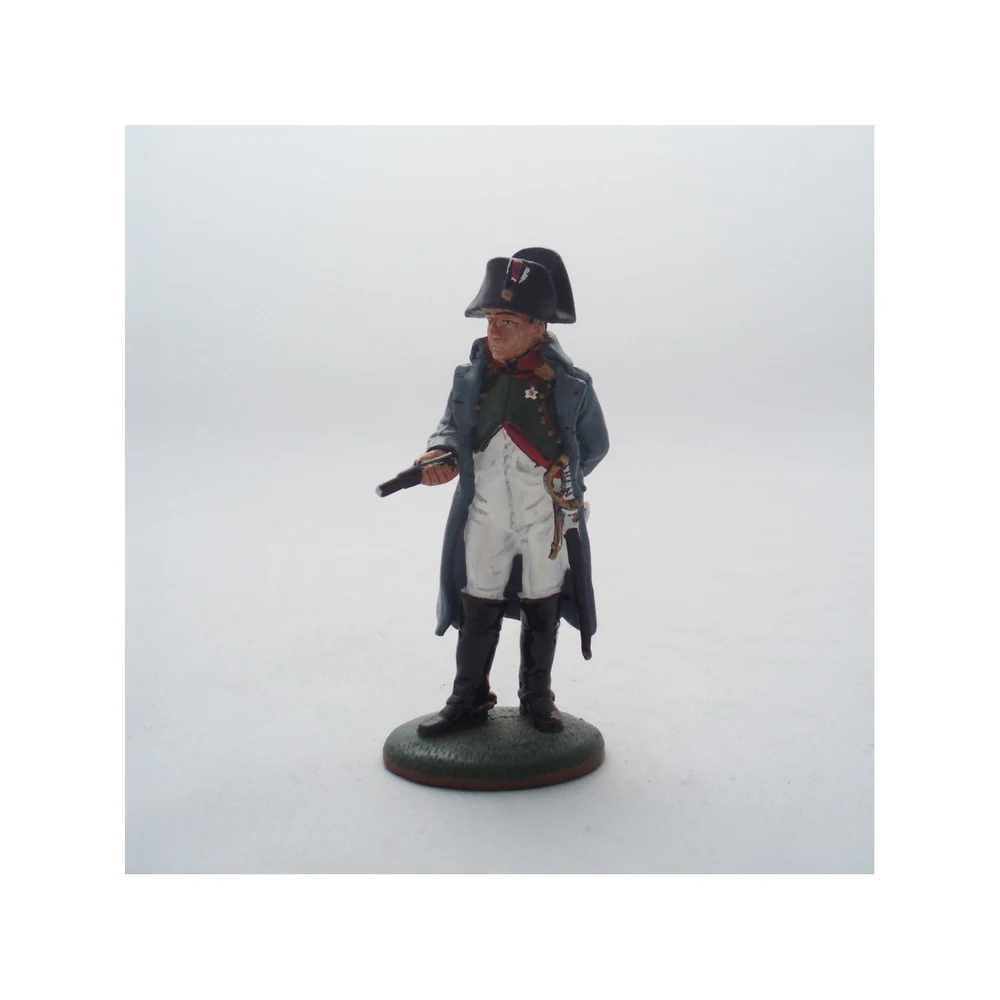
A bicorne, dark coat and restrained gesture make this standing Napoleon immediately readable. The figure provides a compact focal point for a Del Prado command group without the larger footprint of a mounted portrait.
- Maker
- Del Prado
- Subject
- Napoleon on Foot 1805
- Setting
- Napoleonic Wars · France, 1805
- Type
- Painted metal figure
The campaign year behind the label
The 1805 campaign culminated at Austerlitz on 2 December, when Napoleon defeated the allied army of Austria and Russia. That historical setting explains the appeal of an emperor dated to this year. It does not mean the sculpt records his exact appearance at a particular hour of the battle.
A standing command figure also invites a different kind of display. Instead of presenting Napoleon in movement, it places him among the people carrying information, preparing orders and supporting an army. Berthier is an especially useful companion when the subject is headquarters rather than a cavalry charge.
The familiar silhouette
The reference photo shows the broad bicorne above a dark coat, a light waistcoat and breeches, and black boots. One arm extends away from the body while the other remains close to the coat. This asymmetry gives the pose direction: turn him slightly and he appears to address the space beside him.
The hat and pale centre do most of the identifying work. Facial paint is necessarily small, so it is more sensible to assess the overall balance than to expect the precision of a large portrait bust. An uncluttered background also helps separate the extended hand from the coat.
A practical centrepiece
Inspect the bicorne corners, fingertips and boot fronts for chips. Ask whether any projecting part has been repaired, particularly if paint looks unusually thick around the hand. Display the figure with a little open space in the direction of the gesture. Two or three carefully chosen companions will let the emperor remain the focal point more effectively than a crowded ring of unrelated uniforms.
If photographing a command group, take a second image at the height of the figures rather than only looking down from above. Napoleon’s hat can hide much of his face in an overhead view. A lower viewpoint gives the extended arm room and makes the relationship between the neighbouring figures easier to see.
References and further reading
- Fondation Napoléon — Austerlitz and the principles of war
- Planète Légendaire — figure reference
- Génie Miniature — Del Prado identification index
The photograph identifies the model; condition and packaging vary between examples offered for sale.