

Del Prado · Napoleonic Wars · France, 1809
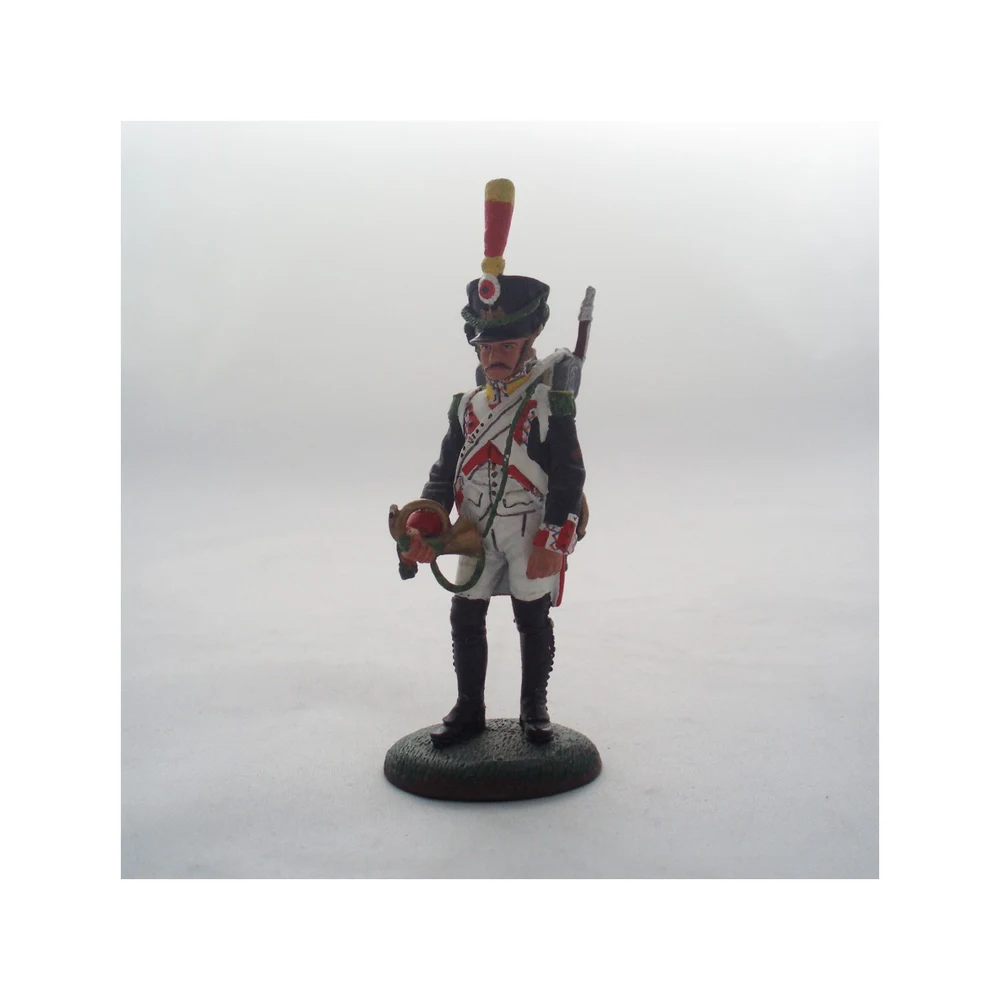
The curved instrument at this infantryman’s front is the detail that changes the story. Del Prado’s 1809 bugler represents communication within a unit, while retaining much of the equipment and appearance of the soldiers around him.
- Maker
- Del Prado
- Subject
- French Line Infantry Bugler 1809
- Setting
- Napoleonic Wars · France, 1809
- Type
- Painted metal figure
Orders needed a voice
Sound signals helped military units communicate routine instructions and movements. They were particularly valuable when the distance between men made a spoken order difficult to pass directly. A bugler therefore belongs to the working organisation of infantry, alongside officers, non-commissioned officers and standard bearers.
The reference calls this figure a French line infantry bugler of 1809. That description is useful without adding an unverified regiment. A model’s musical role also does not mean it is a complete guide to the signals used by every French formation during the period.
The instrument in the composition
The reference photograph shows light trousers, crossed belts and dark headgear with a tall coloured plume. A curved brass-coloured instrument sits across the front, adding a rounded shape to the straight lines of straps and weapon. The pose is standing rather than an exaggerated performance gesture.
Study how the instrument meets the hands and body. Those connections help distinguish the model from an ordinary musket-bearing figure when browsing small photographs. They also reveal whether a loose example has retained the accessory that defines its role.
Condition and a useful pairing
Check the plume and weapon tip as well as the bugle. On a painted metal figure, projecting parts deserve more attention than a seller’s general description of “good condition.” White straps can show chips clearly, so compare them with the adjoining darker paint.
A voltigeur is an effective companion because the pair suggests communication across infantry formations. Set the bugler at a slight angle so the instrument remains visible from the front of the shelf. Keep surrounding weapons clear of the plume when moving a shared tray or dusting the display.
A small group of specialist figures is also useful for photography. Place the bugler at one edge, the standard bearer in the middle and the sapper at the other edge. The curve of the instrument, vertical staff and long axe create three different outlines, allowing each figure’s equipment to remain visible in one image.
References and further reading
- Fondation Napoléon — The French army before the 1805 campaign
- Fondation Napoléon — The Napoleonic infantryman’s equipment
- Planète Légendaire — figure reference
- Génie Miniature — Del Prado identification index
The photograph identifies the model; condition and packaging vary between examples offered for sale.