

Del Prado · Hungary · Second World War · 1941
There is no horse, but the cavalry identity still matters. Del Prado’s Hungarian major brings a distinct national uniform into a collection that can otherwise make the Eastern Front look exclusively German and Soviet.
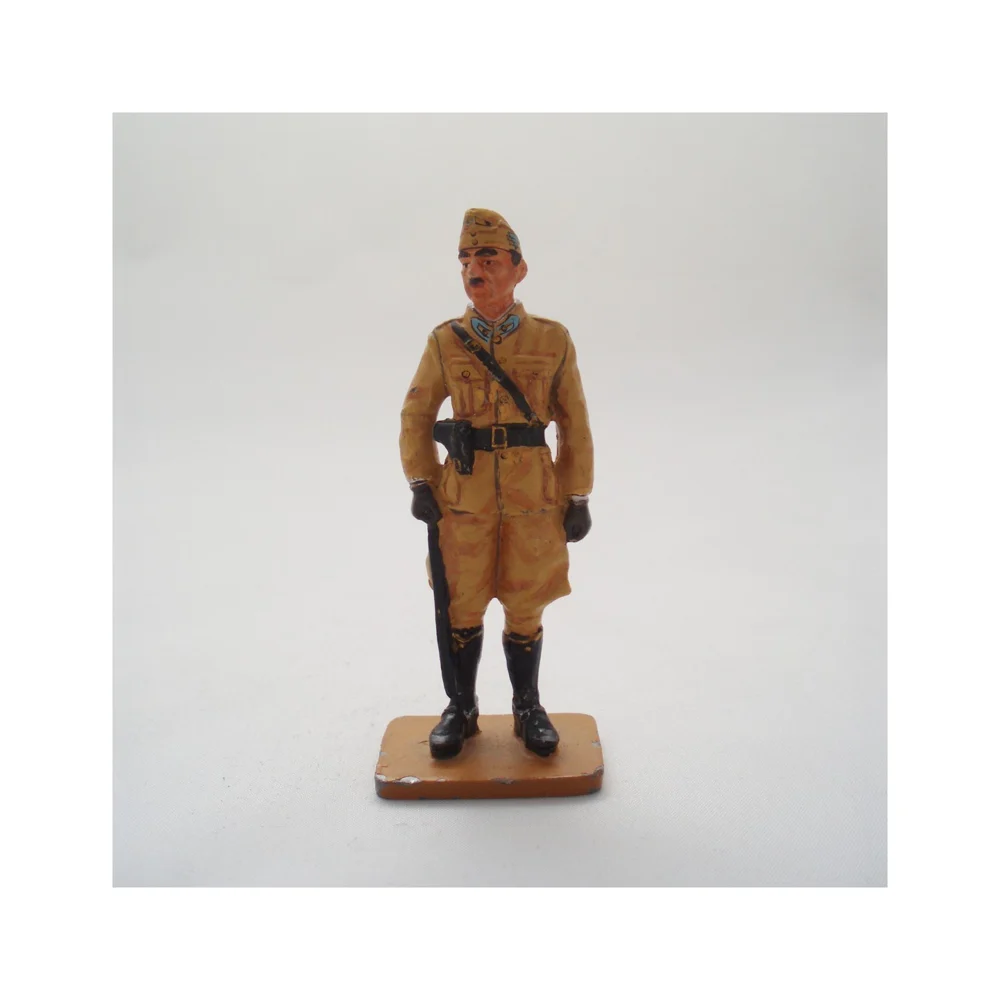
- Maker
- Del Prado
- Subject
- Hungarian Cavalry Major, 1941
- Setting
- Hungary · Second World War · 1941
- Type
- Painted metal figure
The ochre-coloured clothing, dark riding boots and diagonal leather strap give this officer a clear outline without a dramatic pose. The side cap is compact; the figure’s weight rests in the long line from the belted tunic to the boots. He rewards comparison rather than a quick glance.
A separate army within the Axis
Hungary joined the Axis in November 1940. The United States Holocaust Memorial Museum’s overview of the Axis powers places it among Germany’s allies, not within the German armed forces. That distinction belongs on the display label. A Hungarian soldier should not become a “German officer” simply because he is shown beside German figures.
The 1941 date places the subject at the expansion of the war in eastern Europe. It also makes the cavalry designation interesting. Mechanisation did not instantly erase older branches, their dress or the practical use of horses. A cavalry officer portrayed on foot is consequently not an incomplete mounted set: the absence of a horse can be part of the original subject.
The model itself does not identify a particular battlefield. Its usefulness is closer to a uniform study. The boots and leather equipment invite comparison with a contemporary infantry officer, while the national identification prevents that exercise from flattening several armies into a single Axis category.
At the collecting table
The contrast between the light uniform and dark boots is one of the figure’s strengths. When assessing a loose example, look at the boot tops, belt and shoulder strap: these narrow boundaries reveal paint wear or an overenthusiastic restoration more readily than the larger plain surfaces. Ask for a rear view, too. A clean frontal image does not establish the condition of the back or the base corners.
There is also a practical display choice here. Keep him at the front of a group, where the uniform can be read, instead of half-hidden behind a vehicle. A generic tank backdrop would contribute less information than a nearby Hungarian label and a contrasting infantry figure.
This is the kind of less familiar subject that gives a broad Del Prado collection depth. Its interest comes from retaining distinctions—between armies, branches and the roles represented—rather than attaching an unsupported famous battle to every miniature.
References and further reading
- United States Holocaust Memorial Museum — Axis powers in World War II
- Planète Légendaire — figure reference
- Génie Miniature — Del Prado identification index
The photograph identifies the model; condition and packaging vary between examples offered for sale.