KING & COUNTRY WH013
Overview
-
Introduction to the set
-
Individual figures and equipment details
-
Historical background: Wehrmacht marching bands
-
Collector‑oriented notes
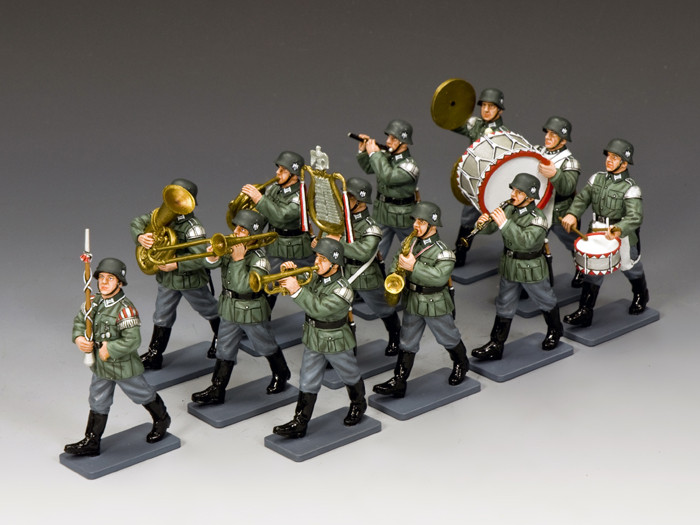
The King & Country set WH013, titled “The 12‑Piece Classic Wehrmacht Band,” presents a meticulously painted ensemble of twelve lead‑tin alloy figures in 1:30 scale, released in April 2015 and retired by January 2016. Each musician is faithfully rendered in field‑grey uniform with distinctive silver and red “swallow‑nest” collar patches, providing collectors with a rare parade ground aesthetic rather than combat poses. Purchasing today often commands close to the original retail price—around USD 489—with secondary listings reflecting its retired rarity.
Historical Background
Wehrmacht marching bands played a significant ceremonial and morale‑boosting role in Nazi Germany, performing at troop movements, civic events, and occupation parades across Europe. Originating from traditional Prussian military music ensembles, these bands accompanied infantry units in “feldgrau” uniforms that were visually authoritative. Their presence in occupied towns and front‑line installations was both symbolic and functional—boosting troop spirits and projecting disciplined unity under the Nazi regime. A Wehrmacht marching band typically included brass, woodwind, and percussion instruments—such as trumpets, tubas, clarinets, drums, and cymbals—sometimes doubling as medics or stretcher‑bearers in field conditions. While exact unit composition varied, a 12‑musician ensemble could consist of a drum major leading the formation, flanked by trumpeters, trombonists, clarinetists, and drummers.
These musicians wore everyday uniforms featuring decorative shoulder “swallow‑nest” insignia in sliver and red, distinguishing them from combat units. Their deployments were widespread: from victory marches through conquered French towns in 1940, to ceremonies near the Eastern Front, and morale‑boosting events in Berlin, Warsaw, and Antwerp. Though not directly involved in combat, bands formed part of the moral and cultural apparatus of the Wehrmacht and the Nazi state. Their performances reinforced military order, nationalistic fervor, and the theatrical projection of power—underscoring the regime’s control through disciplined pageantry.
Collector Notes
Identification is straightforward when the original box bears the SKU WH013, and the twelve figures display the signature “swallow‑nest” collar patches in silver and red (sagerssoldiers.com). The set was released in April 2015 and retired by January 2016 (sagerssoldiers.com). Factory paint quality is typically crisp, though collectors should inspect for chipping on raised details like drum rims or trumpet bells and for any bent metal components. Packaging variants are rare; intact box with insert increases value, and sealed examples command top dollar. Price guides at Sager’s list the set at approximately USD 489 (sagerssoldiers.com), which aligns with secondary‑market listings. Complete, mint‑condition sets often trade between USD 400–550 depending on paint integrity and box condition.
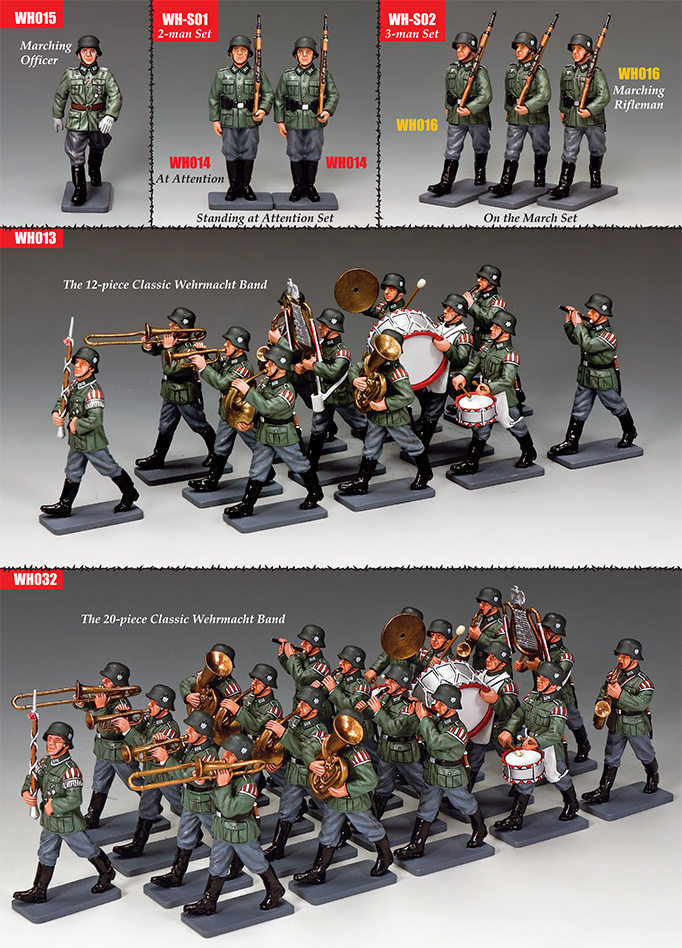
Repainted or unboxed figures may fall in the USD 300–400 range. Collectors should also note that the set is part of the “Classic Wehrmacht” parade‑style line, a niche within King & Country’s WWII catalog offering more decorative than combat figures; similar sets include WH032, the 20‑piece band (sagerssoldiers.com). Overall, WH013 remains a sought‑after piece for parade‑and‑ceremony dioramas rather than battlefield scenes.
Find this set
Currently available on eBay
Matching WH013 listings, lowest displayed price first. Includes shipping when quoted.