EA014 INDIAN ARMY MACHINE GUNNER BY KING & COUNTRY
Overview
-
Introduction to the miniature set
-
History of depicted unit in WWII North Africa
-
Collector-specific review notes
King & Country’s EA014 Indian Army Machine Gunner presents a meticulously crafted lead/tin alloy figure in 1:30 scale, part of the WWII Eighth Army series released in 2006. This retired miniature features three Sikh crew operating a Vickers heavy machine gun, factory-painted with precise uniform detail and accurate insignia. Overall, it showcases Indian troops’ critical role within the British Empire’s North African campaign by combining technical fidelity with historical context.
Historical Background
The EA014 Indian Army Machine Gunner depicts a Vickers heavy machine-gun team of the 4th Indian Division serving with the British Eighth Army in North Africa. The division’s mixed Sikh, Punjab, and Gurkha battalions fought through the see-saw battles of the desert—Operation Crusader (late 1941), the attritional summer of 1942, and finally El Alamein—where steady, sustained fire from Vickers sections helped pin German and Italian positions and blunt counterattacks. In the open desert, where cover was scarce and ranges long, these teams were the backbone of many defensive lines.
A Vickers team typically worked as a well-drilled three-man crew: No. 1 on the trigger and traverse; No. 2 feeding the 250-round canvas belt; No. 3 spotting, carrying ammunition boxes, and tending the condenser can. Water-cooling let the gun maintain a controlled rate of fire for hours—vital when covering an advance or holding a wadi against armor-infantry probes. Crews laid aiming posts, used a dial sight for fixed lines, and could deliver indirect “beaten-zone” fire across thousands of yards to seal gaps or sweep likely approach routes.
Desert conditions forced constant adaptation. Sand socks over the receiver, meticulous oiling, and careful belt handling kept stoppages down. The condenser can’s hose reduced tell-tale steam; when water ran short, crews improvised with whatever liquid was at hand. Positions were scraped into hardpan or built up with stone sangars, with overlapping arcs of fire planned to interlock with neighboring sections and the battalion’s mortars.
The 4th Indian Division—often called the “Red Eagle”—earned its reputation the hard way from Libya to Tunisia. Its battalions fought at notorious waypoints like Sidi Rezegh and Ruweisat Ridge, then helped drive the Axis back through the Mareth Line and Wadi Akarit into the final bridgehead. Throughout, Vickers teams were the quiet constant: covering withdrawals, breaking up night infiltrations, and shielding daylight moves of transport, sappers, and field guns rolling up behind the infantry.
EA014’s portrayal of Sikh gunners highlights both the division’s diversity and the professional standards of its machine-gun sections. Turbans wrapped with pagri, khaki drill, 1937 Pattern webbing, and the heavy tripod all read true to period photographs. Many Indian units in this theater still carried SMLE rifles and wore simple desert marching order; the Vickers tripod and ammo chests add the right sense of weight and permanence to the vignette.
For display, the set shines on a low, scraped desert base—think pale sand with a hint of gravel, a stone sangar wall, and a condenser can tucked to one side. Add a spare belt tin, a map board, or a field telephone to suggest a fixed line to company HQ. Flank the team with riflemen or a Bren group to show how platoons nested the Vickers into their defenses, or place them slightly behind advancing figures to read as a covering fire element in an attack.
Historically, this kind of team is what let the Eighth Army hold ground in the worst moments and exploit success in the best. Their steady arcs of fire made crossings possible, stiffened perimeters, and wore down counterattacks long enough for armor and artillery to do their work. As a model, EA014 captures that quiet, methodical lethality—less flashy than a tank, but just as decisive.
Fixed Lines
At night these crews often fired “fixed lines” by dial sight—pre-registered bearings that let them rake likely approach routes without seeing the target. With the condenser hose running into a water can, a Vickers could thrum for hours; when water ran out, desert crews famously topped it up with whatever they had. It’s unglamorous, but that grim improvisation is exactly how positions were held in the dark.
Collector Notes
Identification tips: EA014 features three Sikh gunners manning a Vickers heavy machine gun, metal 1:30 scale, factory‑painted. Released 2006, retired by August 2009 alongside other Eighth Army sets (lastdodo.com). Look for ‘Indian Army Machine Gunner’ label and King & Country branding. Variants/paint apps: Generally consistent factory paint; however, minor shading on uniforms or machine‑gun details may vary slightly among batches. Packaging: originally boxed in Eighth Army series blister packaging; sealed box condition commands premium. Condition: Collectors seek mint in box (MIB) status; loss of turret or damage to fine barrel or figures’ hands lowers value. Common defects include bent gun barrel or chipped paint on turban or webbing.
Market pricing: Frequently seen on secondary markets such as eBay and UK listings around £180–£200 for MIB examples (grelly.uk). Loose without box fetches significantly less. Rarity: As a retired set, EA014 commands growing interest among WWII and colonial forces collectors.
Find this set
Currently available on eBay
Matching EA014 listings, lowest displayed price first. Includes shipping when quoted.
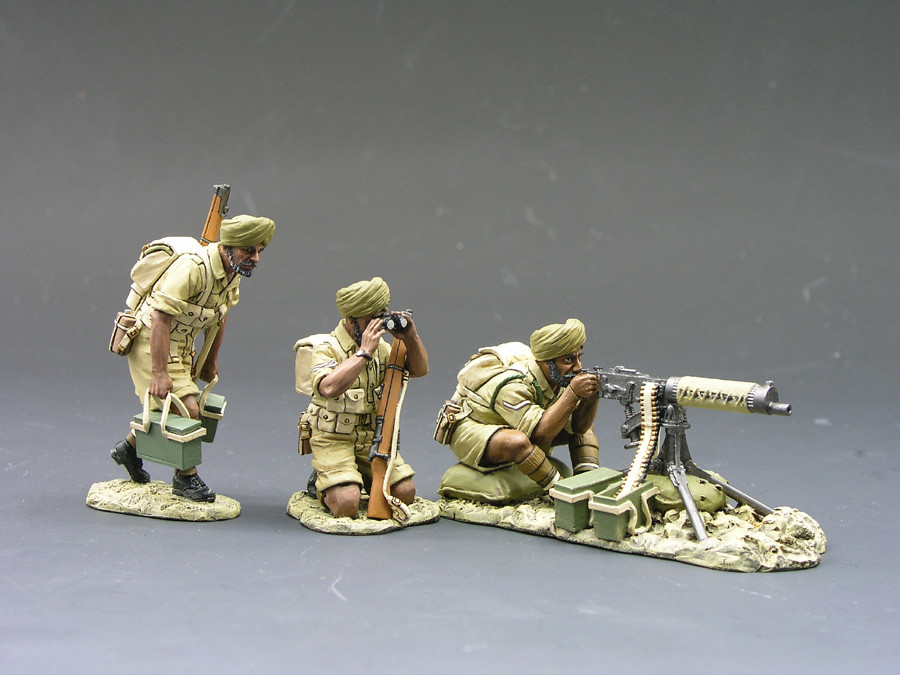
King & Country EA014 Indian Army Machine Gunner Review
Shop on ebay for the best deals.
 Find On eBay