KING & COUNTRY WS006 WS06
Overview
-
Introduction
-
History Section – German Army Motorcycles in WWII
-
Collector Notes
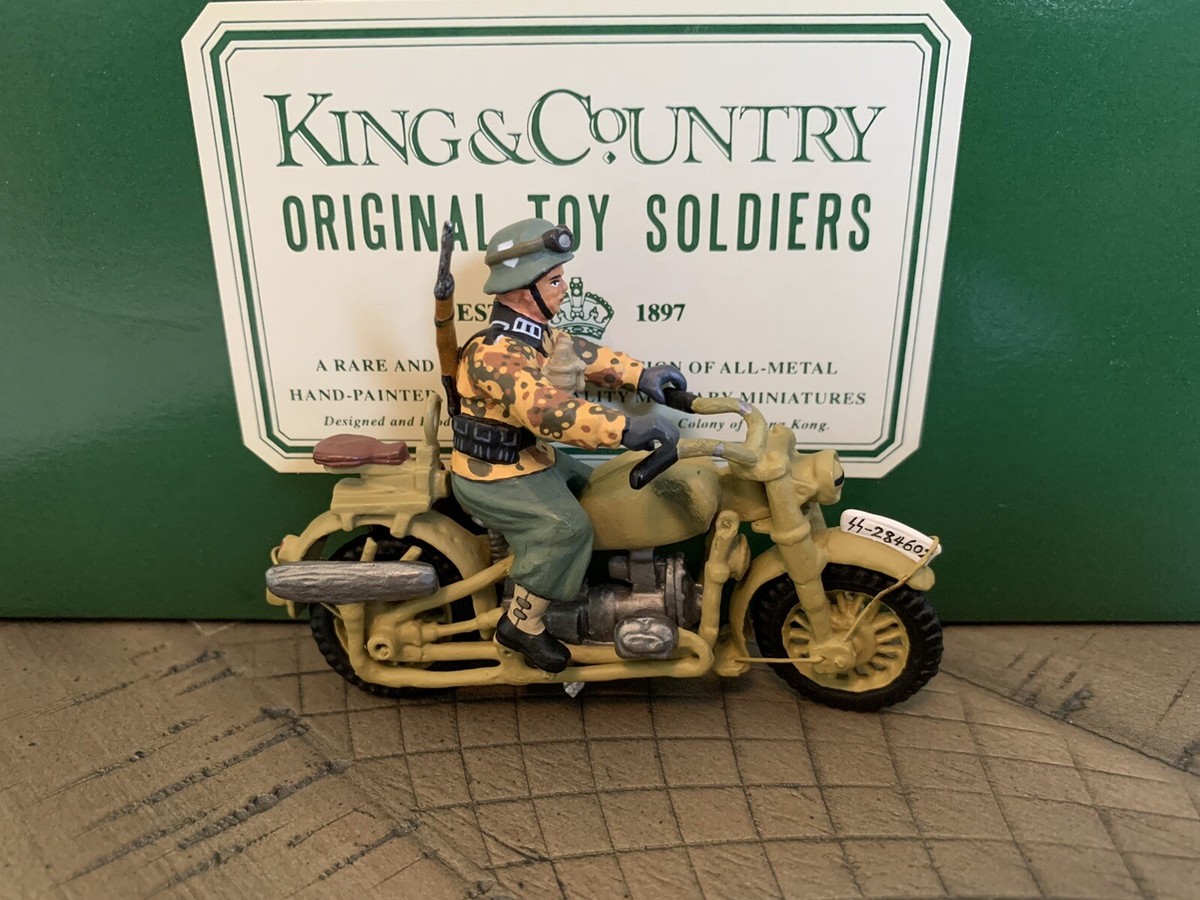
The WS006 “Motorcycle with Sidecar & Two Riders” by King & Country is a retired World War II German-themed miniature set featuring a highly detailed motorcycle with sidecar accompanied by two rider figures. The SKU WS006 indicates this is part of the Waffen‑SS series, though it does not carry the B suffix variant. The metal miniatures are hand‑painted in King & Country’s standard 1:30 scale (approximately 60 mm tall) (sagerssoldiers.com). Released and retired without explicit dates listed on known listings, WS006 typically sells for around USD 83 in secondary‑market listings such as Sager’s Soldiers & Miniatures (sagerssoldiers.com).
Historical Background
Motorcycles with sidecars played a crucial role in the German Wehrmacht’s mobility doctrine during World War II. The most iconic model was the Zündapp KS 750, developed to meet Oberkommando des Heeres requirements starting in 1937 and entering service by spring 1941 (en.wikipedia.org). This rugged design featured a driven rear wheel and sidecar wheel, a 751 cc flat‑twin engine, five‑speed plus reverse transmission, and a locking differential, enabling speeds up to 80 km/h under full load and excellent off‑road performance (en.wikipedia.org). German forces deployed the KS 750 extensively across all battlefronts, including the Eastern Front (1941–1945), North Africa (1940–1943), and the Italian Campaign (en.wikipedia.org). Approximately 18,695 units were produced at Zündapp’s Nürnberg factory between 1941 and early 1945 (en.wikipedia.org).
These motorcycle combinations served multiple roles: reconnaissance, messenger duties, artillery towing, and quick infantry deployment. Sidecars often carried radio equipment or light machine guns. Units favored the KS 750’s reliability, clearance, and ability to traverse difficult terrain—the backbone of a fast, flexible Wehrmacht advance. Though BMW also produced the R75 motorcycle and sidecar, many collectors associate the KS 750 with general Wehrmacht mobility culture during WWII. The WS006 miniature likely represents this style of motorcycle and its crew, embodying the technological sophistication and battlefield versatility that characterized German motorcycle use throughout the war.
Collector Notes
Although specific release and design details such as sculpt number or poses are not listed on Sager’s page, the WS006 set usually includes a driver and sidecar passenger in uniform consistent with Waffen‑SS styling, though no specific insignia are described (sagerssoldiers.com). Collectors should confirm the set code (WS006) on the base or original packaging to match factory issues. Since this set is retired, market prices hover near USD 83 on specialist retailers, with potential premium for mint‑packaging or rare variants like WS006B (ambush‑camo variant) (sagerssoldiers.com). Key condition checks: inspect for bent handlebars, chipped paint on the motorcycle, missing accessories, or mismatched camo on WS006B. Verified factory‑style hand‑painting, intact bases, and any original seals notably increase value.
Packaging clarity, presence of shipping insert, and crisp sculpt detail add collector appeal; well‑preserved sets may exceed USD 100 in auction settings.
 As an eBay Partner Network Affiliate, I earn from qualifying purchases.