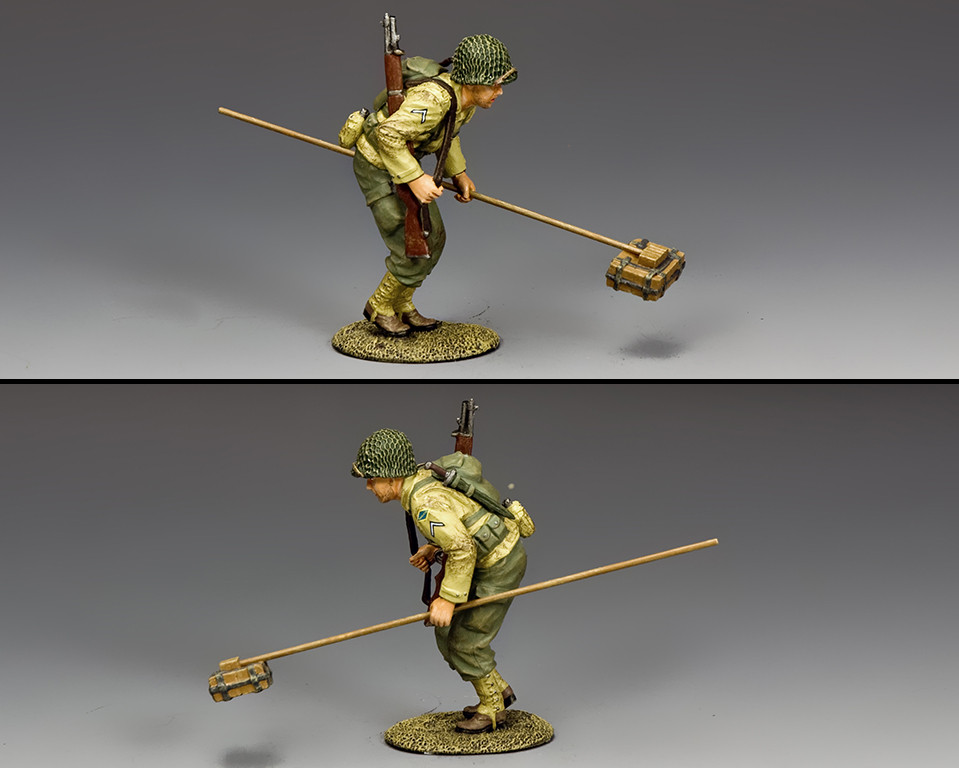
DD323 “Demolition Man” — King & Country
Why this figure grabs you
King & Country’s DD323 “Demolition Man” captures a U.S. Army Ranger mid-mission on Omaha Beach. He’s carrying that unmistakable 12-lb pack charge lashed to a wooden pole—exactly the sort of desperate, up-close solution used to silence a pillbox slit. The sculpt reads clean and purposeful: taut stance, focused posture, kit that looks lived-in rather than parade-ground neat. It’s an easy piece to drop into any D-Day scene and immediately communicate “danger close.”
The quick backstory (D-Day, up close)
June 6, 1944. Rangers, engineers, and assault teams had to open the path off the sand: blow wire, clear obstacles, and—when needed—feed explosives into concrete to shut down machine-gun nests. Work like this wasn’t glamorous; it was done under direct fire, with men hauling awkward loads through surf and shingle. A lot of what succeeded at Omaha came down to small groups making local breakthroughs with tools like this very charge.
What DD323 gets right
- Pose & purpose: The figure isn’t “posing,” he’s moving with intent—hands set to keep the pole steady, head turned just enough to suggest he’s tracking a target or listening for a go-signal.
- Gear choices: Webbing sits tight, the pole and charge look heavy, and the uniform has the kind of wrinkles and weight you’d expect after a cold saltwater dunk.
- Paint read: The palette leans practical: muted greens and khaki that play well under lighting and don’t fight your terrain colors.
“Demolition Man” in your display
- Small diorama, big story: A low sea wall, a chunk of dragon’s teeth, and a half-buried Czech hedgehog is all you need. Angle the figure slightly “into” the obstacle so the pole leads the viewer’s eye.
- Sound of the scene: Pair him with a kneeling rifleman on security and a shouting NCO. Add a prone casualty figure behind a hedgehog to show the risk without getting graphic.
- Texture matters: Mix wet-look sand near the base, darker shingle, and a dusting of chalky rubble. A single length of barbed wire sells the environment.
Ranger demolition, in plain English
These charges were brutal but effective. A crew would belly up to a firing slit, jam the charge as deep as they could reach, light the fuse (or set a cap), and dive for what little cover existed. It was teamwork: someone carrying, someone covering, someone timing. If you’re arranging multiple figures, keep them tight—D-Day work like this happened in crowded, noisy pockets, not spread-out hero shots.
Collector notes (read before you click “buy”)
- Check the pole first: It’s long and slender, so look for bends, hairline cracks, or repaired breaks.
- Edges & high points: Helmet rim, hands, boot toes, and the pole tip show rubs first—normal light wear is fine; shiny metal peeking through is not.
- Base & mark: Expect an oval base with clear series marks/date. A soft or blurry stamp isn’t a deal-breaker, but it can hint at heavy handling.
- Paint variance: Minor shade differences happen batch-to-batch; prioritize neat lines around webbing and the face. Those are what your eye sees first in a case.
Price reality (and how to shop it)
New or “as new in box” typically hovers around the mid-$40s to $60 range; loose or with small faults can dip lower. Photos matter—ask sellers for a straight-on shot of the pole, a 3/4 face view, and a macro of the hands where chips are common. If you’re building a beach run, don’t overspend chasing mint boxed copies—loose pieces are fine once they’re in a diorama.
Pairing ideas (instant vignette)
- Assault team trio: DD323 + a wire-cutter/engineer + a BAR gunner.
- “Last yards” moment: Demolition Man advancing with a Ranger tossing a smoke grenade.
- Beach exit scene: Place him behind an obstacle while a lieutenant points inland and a medic tends a casualty. You’ll get motion, leadership, and stakes in a 6-inch square.
Photography tip (make it pop)
Set your key light low and off to the side to rake across the figure—shadows on the webbing and folds make the sculpt read deeper. A bit of mist from a diffuser bottle on the ground surface gives a cold, wet morning look without touching the figure.
Tiny historical sidebar
A lot of “breakthroughs” on Omaha weren’t sweeping maneuvers; they were five-minute miracles—one obstacle blown here, one nest silenced there—until a narrow lane opened. Figures like this represent those moments better than any tank can. It’s the human scale of D-Day.
Final take
DD323 works because it tells a clear story the second you see it. If your collection leans tactical—actions over parades—this is an anchor piece for any Omaha Beach shelf. Put him to work in a tight scene, give him something solid to attack, and he’ll earn his keep every time you walk past the case.
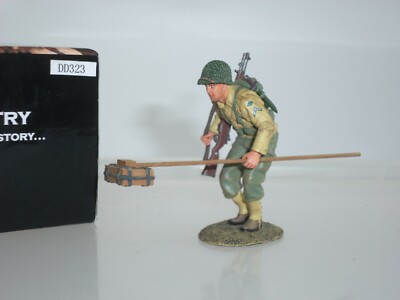
Find this set
Currently available on eBay
Matching DD323 listings, lowest displayed price first. Includes shipping when quoted.